

Undergraduate

Social Work

Ornate door

Take a Step Toward Advancing Human Rights for Marginalized Communities

Students majoring in Social Work prepare for careers working with diverse groups and develop an understanding of how race, class, gender, sexuality and disability shape people’s experiences and opportunities.

Why earn your Social Work degree at St. Edward’s?

Whether you want to pursue a career in public health, education, child welfare or mental health and wellness, one thing is certain: The advantages of your St. Edward’s education will prepare you to succeed. You’ll find opportunities in and outside the classroom to learn, give back and achieve your goals. And your mentors will support you every step of the way.

Gain experience through internship opportunities

As a senior, you’ll complete an intensive field internship at a social justice-focused organization, where you’ll develop your professional skills and learn from experienced mentors.

Earn an Accelerated Master of Social Work degree

Because the St. Edward’s Social Work program is accredited by the Council on Social Work Education, which requires this extended internship, you will receive credit for having completed a field placement if you pursue an accelerated Master of Social Work degree. You’ll get a head start on your career and graduate with the skills and values that will help you succeed.

Conduct graduate-level research

Study with professors conducting real-world research about issues such as human trafficking, immigration detention and LGBTQIA+ youth in foster care.

Build relationships with your professors

You’ll learn in small classes taught by award-winning professors who make a point of getting to know you and becoming your trusted advisors. They’ll help you identify and focus on your goals, and provide guidance and insight during and after your college years.

test

Reap the Rewards of Austin

Austin is a home base for numerous nonprofits and advocacy groups aiding and spreading awareness for underserved communities within our city and surrounding areas. As a Social Work major, you’ll have access to internship opportunities at organizations focused on the disadvantaged where you’ll learn how to make a difference for the causes you care about.

What do our graduates do?

Social Work majors go on to a variety of careers and graduate schools from St. Edward’s. Here’s a sample.

  • Social workers at Integral Care, Communities in Schools, Jolt, Austin Independent School District, Lifeworks and Con Mi Madre.
  • Licensed social workers — which include LBSW, LMSW and LCSW — for private companies, nonprofit organizations and government agencies.
  • Serving with the Peace Corps, Jesuit Volunteer Corps and Mercy Corps.
  • English Teaching Assistant in the Fulbright U.S. Student Program.
  • Graduate students at Washington University, Columbia University, The University of Texas at Austin and the University of Houston.

Explore Details About a Degree in Social Work

This major is accredited by the Council on Social Work Education (CSWE). To meet accreditation standards, students are required to apply for and undertake a social work field internship, demonstrate competencies in 9 core areas, complete a portfolio and participate in an exit interview prior to graduation. Please see the Social Work Major Degree Requirements (PDF) and the Social Work Program Student Handbook (PDF) for additional information, or contact Social Work Program Director Dr. Laurie Cook Heffron, LMSW, at lheffron@stedwards.edu.

An Application for Admission is required before proceeding to upper-division social work courses. Applications must be submitted to the program director on or before October 1 in fall and February 1 in spring. The application, self-assessment form, and Code of Conduct are available online and as a PDF. You can also download it as a Word document.

What You Will Learn

You’ll learn professional ethics that will guide you through difficult decisions, as well as strategies for taking care of yourself while you help other people.

Experiential Learning

You’ll get out into the field right away. Your Introduction to Social Work course requires 40 hours of service learning, where you’re volunteering for course credit at an organization connected to your major. This is your chance to give back while observing, listening, and understanding what social work looks like in practice.

More information can be found in the Social Work Program Practicum Manual (PDF).

Student Learning Assessment Outcomes

Recent student learning assessment outcomes are available here:

Internships

During your senior year, you’ll complete an intensive, 400-hour internship in the community. This is an opportunity to get hands-on experience in a dimension of social work that particularly interests you. You’ll choose an organization that matches your interests and take on real-world responsibilities, supervised by a practicing social worker. A sample of community organizations St. Edward’s students have recently interned with includes:

  • Communities in Schools
  • Health Alliance for Austin Musicians
  • Lifeworks
  • Project Transitions
  • SAFE Alliance
  • Texas Advocacy Project
  • The Sobering Center
  • UT Law Immigration Clinic

During your internship, you’ll experience the realities of social work, including the challenges of working with different personalities and the fact that change takes time. You’ll also interact with social workers and other professionals in the field, which gives you an opportunity to build your network.

Service Experiences

St. Edward’s offers many other opportunities to meet people from different backgrounds, apply what you’ve learned in class, and be of service. 

Study abroad immerses you in unfamiliar settings and cultivates understanding of people from other cultures. 

Service Break Experiences, offered through Campus Ministry, give you the chance to travel to another community, volunteer and learn about local life while living simply. 

Campus Ministry’s S.E.R.V.E. Austin is a structured service program that meets weekly for an entire semester. You’ll help a nonprofit with specific tasks while learning about an issue like senior care, immigration, education, youth development or homelessness. 

These experiences help you apply the theory you’ve discussed in class, come face to face with ethical dilemmas and become better prepared to address them.

The Social Work program also offers professional development workshops and continuing education credits for licensed social workers and other mental health professionals. Here are a few examples of Social Work events.

  • Detention and Migrant Justice
    A panel of experts joins us to help the campus community understand immigrant detention, its scope and impact, and the role that various professions and community members play in supporting immigrant rights in this context.
  • The Unfinished Business of Our Childhoods: Helping to Heal the Childhood Trauma Wounds of Helpers Through Authentic Supervision
    A continuing education webinar for social workers and other mental health professionals.
  • Operation Lone Star and SB 4: Know Your Rights
    A continuing education training webinar for social workers and other mental health practitioners and social service providers.

Offered through the Social Work Program, the Minor in Social Welfare provides students a foundation in social welfare, focusing on social justice, human behavior and development, diversity and cultural competence. Students will learn about the history of the U.S. social welfare system, the theories of behavior used to support various social programs, and how issues of race, social class and gender intersect in the social welfare system.

View the Requirements for a Minor in Social Welfare (PDF). 

At St. Edward’s, our faculty are outstanding scholars, thought leaders, teachers and mentors who bring energy and enthusiasm to our vibrant learning community. They take pride in getting to know you, helping you achieve your goals and celebrating your successes.

View a list of our faculty members and their contact information on the Department of Applied Behavioral Analysis, Criminal Justice, Social Work, and Sociology webpage.

Undergraduate

Psychology

Ornate door

Expand Your Knowledge of the Human Experience

As a Psychology major, you will develop a deep understanding of the human mind and behavior, as well as exceptional communication skills essential for work in social services, case management, consumer research and human resources.

Why earn your Psychology degree at St. Edward’s?

Whether you’re looking to become a psychologist, leader at a mental health facility or embark on a career in consumer research, one thing is certain: The advantages of your St. Edward’s education will prepare you to succeed. You’ll find opportunities in and outside the classroom to learn, give back and achieve your goals. And your mentors will support you every step of the way.

Take advantage of invaluable internship opportunities

In a field internship, you’ll apply your knowledge of psychology in a professional setting. While you’re there, you’ll complete a product – a handbook, institutional report or presentation – that the organization can keep using after you complete your internship.

Gain knowledge as a teaching assistant

Enjoy teaching and mentoring? You can serve as a teaching assistant, helping fellow students develop essential skills and techniques in a related field. Expand your communication skills and improve your own people skills by helping other students learn the material.

Build relationships with your professors

You’ll learn in small classes taught by award-winning professors who make a point of getting to know you and becoming your trusted advisors. They’ll help you identify and focus on your goals, and provide guidance and insight during and after your college years.

test

Reap the Rewards of Austin

Austin is a home base for numerous nonprofits and advocacy groups aiding the mental health and wellness needs of diverse communities. As a Psychology major, you’ll have access to internship opportunities at such organizations where you will learn how to make a difference for the causes you care about.

What do our graduates do?

Psychology majors go on to a variety of careers and graduate schools from St. Edward’s. Here’s a sample.

  • Research and planning analyst for a community college district in San Diego.
  • Coordinator in the People Department on the flight operations/technology recruiting team at Southwest Airlines.
  • Chief of staff at a global tax firm.
  • Research assistant at the Terrorism Research Initiative.
  • Psychometrician at Elsevier, a global information analytics company.
  • Director of Forensic and Family Services for Williamson County Children’s Advocacy Center.
  • Policy analyst at the Texas Criminal Justice Coalition.
  • Graduate students at The University of Texas at Austin, Stanford University, Columbia University, the University of Houston and more.

Explore Details About a Degree in Psychology

Major Requirements: The BA in Psychology requires 31–32 hours of major courses, which include a combination of introductory and advanced topics. In addition, students choose 9 hours of career-emphasis elective courses that help prepare them for future interests, such as graduate study or their career path in psychology.

Electives: Students are free to complete 26 hours of elective courses in any area of study they choose. These courses do not have to relate to the Psychology degree.

General Education Requirements: The Psychology degree requires 57 hours of general education courses that students complete over four years in addition to their major courses and electives.

View and download the full degree plan for our Psychology major (PDF).

A few examples of the Psychology major courses students take:             

  • Social Psychology – Examines how people interact with and are influenced by others, including topics such as conformity and obedience, nonverbal behavior, person perception, leadership, and attraction.
  • Abnormal Psychology – Addresses the causes, consequences, and cures for maladaptive behavior, such as depression, mood disorders, antisocial personality disorder, or schizophrenia.
  • Biopsychology – Delves into the function and anatomy of the nervous system and the role it plays in directing perception, emotion, thought, memory, and motor behavior.

Experiential Learning and Research

As a Psychology major, you’ll graduate with practical experience you can put on your resume. Whether you choose a research assistantship, teaching assistantship or field internship, you’ll get a head start on your career.

For example, St. Edward’s students have recently explored how cues to status affect college students’ preferences for relationship partners, and how different types of distractions affect working memory. To get the full research experience, you’ll travel to a conference like the Southwestern Psychological Association or the Society for Personality and Social Psychology and present your work. These meetings give you a chance to see research that other undergraduates, graduate students and professors have conducted, network with graduate school in mind, and decide if a career in research is right for you.

Your internship depends on what you’re curious about: child development, mental health and mental illness, counseling, criminal justice, LGBTQIA+ issues or politics, to name a few. Students have recently interned at these Austin organizations:

  • Center for Child Protection
  • Lone Star Victims Advocacy Program
  • Austin Family Institute
  • National Alliance on Mental Illness
  • QWell Community Foundation
  • Therapists in private practice – several of them St. Edward’s graduates

Whatever setting you choose, you’ll discover how the psychology you learned in class translates into the world of work, and you’ll build your portfolio of professional skills.

The study of psychology enhances our understanding of how people think, feel, and behave. It provides valuable insight for every area of work and life, and aligns with any field of study. Students interested in learning more about how the human mind works and why people do what they do are encouraged to pursue a minor in psychology, which requires 18 hours of coursework

Required Courses:

  • General Psychology (PSYC 2301)
  • Lifespan Development (PSYC 2310)
  • Social Psychology (PSYC 3319)
  • 1 lower-division Psychology elective (PSYC 2300+)
  • 2 upper-division Psychology electives (PSYC 3300+)

At St. Edward’s, our faculty are outstanding scholars, thought leaders, teachers and mentors who bring energy and enthusiasm to our vibrant learning community. They take pride in getting to know you, helping you achieve your goals and celebrating your successes.

View a list of our faculty members and their contact information on the Department of Psychology and Behavioral Neuroscience webpage.

St. Edward's graduates in cap and gown show off their diplomas

Earn Two Degrees in Five Years

With our Accelerated Graduate Pathways, you can complete your BA in Psychology and one of six master’s degrees in as little as five years, saving time and money. See details and requirements.

Success coaches and academic advisors guide you through undergraduate and graduate courses to maximize benefits.

Undergraduate

Political Science

Ornate door

Create Positive Change Across the Globe With a Degree in Political Science

Majoring in Political Science will prepare you to make bold, strategic decisions grounded in your values through critical-thinking, writing, public speaking and people skills that make a difference.

Why earn your political science degree at St. Edward's?

Whether you’re looking to become a lobbyist, foreign service officer, political journalist, campaign manager or attorney, one thing is certain: The advantages of your St. Edward’s education will prepare you to succeed. You’ll find opportunities in and outside the classroom to learn, give back and achieve your goals. And your mentors will support you every step of the way.

Build relationships with your professors

You’ll learn in small classes taught by award-winning professors who make a point of getting to know you and becoming your trusted advisors. They’ll help you identify and focus on your goals, and provide guidance and insight during and after your college years.

Intern at the Texas State Capitol

Austin is the capital of Texas and is the ideal place to study politics at the local or state level. You’ll have the opportunity to intern for a state senator or representative during the biannual Texas legislative session, where you’ll learn how a bill becomes a law (or doesn’t).

Gain skills with experiential learning

State and Local Governments use the city of Austin as a lab. You’ll complete hands-on learning activities in and around City Hall in Texas’ top political scene.

Make your voice heard on a civics life podcast

One of the most exciting ventures that Political Science offers is the opportunity to assist with The Civics Lab, a podcast that gives St. Edward's students the opportunity to discuss issues around the intersection of politics, economics, society, public policy, religion and much more.

test

Reap the Rewards of Austin

Austin is the home base for nonprofits and advocacy groups that work to shape state laws that affect children, the environment, and dozens of different industries. As a Political Science major, you’ll have the chance to learn how to lobby for a cause you care about.

What do our graduates do?

Political Science majors go on to a variety of careers and graduate schools from St. Edward’s. Here’s a sample.

  • Foreign service officer for the U.S. Department of State
  • Judicial law clerk at Court of Appeals for the First District of Texas
  • Asylum and immigration attorney
  • Health policy and advocacy director for Young Invincibles
  • Director of marketing for FILA North America
  • Trial attorney for the U.S. Department of Housing and Urban Development
  • Data Analyst for the Center on Budget and Policy Priorities 
  • Law students at The University of Texas at Austin, the University of Pennsylvania and George Washington University
  • Graduate students at the Elliott School of International Affairs at George Washington University, Georgetown University, New York University, and Stanford University.

Explore Details About a Degree in Political Science

Major Requirements: The Bachelor of Arts in Political Science requires 45 hours of major courses, which include a combination of different political studies classes. In addition, students choose two of the following tracks: American Politics, Applied Politics, International Politics or Pre-Law.

Electives: Students complete 6 hours of Political Studies electives and 21 hours of elective courses in any area of study they choose. 

General Education Requirements: The degree requires 54 hours of general education courses that students complete over four years in addition to their major courses and electives.

View and download the full degree plan for our Political Science major (PDF).

A few examples of courses students in this major take:             

  • Politics and the Media – explore how public officials, political campaigns, and interest groups attempt to influence media coverage.
  • Civil Rights and Liberties – examine the way the U.S. Constitution protects individual rights in the context of competing claims by various groups and interests.
  • Strategic Intelligence and Covert Action – delves into the role the intelligence community plays in American foreign relations.


What You Will Learn

  • You’ll study how people obtain and use power at the local, state, national and international level.
  • Your courses will teach you the history and theory behind the political process and then immerse you in the practice.
  • You will learn how to work towards positive change in your community.

Skills You Will Gain

  • Political Science will give you the knowledge required for understanding and navigating political processes at the local, national, and international levels.
  • You will develop the analytical skills required for developing strategic political solutions for thorny issues of relevance for your community.
  • You will sharpen your ability to critically assess how to translate your values into political action.

Experiential Learning

Your courses will teach you the history and theory behind the political process and then immerse you in the practice. Legislative Process and Lobbying meets when the Texas legislature is in session. You’ll alternate between attending classroom lectures and discussions on campus, and sitting in on hearings, debates and programs at the Texas State Capitol.

Scholarships, Conferences and Summer Institutes

Political Science majors have been selected for many competitive learning opportunities domestically and abroad. They include:

  • The Benjamin A. Gilman International Scholarship, sponsored by the State Department, which offers grants to undergraduates to study or intern abroad in locations including Chile, Brazil and Morocco.
  • The State Department Critical Language Scholarship, an intensive overseas language and cultural immersion designed to expand the number of Americans mastering foreign languages that are critical to national security and economic prosperity.
  • The Public Policy and International Affairs Junior Summer Institute at Carnegie Mellon University, a highly competitive seven-week program that trains students in the quantitative, analytical and communication skills they’ll need to study public policy in graduate school and enter a career that serves the public good.
  • The highly selective Harvard Kennedy School Public Policy Leadership Conference, which introduces students to graduate programs in public policy at Harvard.
  • The John Jay Fellows Program in Philadelphia, a semester-long leadership development program based on Christian principles that prepares participants for careers in public service.

Internships

Every Political Science major completes at least one internship, but you’ll be encouraged to go beyond that requirement to expand your education. Students recently have interned with these organizations:

  • No Labels, a Washington, D.C.-based organization that supports nonpartisan problem solving
  • Office of Austin Mayor Steve Adler
  • Office of U.S. Representative Lloyd Doggett
  • Office of State Rep. Oscar Longoria
  • Office of former Colorado Governor John Hickenlooper
  • Office of Texas Governor Greg Abbott
  • Beto O’Rourke Senate Campaign
  • Texas Public Policy Foundation
  • Texas Senate Finance Committee
  • Equal Justice Center, a nonprofit law firm
  • Workers Defense Project
  • Foley & Lardner LLP
  • Generation Citizen, a nonprofit that teaches middle- and high-school students civic participation and engagement strategies
  • Mighty Citizen, a local marketing agency focused on promoting community-impact organizations
  • Annie’s List
  • Caritas of Austin
  • Texas Democratic Party
  • Congressional Hispanic Caucus Institute in Washington, D.C.
  • Public Citizen, a nonprofit consumer advocacy organization
  • Make-A-Wish Central and South Texas

Student Organizations

  • The St. Edward’s Criminal Justice Club is a chapter of the American Criminal Justice Association, Lambda Alpha Epsilon. The club meets twice a month to hear guest speakers, go on field trips, offer community service, and complete training together.
  • Alpha Phi Sigma is the national criminal justice honor society.
  • Phi Alpha Delta, the pre-law organization, meets weekly to listen to guest speakers, learn about the law school admission process, participate in mentorship programs, do service work and learn about internships. The club also has a mock trial team that competes in events hosted by the American Mock Trial Association and Phi Alpha Delta. The team has traveled to Washington, D.C., to compete.
  • Student Government Association represents the ideas and needs of all St. Edward’s students.
  • Students for Sustainability educates the St. Edward’s community about eco-friendly practices and works with the St. Edward’s administration to implement environmental initiatives. Members help maintain the campus garden, learn about biking and public transportation, encourage fellow students to reduce their use of plastic water bottles, and have clothing swaps and upcycled craft nights.
  • Hilltop Views, the weekly student newspaper, is published both in print and online. Student journalists report news from the campus and greater Austin community. You can get involved as early as your freshman year as a writer, editor, photographer or designer.
  • The S.E.R.V.E. program, coordinated by Campus Ministry, connects you with volunteer opportunities in Austin. You can participate in a Saturday-morning program where you clean up a park or paint a school building, or commit to weekly service for the whole semester at an organization helping immigrants, children or the elderly.

Students interested in pursuing a role in law or government can enhance their knowledge and skill sets with a Political Science minor. Students must complete the 18 hours of required coursework.

Required Courses:

  • American National Government
  • International Relations
  • Comparative Politics
  • Any three upper-division Political Science courses

At St. Edward’s, our faculty are outstanding scholars, thought leaders, teachers and mentors who bring energy and enthusiasm to our vibrant learning community. They take pride in getting to know you, helping you achieve your goals and celebrating your successes.

View a list of our faculty members and their contact information on the Department of Political Science, International Affairs, and Environmental Science and Policy webpage.

St. Edward's graduates in cap and gown show off their diplomas

Earn Two Degrees in Five Years

With our Accelerated Graduate Pathways, you can complete your BA in Political Science and one of four master’s degrees in as little as five years, saving time and money. See details and requirements.

Success coaches and academic advisors guide you through undergraduate and graduate courses to maximize benefits.

Undergraduate

History

Ornate door

Build a Better Future with a Degree in History

As a History major, you’ll study diverse cultures and eras of the past while learning research, analysis and communication skills and developing a strong sense of ethics about how information is used.

Explore the history of the civil rights movement, wars of the 20th century, Middle East history, radicals and reformers and much more as you journey down a path toward becoming an engaged citizen and making your voice heard. 

By studying the people, events and ideas of the past, you’ll gain an understanding of issues that face society today — in the United States and globally. You’ll learn how to better understand people whose lives, cultures and beliefs differ from yours. These skills and understanding are attributes of the accomplished historian and are widely valued by employers and graduate schools. Knowing how to think historically will help you become a better leader and succeed in various careers.

Why earn your History degree at St. Edward's?

Whether you’re looking to pursue a career in library or archival work, museum curation, international business, diplomacy, teaching or analyzing historic events, one thing is certain: The advantages of your St. Edward’s education will prepare you to succeed. You’ll find opportunities in and outside the classroom to learn, give back and achieve your goals. And your mentors will support you every step of the way.

Conduct graduate-level research

History majors will conduct research supervised by one of your professors to present at the St. Edward’s Symposium on Undergraduate Research and Creative Expression or at a professional conference.

Build relationships with your professors

You’ll learn in small classes taught by award-winning professors who make a point of getting to know you and becoming your trusted advisors. They’ll help you identify and focus on your goals, and provide guidance and insight during and after your college years.

test

Reap the Rewards of Austin

As a History major, you will have access to internships offered at dozens of museums, archives and research libraries across the fast-growing city of Austin.

What do our graduates do?

History majors go on to a variety of careers and graduate schools from St. Edward’s. Here’s a sample.

  • Archivist for the Texas State Archives and Library Commission
  • City attorney
  • Graduate student in the Master of Arts in Museum Studies at George Washington University
  • English Teaching Assistant in the Fulbright U.S. Student Program
  • Law students at The University of Texas at Austin and Duke University
  • Teach for America corps member
  • Social Studies teachers at area middle and high schools


Explore Details About a Degree in History

Major Requirements: The Bachelor of Arts in History requires 37 hours of History major courses, which include introductory courses in U.S. and World history, and advanced courses in U.S., European, and World History. Through these courses students build skills that help prepare them for future interests in a broad range of career fields. 

Electives: In addition to History classes, students complete 29 hours of elective courses in any area of study they choose. These courses do not have to relate to the History major.

General Education Requirements: The History degree requires up to 54 hours of general education courses that students complete over four years in addition to their major courses and electives.

View and download the full degree plan for our History major (PDF).

A few examples of courses students in this major take:             

  • Introduction to Historical Methods – This class is designed to introduce students to how historians think, argue, research and write. The course will engage in a shared research project which will vary by semester.
  • Civil Rights and Social Wrongs – This course is a survey of post-WWII movements for Civil Rights in the United States. The course explores issues of power, race, gender, and class in U.S. society.
  • Wars of the 20th Century – This course will investigate causes and consequences of conflict focusing on how people understood a particular conflict and how it impacted different populations.

Research Opportunities

Students majoring in History are challenged to pursue research projects. You’ll be required to produce research papers in particular subjects and will have multiple opportunities to produce work worthy of presentation.

Delve into Professional Research Methods
As you progress through your coursework, you are trained in historical methods where you learn how historians think, argue, research and write. You’ll learn how to design a research project, frame a key question of inquiry, locate primary and secondary sources, read them critically, reach an evidence-based interpretation, and present your work. You’ll discover how historians draw on other disciplines such as statistics, psychology, sociology, economics, anthropology and political science.

Access  Historical Archives
Austin has a large number of archives and other sources of historical materials for students to use. This provides firsthand experience with archival materials. The Introduction to Historical Methods course and the Senior Research Seminar both invite students to use local archives, such as those at the Lyndon B. Johnson Presidential Library, the Briscoe Center for American History, the Texas State Archives and the Austin History Center. In these classes, you’ll engage with materials produced by the people in the era you are studying. You’ll learn how to use original documents from this time period to inform your historical projects.

Present Your Work at Conferences
As a History major, you may present at conferences such as the World History Association of Texas, Phi Alpha Theta (history honor society) and St. Edward's Symposium on Undergraduate Research and Creative Expression (SOURCE). 

Apply for Prestigious Fellowships 
Current students have the opportunity to apply for the McNair Fellowship. Our graduates have also been awarded the prestigious Fulbright Scholarship.

Learn by Doing

By interning with an organization focused on the preservation and teaching of history, you’ll improve your research and organizational skills and get a firsthand look at the complex decisions that are part of historical interpretation. History students have recently interned at the following:

  • Texas Historical Commission
  • Washington Center Internship Program
  • Texas General Land Office
  • Texas Military Forces Museum
  • Bob Bullock State History Museum
  • Texas State Cemetery
  • Texas State Library and Archives Commission
  • Texas State Historical Commission, Archeology Lab

Connect with peers and professionals who share your interests. Get involved with student organizations on campus that support your goals. Learn and work together to promote the study of history. Attend networking events and workshops, and hear from guest speakers.

Hilltop Historians (History Club)

The Hilltop Historians facilitate fellowship among students with an interest in any aspect of history. Through bi-monthly events, the club promotes historical awareness and preservation through academic meetings and movie nights.

Phi Alpha Theta (PAT)

Phi Alpha Theta is a professional society that promotes the study of history through the encouragement of research, good teaching, publication, and the exchange of learning and ideas among historians. The organization brings together students, teachers and writers of history for intellectual and social exchanges, which promote and assist historical research and publication by their members.

Students who wish to broaden their knowledge of history are encouraged to pursue a minor in History. Take the Introduction to Historical Methods class and 15 more hours of courses on topics of your choosing, 9 of which are upper division.

To get a History minor, students must complete 18 total hours of coursework. 

Required Coursework (18 hours):

  • Introduction to Historical Methods (required)
  • Five History elective courses, with at least three upper-division courses

At St. Edward’s, our faculty are outstanding scholars, thought leaders, teachers and mentors who bring energy and enthusiasm to our vibrant learning community. They take pride in getting to know you, helping you achieve your goals and celebrating your successes.

View a list of our faculty members and their contact information on the Department of History and Leadership webpage.

St. Edward's graduates in cap and gown show off their diplomas

Earn Two Degrees in Five Years

With our Accelerated Graduate Pathways, you can complete your BA in History and one of three master’s degrees in as little as five years, saving time and money. See details and requirements.

Success coaches and academic advisors guide you through undergraduate and graduate courses to maximize benefits.

Undergraduate

International Affairs

Ornate door

Create a More Prosperous Future With a Degree in International Affairs

Through the study of world history, international politics, global economics and peace and conflict, International Affairs majors discover solutions for contemporary problems such as climate change, mass migration, and transnational crime networks that require global cooperation.

Why earn your International Affairs degree at St. Edward’s?

Whether you want to build positive relationships between nations as a diplomat, tackle humanitarian issues such as disaster relief or human trafficking, work for governmental and nongovernmental organizations, enter the world of international business enterprises or consulting companies, one thing is certain: The advantages of your St. Edward’s education will prepare you to succeed. You’ll find opportunities in and outside the classroom to learn, give back and achieve your goals. And your mentors will support you every step of the way.

Study abroad opportunities with your peers.

Develop expertise in the politics, economy, culture and history of a specific region, choosing from Africa, Asia, Europe, Latin America or the Middle East. You will have the opportunity to gain direct knowledge about that region through a study abroad program.

Gain insight from meaningful internships.

International Affairs majors have access to internship opportunities at organizations that support underserved communities throughout Austin and other Texas cities.

Gain skills with experiential learning.

Cultivate an international perspective by participating in active-learning projects in your classes and meeting with global experts through the Kozmetsky Center for Excellence.

Build relationships with professors.

You’ll learn in small classes taught by award-winning professors who make a point of getting to know you and becoming your trusted advisors. They’ll help you identify and focus on your goals, and provide guidance and insight during and after your college years.

test

Reap the Rewards of Austin

International Affairs majors in Austin have a plethora of opportunities to work with diverse organizations and nonprofits that support immigrants, research global economic and political trends or facilitate international trade.

What do our graduates do?

International Affairs majors go on to a variety of careers and graduate schools from St. Edward’s. Here’s a sample.

  • Foreign service officer for the U.S. Department of State
  • Foreign affairs officer for the National Nuclear Security Administration in the U.S. Department of Defense
  • Consultant for Deloitte
  • Active channels associate lead at Google
  • Junior Officer in Strategic Partnerships for the European Climate Foundation
  • Senior Associate in Resilience and Net Zero for iDE - International Development Enterprises.
  • Public Health Advisor at the Center for Disease Control and PreventionGraduate students at Columbia University School of International and Public Affairs, Georgetown University, New York University and the LBJ School of Public Affairs at The University of Texas at Austin

Explore Details About a Degree in International Affairs

Major Requirements: The Bachelor of Arts in International Affairs requires 43-57 hours of major courses, which include a combination of global studies, history, and political studies. In addition, students choose both a regional concentration and a thematic concentration to specialize their studies.

Electives: Students complete 18 hours of elective courses in any area of study they choose. These courses do not have to relate to the major.

General Education Requirements: The degree requires 45 hours of general education courses that students complete over four years in addition to their major courses and electives.

View and download the full degree plan for our International Affairs major (PDF).

A few examples of courses students in this major take:

  • Comparative Politics - identifies and explains the political, economic, and social differences between countries of the world.
  • International Security and Conflict Resolution - explores the causes of war and the nature of diplomacy
  • American Foreign Relations - delves into the interactions the United States has with other countries and the policymakers who craft those relations

What You Will Learn

  • A variety of current and vital issues including challenges to democracy and freedom around the world; equity and inequality in the global distribution of wealth; the roles of identity and culture in societies; conflicts arising from nationalism and globalization; the causes of war and the means to promote peace, among others.
  • To apply your knowledge to real life scenarios and simulations. You will explore the challenges and opportunities for cooperation between the governments and peoples of the globe, and use your knowledge to help devise solutions for international and transnational problems.


Skills You Will Gain

  • Gain the knowledge base required for effectively understanding and engaging with crucial global issues.
  • Gain the analytical skills required for making sense of how political, economic, and social factors interact on a global scale to produce local and international outcomes.
  • Develop the critical thinking skills required for the design and assessment of solutions for existing global challenges. 

Experiential Learning

  • Students will have the opportunity to participate in a Model Organization of American States conference with peers from other universities. They will take on the role of diplomats for a country in the hemisphere, and collaborate with other delegates on the solution of a crisis scenario. 

Internships

Internships help you develop cultural competency and gain experience in a professional work environment. Students have interned with these organizations:

  • Henry Davis Foundation
  • Global Austin
  • The Refugee and Immigrant Center for Education and Legal Services (RAICES)
  • Community development internship in Ecuador
  • Equal Justice Center, a nonprofit law firm
  • LifeWorks, an Austin agency that supports youth and families with housing, education and counseling
  • AIDS Foundation Houston

Student Organizations

  • The Kozmetsky Center of Excellence at St. Edward’s brings international experts to campus, either in person or virtually, to share their knowledge with the university community. Past speakers have included American and foreign diplomats, policy makers, university scholars, and leaders of the business, non-profit and cultural communities. You’ll have the chance to listen and ask questions of these global experts in sustainable development, peace and security, global health, climate change and global finance.
  • Students for Sustainability educates the St. Edward’s community about eco-friendly practices and works with the St. Edward’s administration to implement environmental initiatives. Members help maintain the campus garden, learn about biking and public transportation, encourage fellow students to reduce their use of plastic water bottles, and have clothing swaps and upcycled craft nights.
  • The S.E.R.V.E. program, coordinated by Campus Ministry, connects you with volunteer opportunities in Austin. You can participate in a Saturday-morning program where you clean up a park or paint a school building, or commit to weekly service for the whole semester at an organization helping immigrants, children or the elderly.
  • Service Break Experiences give you the chance to travel to another community, volunteer and learn about local life. SBEs are built on ongoing relationships between St. Edward’s and the service location and require students to prepare — educationally and spiritually — for several months beforehand. The trips incorporate structured reflections so you’ll integrate what you’ve learned and use it to fuel your charity and justice work going forward. A hallmark of SBEs is their emphasis on living simply — you’ll leave your phone and other luxuries behind. In previous years, SBEs have gone to Peru, Canada, and India.

Traveling abroad is the perfect way to learn about another culture, government, and economy and strengthen your language skills. You’ll be able to study abroad at one of St. Edward’s partner universities across more than 15 countries, or take your studies almost anywhere in the world through another international education provider. You can also choose to intern abroad, helping increase your cultural agility, add to your skill set and expand your global network.

The St. Edward’s–Asia Pacific University dual-degree program gives you the chance to earn two degrees in four years and spend two years studying abroad. You’ll spend your first and fourth years of college at St. Edward’s, earning a Bachelor of Arts in International Affairs, and your second and third years at our partner university Ritsumeikan Asia Pacific University in Beppu, Japan, earning a Bachelor of Social Science degree. APU is a multicultural campus with students from nearly 100 countries and offers most classes in Japanese and English. Your courses there will focus on Asia Pacific studies and business. The dual degrees — along with the cultural understanding, language skills and international perspective you’ll gain — will make you a stronger applicant for jobs or graduate school.

Contact Dr. William Nichols williamn@stedwards.edu for more information.

Learn more about the Dual Degree Program

The minor in International Affairs is an asset for any student who wishes to add an international perspective to their education. Students are required to take 18 hours to complete the minor.

Required Courses:

  • Global Issues
  • One International Affairs area survey course and one advanced History, Political Science or Economics course in that region
  • Senior Seminar in International Affairs
  • One course from each thematic track (International Business & Economics, International Conflict, Cooperation & Security, and Global Public Health) 

At St. Edward’s, our faculty are outstanding scholars, thought leaders, teachers and mentors who bring energy and enthusiasm to our vibrant learning community. They take pride in getting to know you, helping you achieve your goals and celebrating your successes.

View a list of our faculty members and their contact information on the Department of Political Science, International Affairs, and Environmental Science and Policy webpage.

St. Edward's graduates in cap and gown show off their diplomas

Earn Two Degrees in Five Years

With our Accelerated Graduate Pathways, you can complete your BA in International Affairs and one of four master’s degrees in as little as five years, saving time and money. See details and requirements.

Success coaches and academic advisors guide you through undergraduate and graduate courses to maximize benefits.

Undergraduate

Criminal Justice

Ornate door

Protect the Innocent and Maintain Public Order With a Degree in Criminal Justice

Criminal Justice majors learn to identify patterns of criminal behavior and understand the different facets of the criminal justice system. 

Study the processes for rehabilitation and treatments for those who have committed crimes and learn about the law and judicial philosophy.

Why earn your Criminal Justice degree at St. Edward’s?

Whether you aspire to become a police officer, investigator, probation officer or attorney, one thing is certain: The advantages of your St. Edward’s education will prepare you to succeed. You’ll find opportunities in and outside the classroom to learn, give back and achieve your goals. And your mentors will support you every step of the way.

Build relationships with your professors.

You’ll learn in small classes taught by award-winning professors who make a point of getting to know you and becoming your trusted advisors. They’ll help you identify and focus on your goals, and provide guidance and insight during and after your college years.

Gain skills with experiential learning.

Participate in a mock trial and learn about the jury trial system by staging a trial for a fictional case.

Engage with local experts.

Hear from guest speakers such as Austin attorneys, law enforcement officers and counselors who will share discussions on real-world experiences and provide insight on careers in a field that are vital to society.

Join student organizations focused on Criminal Justice.

The St. Edward’s Criminal Justice Club is a chapter of the American Criminal Justice Association, Lambda Alpha Epsilon-Beta Phi Zeta. The club meets twice a month to hear guest speakers, go on field trips, offer community service and complete training together.

test

Reap the rewards of Austin.

Gain access to internship opportunities with organizations and entities across the Austin-area catering to the educational needs of Criminal Justice majors, such as Sobering Center Austin, the Austin Police Department, the Travis County Sheriff’s Office and the Travis County District Attorney’s Office.

What do our graduates do?

Criminal Justice majors go on to a variety of careers and graduate schools from St. Edward’s. Here’s a sample.

  • Officers in the Austin and Dallas Police Department
  • Investigator for the Travis County Medical Examiner’s Office
  • Intelligence analyst for the U.S. Department of Justice
  • Investigator for the Texas Department of Family and Protective Services
  • Law students at The University of Texas at Austin and the University of Houston Law Center
  • Juvenile Probation Officer
  • Correctional Officer at TDCJ
  • Program Services at Travis County Juvenile Court

Explore Details About a Degree in Criminal Justice

Major Requirements: The BA in Criminal Justice requires 33 hours of core criminal justice major courses, which include a combination of foundation courses about the criminal justice system, corrections, law enforcement, theory, research methods, and statistics. Students then select 15 hours of upper level courses that align with their interests, i.e. Victimology, Drugs and Crime, Juvenile Justice, etc. 

General Education Requirements: The degree requires 54 hours of general education courses that students complete over four years in addition to their major courses and electives.

View and download the full degree plan for the major (PDF).

A few examples of courses students in this major take:

  • American Court System – The history, structure, law and mechanics of criminal prosecution and adjudication in the United States.
  • Crime, Justice, & Diversity - This course examines and critically analyzes the reflexive relationship and observed disparities between social constructions of race, ethnicity, gender, crime and justice. 
  • Mock Trial – Explores effective advocacy, appropriate professional conduct, and trial preparation.  Students have the opportunity to participate in direct and cross examination of witnesses, opening statements, closing arguments, and the introduction of evidentiary exhibits.

What You Will Learn

This is a field that engages both the head and the heart: You will learn the law, how to process information, make smart decisions, people skills and the empathy contribute to something greater than yourself.

Experiential Learning

In Mock Trial, you’ll learn about the jury trial system by staging a trial for a fictional case. Each student in your class will act as both a lawyer and a witness. You’ll learn how to present opening statements and closing arguments, direct and cross-examinations of witnesses, and introduction of evidentiary exhibits. The class will introduce you to legal reasoning and argument in the context of trial advocacy.

In Victimology, you’ll complete the Texas Victim Assistance Training, a statewide educational program that trains new victim advocates in the basics of service delivery. Then, you’ll have the option to complete an additional 30 hours of more specialized credits in victim service training. Or, you can volunteer 20 hours with an organization that provides service and education for crime victims. Students have worked with Mothers Against Drunk Driving, Austin Police Department Victim Services, and the SAFE Alliance. In these settings, you’ll see real-world applications of what you’ve learned in class. This training background also can make you a more attractive candidate for future jobs and internships.

Internships

Internships help you understand professional work conditions and how the material you’ve learned in class looks in the real world. Students have interned with these organizations:

  • Sobering Center Austin
  • Juvenile Probation
  • Austin Police Department
  • Travis County Sheriff’s Office
  • Travis County District Attorney’s Office
  • Criminal Defense Attorney 
  • Women’s Storybook Project of Texas - Nonprofit working with incarcerated mothers

Student Organizations

Alpha Phi Sigma is the national criminal justice honor society.

Phi Alpha Delta, the pre-law organization, meets weekly to listen to guest speakers, learn about the law school admission process, participate in mentorship programs, do service work and learn about internships. The club also has a mock trial team that competes in events hosted by the American Mock Trial Association and Phi Alpha Delta. The team has traveled to Washington, D.C., to compete.

Students who are interested in doing work related to the criminal justice system can expand their knowledge and experience by getting a minor in Criminal Justice. A minor in Criminal Justice is particularly helpful for students who are interested in pursuing criminal investigations and enforcement.

Required Courses for a Minor in Criminal Justice, General (18 hours):

  • Administration of Justice
  • Criminal Law
  • Criminology
  • 9 hours of the following upper division criminal justice courses

Required Courses for a Minor in Criminal Justice, Pre-Law (18 hours):

  • Introduction to Criminal Justice
  • Criminal Law 
  • American Court System
  • Criminal Procedure and the Constitution
  • 6 hours of upper division criminal justice courses

Required Courses for a Certificate in Pre-Law (12 hours):

  • Criminal Evidence and Proof
  • Crime, Justice, and Diversity
  • Mock Trial
  • Criminal Procedure and the Constitution

Students must satisfy all General Certificate Requirements to be eligible to complete this certificate.

At St. Edward’s, our faculty are outstanding scholars, thought leaders, teachers and mentors who bring energy and enthusiasm to our vibrant learning community. They take pride in getting to know you, helping you achieve your goals and celebrating your successes.

View a list of our faculty members and their contact information on the Department of Applied Behavioral Analysis, Criminal Justice, Social Work, and Sociology webpage.

St. Edward's graduates in cap and gown show off their diplomas

Earn Two Degrees in Five Years

With our Accelerated Graduate Pathways, you can complete your BA in Criminal Justice and one of three master’s degrees in as little as five years, saving time and money. See details and requirements.

Success coaches and academic advisors guide you through undergraduate and graduate courses to maximize benefits.

UNDERGRADUATE

Writing and Rhetoric

Ornate door
Program Snapshot
Program Type
Bachelor of Arts
Department
English

Harness the Power of Words with a BA in Writing and Rhetoric

Express yourself and make a positive impact on your community through language. 


Why earn your Writing and Rhetoric degree at St. Edward’s?

Austin is packed with opportunities for strong writers. Intern with an award-winning advertising agency, a policy research organization that’s analyzing bills during the Texas legislative session, or one of the many publications that cover news and profile the capital city’s incredible characters. You’ll also learn from experienced, passionate, and invested faculty whose work has appeared in professional journals, short-story collections, books, newspapers and more. 

Learn from published authors

Hosted by the School of Arts and Humanities, the Marcia Kinsey Visiting Writers Series brings poets, novelists, playwrights and essayists to campus to read from their work and talk with students about the process of writing. Previous visiting writers include Pulitzer Prize winner Jericho Brown, Jonathan Safran Foer, Naomi Shihab Nye, and many more.

Collaborate with avid readers

A fully student-run organization, The Book Jackets Literary Club gathers students to share conversation about books and writing ideas. Students also gather to read and perform each other’s work and invite speakers to discuss internship and job opportunities for literature and writing majors. The club also shares information about upcoming literary events on campus and at local bookstores.

Get published on the hilltop

If you have a love for poetry and prose, a desire to report news, or an itch for comedy writing, there’s likely a publication on the hilltop waiting for you! Submit a piece to or join the editorial staff of Sorin Oak Review, St. Edward’s literary magazine that showcases the poetry, prose and artwork of the students. Arete is the student-produced academic journal that publishes student-written research and nonfiction essays. Inspired by our Hilltopper goat mascot, B. Hooved is the student humor magazine and is often featured in the student newspaper, Hilltop Views. The award-winning print and online newspaper welcomes creatives from all over campus.

test

Reap the Rewards of Austin

You’ll have ample opportunities to intern in the book publishing world, in media, and on communications teams for businesses and nonprofits. St. Edward’s students have recently interned at the Texas Book Festival, KUT Radio, Community Impact Newspaper, Texas Monthly, Austin Chronicle, KXAN-TV, The Writing Center, Austin Film Festival and many more. 

What do our graduates do?

Writing and Rhetoric majors go on to a variety of careers and graduate schools from St. Edward’s. Here’s a sample:

  • Technical writer at Amazon Publisher Services
  • Communication chief in the Dallas Mayor’s Office
  • Content strategist for IBM
  • Information specialist for the American Cancer Society
  • Graduate student at the Newhouse School of Journalism at Syracuse University
  • Assistant Editor at Better Homes & Gardens
  • Editor for the Texas Legislative Council
  • Reporter at the Houston Chronicle
  • Grant Writer for the City of Brownsville

Explore Details About the BA in Writing and Rhetoric

Under the Writing and Rhetoric Program, students can choose one of four specializations.

1. Creative Writing

Creative Writing offers courses from traditional genres such as poetry, fiction, nonfiction, playwriting and writing for stage screen, as well as writing in emerging and hybrid genres. Our Creative Writing faculty is led by award-winning working artists. In addition to traditional workshop-based writing courses, this concentration includes courses in literature and professional writing to create customized writing experiences and broad skills.

  • Major Requirements: 36 hours of major courses plus electives.
  • General Education Requirements: 34 hours of general education courses.

View and download the full degree plan the Creative Writing concentration (PDF).


2. Professional Writing

The Professional Writing track provides students with timely experience that they can apply in the job market. The professional writing faculty, whose experience ranges from the courtroom to the conference room, help students develop an array of skills and problem-solving strategies. Students can choose coursework in editing, magazine writing, advertising and public relations, and technical and business writing, as well as courses in journalism and creative writing. 

  • Major Requirements: 33 hours of major courses plus electives.
  • General Education Requirements: 34 of general education courses.

View and download the full degree plan for the Professional Writing concentration (PDF).


3. Journalism and Digital Media

The Journalism and Digital Media track offers courses in reporting and writing news, digital media production and design, copyediting and media standards. Students select additional courses in various areas of journalism and digital media, including magazine writing, opinion writing, broadcast journalism, documentary production, entertainment writing, and sportswriting. Those pursuing careers in journalism and digital media need strong writing and research skills. Public relations and business professionals benefit from learning clear communication for branding, marketing, and pitching new ideas.

  • Major Requirements: 36 hours major courses plus electives.
  • General Education Requirements: 34 hours of general education courses

View and download the full degree plan for the Journalism and Digital Media concentration (PDF).


4. General

The General track is for students who seek to develop their versatility as writers and scholars. With a solid foundation in grammar, style, and rhetorical theory, students can choose to customize a course of study that may include classes in Legal Writing, Entertainment Journalism, Grant Writing, or Humor Writing. 


  • Major Requirements: 24 hours of major courses plus electives.
  • General Education Requirements: 34 hours of general education courses.

View and download the full degree plan for the General concentration (PDF).

A few examples of courses students take in the major:

  • Grant Proposal Writing: You’ll choose an Austin-area nonprofit to help with an application for grant funding. Your class will visit the foundation's library to search for funders, choose a foundation that matches the mission of your nonprofit, and write a grant proposal. Many students have successfully won funding for their cause in amounts of up to $75,000.
  • Technical Writing: This course will help you communicate complex ideas clearly in any professional context. You'll conduct usability testing and learn about the principles of universal design that improve accessibility for English language learners and for users with physical and neurological differences.  You’ll leave the course with professional writing samples you can use to apply for scholarships, internships and employment opportunities.
  • Career Preparation: You’ll network with alumni from across the country, curate a personal branding and e-portfolio, and learn about graduate programs and freelancing. You’ll also participate in “deep dives” with employers from different professional writing sectors. These guest speakers are in a position to hire, and they explain the history and mission of their organization, what the workplace culture is like, and what a strong application looks like. Previous speakers have included staff from National Instruments and the Greater Austin Hispanic Chamber of Commerce. 

What you will learn.

Develop your ability to persuade your audience as a campaign speechwriter, an advocate for policy changes, or a marketing copywriter. Learn digital techniques and skills that will prepare you for work in newsrooms and other media outlets. Train your editor’s eye to notice mistakes and improve a piece of writing. Use your skills to make the world a better place, by writing copy for nonprofits or winning grants that let them expand their mission. Your classes are built to help you refine your craft and practice writing in real-world settings.

Skills you will gain.

Upon completing the Writing & Rhetoric program, you’ll be ready to:

  • Clearly communicate complex information to a variety of audiences;
  • Confidently apply your extensive knowledge of grammar and style;
  • Market and pitch original ideas;
  • Support statements using trustworthy sources;
  • Conduct in-depth research;
  • Professionally provide and accept feedback;
  • Share your writing using a variety of formats;

Whether your primary field of study is in business, psychology, the arts or the sciences, a Writing and Rhetoric minor makes an excellent pairing with nearly any major. Strong writing skills are always in demand. A Writing and Rhetoric minor is especially useful in careers involving content creation, research or policy.

 Students who wish to earn a Writing and Rhetoric minor must take the following coursework, totaling 24 hours.

Required Courses

In addition to the following 24 hours of minor requirements, including at least 9 upper-level courses, students must satisfy all General Education Requirements

  • Writing in the Digital Age: WRIT 2311 — 3 hours  
  • Grammar and Style: WRIT 2320 — 3 hours
  • Analyzing Rhetoric: WRIT 2325 — 3 hours
  • Introduction to Professional Writing: WRIT 2313 — 3 hours  
    OR
    Introduction to Creative Writing: WRIT 2300 — 3 hours  
  • Digital Media Production and Design: JOUR 3314  — 3 hours  
    OR
    The Craft of Editing 3 hrs: WRIT 3330 — 3 hours  

Select nine hours from the list below. At least six hours must be upper-division.

  • Journalism I: Introduction to Writing and Reporting News: JOUR 2321 — 3 hours
  • The Persuasive Writer: JOUR 3303 — 3 hoursArts and Entertainment Writing: JOUR 3304 — 3 hours
  • Digital Media Production and Design: JOUR 3314 — 3 hours
  • Journalism II: Producing News Online: JOUR 3322 — 3 hours
  • Sports Journalism: JOUR 3324 — 3 hours
  • Introduction to Creative Writing: WRIT 2300 — 3 hours
  • Playwriting Workshop: WRIT 2303 — 3 hours
  • Special Creative Writing Workshop: WRIT 2304 — 3 hours
  • Creative Nonfiction Workshop: WRIT 2305 — 3 hours
  • Poetry Workshop I: WRIT 2312 — 3 hours
  • Introduction to Professional Writing: WRIT 2313 — 3 hours
  • Fiction Workshop I: WRIT 2314 — 3 hours
  • Topics in Writing WRIT 2399 — 3 hours
  • Fiction Writing II: WRIT 3308 — 3 hours
  • Stage and Screen Writing: WRIT 3309 — 3 hours
  • Topics in Intermediate Creative Writing: WRIT 3310 — 3 hours
  • Poetry Writing II: WRIT 3322 — 3 hours
  • Legal Writing: WRIT 3326 — 3 hours
  • Technical Writing: WRIT 3329 — 3 hours
  • The Craft of Editing: WRIT 3330 — 3 hours
  • Advertising and Publicity: WRIT 3331 — 3 hours
  • Workplace Writing: WRIT 3332 — 3 hours
  • Print Production: WRIT 3333 — 3 hours
  • Content and Social Media Strategy: WRIT 3334 — 3 hours
  • History and Theories of Rhetoric: WRIT 3336 — 3 hours
  • Advanced Editing: WRIT 3337 — 3 hours
  • Special Nonfiction Writing Topics: WRIT 3339 4340 — 3 hours
  • Magazine Writing: WRIT 4342 — 3 hours
  • Advanced Creative Writing Seminar: WRIT 4343 — 3 hours
  • Career Preparation in Writing and Rhetoric: WRIT  — 2 hours
  • Grant Proposal Writing: WRIT 4345 — 3 hours
  • Internship in Writing and Rhetoric: WRIT 4150; 4250; 4350 — 1–3 hours
    OR
    Internship in Journalism and Digital Media JOUR 4150; 4250; 4350 — 1–3 hours


At St. Edward’s, our faculty are outstanding scholars, thought leaders, teachers and mentors who bring energy and enthusiasm to our vibrant learning community. They take pride in getting to know you, helping you achieve your goals and celebrating your successes.

View a list of our faculty members and their contact information on the Department of English webpage.

UNDERGRADUATE

Video Game Development

Ornate door
Program Snapshot
Program Type
Bachelor of Arts
Department
Visual Studies

Create New Worlds with a BA in Video Game Development

Learn to adapt and become well-versed in interactive storytelling techniques, game design and audio.

Learn every phase of the process of creating games: building a concept, prototyping, narrative design, asset creation, testing and release. You’ll become well-versed in interactive storytelling techniques, game design and game audio, and you’ll learn strategic software platforms. But—equally important—you’ll learn how to think and adapt.

Why earn your Video Game Development degree at St. Edwards?

Welcome to the third largest hub for video game development in the country. Video Game Development majors at St. Edward's are in a prime location to network and volunteer at events like the Austin Game Conference and Classic Game Fest

Take your learning outside of the classroom

The "Meet the Makers" series brings accomplished industry veterans to campus. Learn from—and network with speakers like programmers, game designers, board game creators, comic book writers and working professionals from DC Comics, SXSW Gaming, Worldwalker Games and Team Dogpit. Video Game Development majors have recently interned with Nokia, McAfee, HealthStart Foundation, The Museum of Human Achievement and We Care Insurance. 

Showcase your work at Game Fairs

Show off your work at the end of every semester and have the humbling experience of watching others play your game at the Game Fair. This student showcase gathers all Video Game Development students for a party in the game lab. Invite your friends and family to play your game, offer feedback, and take time to test out your classmates' creations. 

Explore the world

Spend a semester at our partner school Abertay University in Dundee, Scotland. Abertay is the one of the first universities in the world to offer a game development curriculum, offering one of the best game programs in northern Europe. 

Become a game changer

Help a community organization design and develop an educational game to advance its mission. Video Game Development majors have worked on the tablet game Monstralia, produced by Austin's HealthStart Foundation, which helps children develop healthy habits.

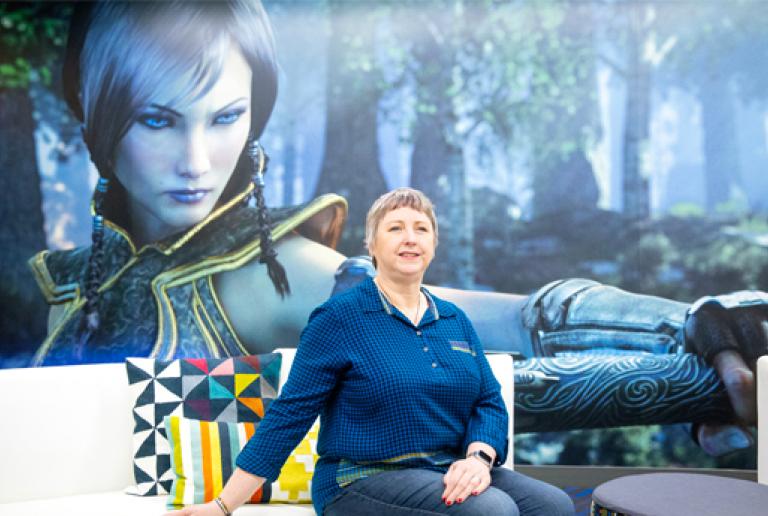
Sheri Graner Ray, a former Senior Game Designer at EA and now a game industry consultant, poses in her office.

Reap the Rewards of Austin

Austin is home to small indie developers and global competitors like Blizzard Entertainment, Electronic Arts, BioWare, Cloud Imperium Games, Daybreak Game Company, NCSoft, ZeniMax/Bethesda, Kabam, Wargaming,net, Retro Studios, Devolver Digital and Aspyr Media. 

What do our graduates do?

Video Game Development majors go on to a variety of careers from St. Edward's. Here is a sample:

  • Production coordinator at Bungie, Inc.
  • Embedded software engineer at Activision
  • Game engineer at Schell Games
  • Senior Business Operation coordinator at Zynga
  • Software developer at Epic Systems Corporation PLC
  • Associate producer at Electronic Arts
  • QA tester at Aspyr Media

Explore Details About a BA in Video Game Development

Degree Requirements

Major Requirements: The B.A. in Video Game Development requires 56 hours of major courses, which include courses in computational foundations, digital media, visual studies, and game development. 

General Education Requirements: The degree requires approximately 40 hours of general education courses which students complete over four years in addition to their major courses and electives.

A few examples of courses students take in this major:

  • Interactive Storytelling – This seminar contrasts traditional storytelling with the particular challenges of interactive narrative. Students develop an ability to craft interactive narrative and explore the range of storytelling techniques available in video games.
  • Game Design Studio I – Designed as a portfolio course, this course explores gameplay in 2D space and gives the student the opportunity to expand their game design portfolio by creating interactive projects using sound game design tools and methods.
  • Introduction to Game Audio – This course will give students a solid understanding of physics of audio and sound design techniques used to record and produce sound effects, ambient tracks, and dialog for video games.  

Skills You Will Gain

Upon completing the Acting program, you’ll be ready to…

  • Confidently craft interactive narratives;
  • Expand your game design portfolio by creating interactive projects using sound game design tools and methods;
  • Understand the physics of audio;
  • Adapt to new technologies and consumer needs;
  • Implement sound design techniques used to record and produce sound effects, ambient tracks and dialog for video games.

At St. Edward’s, our faculty are outstanding scholars, thought leaders, teachers and mentors who bring energy and enthusiasm to our vibrant learning community. They take pride in getting to know you, helping you achieve your goals and celebrating your successes.

View a list of our faculty members and their contact information on the Department of Visual Studies webpage.

Undergraduate

Theater Arts

Ornate door
Program Snapshot
Program Type
Bachelor of Arts
Department
Performing Arts

Expand Your Creative Abilities with a BA in Theater Arts

Learn every aspect of the craft—singing, directing, design, administration—and graduate prepared to work in any part of a theater organization. 

Learn to write and direct your own play, or design a costume from drawing to finished product. Gain a core foundation of theatre history, music and dance. Then let your skills shine in the four productions you’ll work on each year.
 

Why earn your Theater Arts degree at St. Edward's?

Theater Arts majors are uniquely positioned to take advantage of the arts supported by Austin’s vibrant culture. You’ll be connected to the pulse of a cosmopolitan city, an epicenter to creativity and a handful of world-class events. You’ll get to study at our award-winning theater program, hosted in the intimate professional Mary Moody Northen Theatre, which consistently receives awards from Austin critics. 

Become a member of Actors' Equity

Through our degree specializations, you’ll have the option to focus on design and technology, specialize in theater management, or be a part of the next generation of storytellers. No matter what you choose, you’ll learn from working alongside professional artists and you’ll have the chance to earn your membership in Actors' Equity Association, the American labor union of professional actors and stage managers. 

Test your fit

As you are making your college decision, get a better feel of out theater program through Scholarship Audition Weekend. Prospective theater students who have applied for university admission and have been accepted to St. Edward’s are invited to join us in February for a weekend of theater program activities! You'll have opportunities to sit in on classes, tour the campus, dine with current students, audition for a theater scholarship, see a show, meet the cast and crew and take workshops with university faculty. 

Learn from guest artists

Guest artists from the world of professional theater, film and television work with faculty and students in production. Students will also have the opportunity to engage in hands-on work in acting, writing, design and directing.

Study in the epicenter of creative expression

While studying at St. Edward's, you will be connected to the pulse of a cosmopolitan city. Our students regularly participate in both internships and other professional positions in Austin’s many professional theater companies. Your immersion in such a colorful art scene will enrich your educational experience and connect you to people who share your passion. 

Students performing in Godspell at the Mary Moody Northen Theatre at St. Edward's.

Reap the Rewards of Austin

Austin is home to 80 theatre companies and to a community of people who appreciate the beauty of human expression. By studying Theater Arts on the hilltop, you'll learn from local artists and gain access to attend (and even contribute to) performances in and around the city!

What do our graduates do?

Theater Arts majors go on to a variety of careers and graduate school from St. Edward's. Here's a sample:

  • Production manager for the Broadway production house of Juniper Street in New York City
  • Assistant production manager for Hudson Scenic Shop, a commercial scenery construction shop
  • Head of wardrobe for Cirque du Soleil’s LUZIA tour
  • Development associate for Theatre for a New Audience, in New York City
  • MFA in Design from Yale University
  • Rigger for Disney World
  • Apple

Explore Details About a BA in Theater Arts

Degree Plan

Major Requirements: 
The Bachelor of Arts in Theater Arts requires  28 hours of Theater Core major courses and 25 hours of Emerging Forms Specialization courses.

General Education Requirements: 
The Theater Arts degree requires 39 hours of general education courses plus major courses and electives.

Skills You Will Gain

Upon completing the Theater Arts program, you’ll be ready to:

  • Enhance your skills in writing, video-game design and digital content creation so you’re telling the story;
  • Produce costumes and set pieces;
  • Confidently set up professional lighting and sound;
  • Build wigs, apply theatrical makeup techniques and construct scenes;
  • Analyze interpersonal relationships within productions;
  • Take ethical precautions for running shows.

Under the Theater Arts Program, students can choose one of three specializations.

1. Emerging Forms

Emerging Forms establishes an interdisciplinary approach to theater studies by including courses from the writing, video-game design and digital content creation, offering students a unique opportunity to become the storytellers. 

  • Major Requirements: 28 hours of Theater Core major courses and 25 hours of Emerging Forms Specialization courses.
  • General Education Requirements: 39 hours of general education courses plus major courses and electives.
  • Electives: 28 hours of elective options

Upon completion of the freshman year, students will choose whether to continue with the Emerging Forms emphasis or, shift their focus to Theater Design/Technology or Theater Management, or audition for the BFA in Acting. View and download the full degree plan for Theater Arts with Emerging Forms Specialization (PDF).


2. Theater Design & Technology

Theater Design & Technology students will master skills to produce costumes and set pieces, as well as lighting at a professional caliber. 

  • Major Requirements: 28 hours of Theater Core major courses and 37 hours of Theater Design/Technology Specialization courses.
  • General Education Requirements: 39 hours of general education courses plus major courses and electives.
  • Electives: 16 hours of elective options

View and download the full degree plan for Theater Arts with Design/Technology Specialization (PDF).


3. Theater & Stage Management 

The Theater & Stage Management specialization will bestow students with the leadership and communication skills necessary to be successful in this field. Students will also earn the necessary professional production credits to join the Actor’s Equity Association upon graduation.

  • Major Requirements: 28 hours of Theater Core major courses and 24 hours of Theater Management Specialization courses.
  • General Education Requirements: 22 hours of general education courses plus major courses and electives.
  • Electives: 29 hours of electives

View and download the full degree plan for Theater Arts with Management Specialization (PDF).

At St. Edward’s, our faculty are outstanding scholars, thought leaders, teachers and mentors who bring energy and enthusiasm to our vibrant learning community. They take pride in getting to know you, helping you achieve your goals and celebrating your successes.

View a list of our faculty members and their contact information on the Department of Performing Arts webpage.

Undergraduate

Spanish

Ornate door

Develop a Global Mindset with a BA in Spanish

Build upon your cultural understanding of Spanish-speaking nations and communities. 

Refine and professionalize your language skills and cultivate an understanding of Hispanic cultures. With a Spanish major, you'll gain practical experience through study abroad, internships and courses in Spanish for the professions.

Why earn your Spanish degree at St. Edward's?

Spanish majors participate in service experiences and often volunteer their Spanish-speaking skills to social services across Austin. The Spanish program also offers opportunities to study abroad in Argentina, Chile, Mexico and Spain. Choose a program led by St. Edward’s professors for several weeks, or study at an international university for a semester.

Grow as a second-language learner

If you have studied Spanish formally and did not grow up hearing the language, you are probably a second-language learner. You can take a placement test or receive credit through CLEP or AP exams. For information on receiving credit for your prior knowledge in Spanish, contact Georgia Seminet.

Improve as a heritage learner

If you grew up hearing Spanish spoken by your parents or grandparents, you are probably a heritage learner. We have special classes designed to help heritage learners improve their grammar, vocabulary, and cultural knowledge. You can also take a placement test or receive credit through CLEP or AP exams. For more information, contact Emily Bernate.

Gain hands-on experience

Apply your Spanish skills by interning or volunteering at organizations that serve Austin’s Spanish-speaking residents where you’ll assist immigrants, refugees, asylum-seekers and other vulnerable members of the community. Spanish majors have interned as tutors and advocates for young English learners. They have interned at El Buen Samaritano, which provides healthcare, education and basic needs for Latino families, and at the Equal Justice Center, a nonprofit law firm. 

Use your Spanish for good

The Spanish program at St. Edward’s University offers a certificate in Advanced Spanish for the Health and Helping Professions for students with advanced oral proficiency.  Develop interpersonal communication skills in Spanish focused on in-person encounters and interviews in a clinical or medical setting. Through this certificate, students will demonstrate cultural knowledge of the Latinx sociocultural context through research and experiential learning. 

What do our graduates do?

Spanish majors go on to a variety of careers and graduate schools from St. Edward's. Here's a sample:

  • Reporter for Searchlight New Mexico, a nonprofit investigative journalism outlet
  • Graphic designer at the Metropolitan Museum of Art in New York
  • Account executive at NWN Corporation, a technology solutions company
  • Vice president of sales for Brazilian Blowout
  • Officer at European Climate Foundation
  • House manager at The Long Center for Performing Arts

Explore Details About the BA in Spanish

Degree Plan

Major Requirements: 
The BA in Spanish requires 36 hours of major coursework, which includes a combination of language, linguistic, and cultural studies in Spanish. Our Majors are required to take SPAN 3330 (offered every fall), 3341 (offered every spring), 3322 and 4398. They must complete a total of 2 4000-level courses.

General Education Requirements: 
The degree requires 34 hours of general education courses that students complete over four years in addition to their major courses and electives. 

Electives:
Students complete three (3) additional hours of elective coursework from the following areas of study: cultures, communication, history, political science, religious studies, or history. 

For a complete list of required and elective courses and course descriptions for the Spanish major, view the current Undergraduate Bulletin (PDF).

Skills You Will Gain

Upon completing the Spanish program, you’ll be ready to:

  • Effectively communicate with Spanish speakers from all over the world;
  • Translate and apply your Spanish to careers like immigration law, bilingual psychiatry and counseling, bilingual speech therapy, education and non-profit work;
  • Provide a comforting and accepting space for Spanish-speakers.
Degree Requirements (PDF)

Minor Requirements

Students will complete 18 hours of Spanish courses. SPAN 3330 and SPAN 3341 are required of all minors. Nonnative speakers will usually start the minor with SPAN 2312 and complete the 18 hours with subsequent courses. Native speakers and bilinguals seeking a minor in Spanish will normally begin with higher-level courses and complete the hours required with the two core courses plus electives. 

In addition to the following 18 hours of minor requirements, students must satisfy all General Requirements for a Minor (page 50) to be eligible to complete this minor.

Required Spanish Language Courses: 6 hours

  • Spanish Grammar in Context – SPAN 3330  (3 hours)
  • Effective Written Communication – SPAN 3341  (3 hours)

Intermediate Spanish Language Courses: 0–9 hours
Students who place out of 15 hours of Spanish may not take intermediate courses, except for SPAN 2351. However, they are usually necessary as foundational courses for nonnative speakers and English-dominant bilinguals who need to refine their skills before entering the 3000-level. Up to nine hours of the intermediate courses listed below can be used as electives to fulfill the requirements for the major or minor.

  • Spanish IV (Intermediate) – SPAN 2312  (3 hours)
  • Topics in Modern Latin America and Spain – SPAN 2325  (3 hours)
  • Practical Spanish Conversation – SPAN 2326  (3 hours)
  • Topics in Hispanic Studies – SPAN 2351  (3 hours)

For a complete list of required elective courses and course descriptions for the Spanish minor, view the current Undergraduate Bulletin (PDF).

At St. Edward’s, our faculty are outstanding scholars, thought leaders, teachers and mentors who bring energy and enthusiasm to our vibrant learning community. They take pride in getting to know you, helping you achieve your goals and celebrating your successes.

View a list of our faculty members and their contact information on the Department of Languages, Literature and Cultures webpage.

St. Edward's graduates in cap and gown show off their diplomas

Earn Two Degrees in Five Years

With our Accelerated Graduate Pathways, you can complete your BA in Spanish and master’s degree in Business Administration (MBA) in as little as five years, saving time and money. See details and requirements.

Success coaches and academic advisors guide you through undergraduate and graduate courses to maximize benefits.

Subscribe to Bachelor of Arts