

Menu
School of Arts and Humanities
School
Off
Academic Department
On
Administrative Department
Off

Language and International Experience

Ornate door

Expand Your World – One Language and Culture at a Time

Ready to take your language skills and global awareness to the next level? The Certificate in Language and International Experience offers a pathway to deepen your understanding of languages and cultures, enhance your intercultural competence, and sharpen your critical thinking.

This certificate provides an entry point between the modern language requirements and more advanced studies such as a French, German or Spanish minor, or even a major in Global Languages and Cultural Studies, or Spanish. This program will inspire you to go beyond the standard two introductory language courses, providing a structured and rewarding route to a valuable credential that includes an unforgettable study abroad experience.

What skills will you gain from this certificate program?

Learning a new language is a gateway to boosting your current skills and cultivating new ones. In this program, you can expect to:  

  • Improve your practical and functional command of a second language.
  • Heighten your ability to navigate and thrive in different cultural contexts.
  • Grow your capacity to adjust to new environments, solve problems independently and embrace unexpected challenges with confidence.
  • Strengthen your communication and decision-making skills, which can lead to increased job opportunities and global readiness, and in many cases, a higher salary. 

Explore Details About the Language and International Experience Certificate

In addition to the following 9 hours of certificate requirements with a grade of B- or higher, students must satisfy all General Requirements for a Certificate (page 50 of Undergraduate Bulletin) to be eligible to complete this certificate. A minimum of 6 hours must be completed in residence.

Required Courses

  • 3 Spanish courses at the 2000 level or above (9 hours total) in the target language, depending on placement test.
    OR
  • 3 French courses at the 2000 level or above (9 hours total) in the target language, depending on placement test.
    OR
  • 3 German courses at the 2000 level or above (9 hours total) in the target language, depending on placement test
    OR
  • 3 Japanese courses at the 2000 level or above (9 hours total) in the target language, in consultation with the Japanese instructor. Students who do not receive 3 hours of Japanese language credit from studying abroad in Japan will consult with the department chair about transferring university credits from another institution, as St. Edward’s currently does not offer a course beyond JAPN 2312.

For course descriptions, view the current Undergraduate Bulletin (PDF) (page 169).

Required Study Abroad Experience 

Participation in any accredited university study abroad program (semester, summer or embedded) in a country of the target language selected for the required certificate courses. All students will be required to complete a Final Reflection Project in consultation with the faculty of the Department of Languages, Literatures and Cultures.

Upon completion of the Certificate in Languages and International Experience, students will be able to:

  • Communicate effectively in a second language at an intermediate level (or higher for those who have a background in the target language), demonstrating enhanced linguistic proficiency beyond foundational requirements.
  • Apply cross-cultural understanding and communication skills to navigate diverse environments and interactions, fostering global competence.
  • Demonstrate increased self-reliance, adaptability and an open-minded approach to unfamiliar situations, developed through international experience.
  • Pursue global engagement and professional opportunities that require intermediate language proficiency.

The rising demand for bilingual and multilingual talent is at an all-time high across numerous industries. A 2019 survey among U.S. employers conducted by the American Council on the Teaching of Foreign Languages (ACTFL) revealed that:

  • 9 out of 10 employers rely on employees who can speak languages other than English.
  • 56% reported that their demand for bi/multilingual speakers will increase in the next five years.
  • 1 in 3 reported a language skills gap.
  • 1 in 4 has lost business due to a lack of foreign language skills.

At St. Edward’s, our faculty are outstanding scholars, thought leaders, teachers and mentors who bring energy and enthusiasm to our vibrant learning community. They take pride in getting to know you, helping you achieve your goals and celebrating your successes.

View a list of our faculty members and their contact information on the Department of Languages, Literature and Cultures webpage.

Advanced Spanish for Health and Helping Professions

Ornate door

Become a Bilingual and Bicultural Healthcare Professional

Promote health equity and boost your career with a Certificate in Advanced Spanish for the Health and Helping Professions.

According to the Centers for Disease Control and Prevention (CDC), health equity is achieved “when every person has the opportunity to attain his or her full health potential and no one is disadvantaged from achieving this potential because of social position or other socially determined circumstances.”

Understanding that communication is one of the keys to advancing health equity in our society, St. Edward's created the Certificate in Advanced Spanish for the Health and Helping Professions to help meet the need in the healthcare sector for bilingual and bicultural professionals.

Program Benefits

This program allows you to earn certification while pursuing your undergraduate degree. You’ll leverage your skills as a bilingual speaker or advanced second-language learner of Spanish. And you’ll be prepared for health-related professions that require specific, technical vocabulary and cultural knowledge.

The methodology of this program will be grounded in an inquiry-based approach, employ best practices from translation studies, as well as refine your written and spoken Spanish. The certificate provides an experiential learning component (internship) in the area of your major.

The certificate is designed for students with advanced oral proficiency — Spanish/English bilinguals and second-language learners.

What will you learn?

The linguistic and cultural competencies addressed in the certificate will position you to become a leader in the health and helping professions as an advocate for the Latino/Latinx population in the United States. Learning outcomes include:

  • Developing interpersonal communication skills in Spanish focused on in-person encounters and interviews in a clinical or medical setting.
  • Demonstrating cultural knowledge of the Latinx sociocultural context through research and experiential learning.
  • Applying the fundamentals of translation and interpretation necessary in healthcare settings.
  • Refining and professionalizing oral presentational skills in Spanish in order to communicate in a caring and effective manner.

The Advanced Spanish for Health and Helping Professions Certificate consists of 12 credit hours at the Advanced Spanish proficiency course level.

  • Spanish for the Health and Helping Professions – Spanish 3355
  • Spanish for Healthcare Professionals and Latino Issues in Health – Spanish 3357
  • Introduction to Translation and Interpretation – Spanish 4305
  • Internship in Advanced Spanish for the Health and Helping Professions – Spanish 4363

For more details and course descriptions, view and download the Undergraduate Bulletin (PDF).

At St. Edward’s, our faculty are outstanding scholars, thought leaders, teachers and mentors who bring energy and enthusiasm to our vibrant learning community. They take pride in getting to know you, helping you achieve your goals and celebrating your successes.

View a list of our faculty members and their contact information on the Department of Languages, Literature and Cultures webpage.

UNDERGRADUATE

German

Ornate door

Open Doors to International Careers With a Minor in German

Germany is home to Europe's largest economy. Learn the language and culture and join the one million Americans employed by German companies. 

You’ll graduate with skills you can apply in the financial, medical and educational fields or use in business or diplomacy at this pivotal moment for Germany and European Union.

Why study German at St. Edward's?

Explore German culture right here in Texas

Students interested in German can count of plenty activities right here in Austin. Join Deutschklub to learn about German culture and appreciate german-themed events on campus and in Central Texas. Tune into the German-speaking social hour and join in on trips to local German restaurants and bakeries. 

Make the most out of your career path

Students in STEM fields will find no shortage of opportunities to work and study in Germany before and after graduation. For example, the German Academic Exchange Service offers funding for students and recent graduates to conduct paid Research Internships in Science and Engineering every year. Apply your German-speaking skills to make the most out of your chosen career path. The Congress-Bundestag Youth Exchange (CBYX) for Young Professionals also provides 75 scholarships each year to young adults wishing to improve their German and intern in a setting directly related to their career field.

Check out study abroad opportunities

Study abroad at our partner universities in Eichstatt and Koblenz, Germany, and Innsbruck, Austria, to strengthen your language skills while learning about the rich culture and tumultuous history of the German-speaking world.

Explore Details About a Minor in German

The German Minor consists of 18 hours:

  • 6 hours of GERM 2311 and 2312
  • 12 hours selected from:
    • GERM 3331
    • GERM 3334
    • GERM 3335
    • GERM 3338
    • GERM 3350

The elective classes above include Business German, internships, conversation courses, and courses on literature and culture. You can also earn credit through study abroad!

St. Edward's has an impressive track record of successful Fulbright applicants. Many of these students received grants to teach or conduct research in Germany. In fact, Germany awards more Fulbrights to U.S. students than any other country on earth!

At St. Edward’s, our faculty are outstanding scholars, thought leaders, teachers and mentors who bring energy and enthusiasm to our vibrant learning community. They take pride in getting to know you, helping you achieve your goals and celebrating your successes.

View a list of our faculty members and their contact information on the Department of Languages, Literature and Cultures webpage.

UNDERGRADUATE

Chicanx and Latinx Studies

Ornate door

Study Significant Issues Surrounding the Chicanx and Latinx Population  

Whether you want to create a deeper connection with your own culture, or you’re planning a career where you’ll work with Chicanx and Latinx communities, this minor will equip you with valuable knowledge.

Learn about the historical, social and political experiences of Chicanx and Latinx communities, including social justice movements. Analyze Chicanx and Latinx literary and artistic works, and appreciate how Latin American migration has influenced the United States.

Why study Chicanx and Latinx Studies at St. Edward's?

Consider how differences in national origin, citizenship, gender and sexuality shape experiences within Latinx communities.

Develop understanding and appreciation

Whether you plan to pursue a career in business, government, law, medicine, journalism, social work, teaching, religion or the arts, courses in this minor will equip you to approach issues in the Chicanx and Latinx communities with empathy.

Gain intercultural and cross-cultural awareness

With a minor in Chicanx and Latinx Studies, you learn to critically analyze information as it pertains to the intersection of historical events and the concept of a Latinx identity within the context of being a United States citizen. 

Explore Details About a Minor in Chicanx and Latinx Studies

Required Courses (18 hours)

Students who wish to earn an Art History minor must take the following coursework with at least nine (9) of these hours in upper-division coursework.

  • CHLX 1302: Introduction to Chicanx and Latinx Studies 
  • CHLX 3325: Identities, Communities and Social Justice

In addition, students must take 12 hours of elective courses, including at least nine (9) hours of upper-division coursework. At least nine (9) hours of courses may not be counted to satisfy requirements for any other major or minor. 

Electives include courses on the U.S. Mexico Borderlands, Chicana Writers and Artists, and other courses in Literature, Communication, Spanish, History, Sociology, Political Science and Art History.

Students can intern at various non-profit organizations in Austin that work with immigrant populations, particularly Latinx populations: Worker’s Defense Project, Casa Marianela, Caritas and others.

At St. Edward’s, our faculty are outstanding scholars, thought leaders, teachers and mentors who bring energy and enthusiasm to our vibrant learning community. They take pride in getting to know you, helping you achieve your goals and celebrating your successes.

View a list of our faculty members and their contact information on the Department of Languages, Literature and Cultures webpage.
Undergraduate

Spanish

Ornate door

Develop a Global Mindset with a BA in Spanish

Build upon your cultural understanding of Spanish-speaking nations and communities. 

Refine and professionalize your language skills and cultivate an understanding of Hispanic cultures. With a Spanish major, you'll gain practical experience through study abroad, internships and courses in Spanish for the professions.

Why earn your Spanish degree at St. Edward's?

Spanish majors participate in service experiences and often volunteer their Spanish-speaking skills to social services across Austin. The Spanish program also offers opportunities to study abroad in Argentina, Chile, Mexico and Spain. Choose a program led by St. Edward’s professors for several weeks, or study at an international university for a semester.

Grow as a second-language learner

If you have studied Spanish formally and did not grow up hearing the language, you are probably a second-language learner. You can take a placement test or receive credit through CLEP or AP exams. For information on receiving credit for your prior knowledge in Spanish, contact Georgia Seminet.

Improve as a heritage learner

If you grew up hearing Spanish spoken by your parents or grandparents, you are probably a heritage learner. We have special classes designed to help heritage learners improve their grammar, vocabulary, and cultural knowledge. You can also take a placement test or receive credit through CLEP or AP exams. For more information, contact Emily Bernate.

Gain hands-on experience

Apply your Spanish skills by interning or volunteering at organizations that serve Austin’s Spanish-speaking residents where you’ll assist immigrants, refugees, asylum-seekers and other vulnerable members of the community. Spanish majors have interned as tutors and advocates for young English learners. They have interned at El Buen Samaritano, which provides healthcare, education and basic needs for Latino families, and at the Equal Justice Center, a nonprofit law firm. 

Use your Spanish for good

The Spanish program at St. Edward’s University offers a certificate in Advanced Spanish for the Health and Helping Professions for students with advanced oral proficiency.  Develop interpersonal communication skills in Spanish focused on in-person encounters and interviews in a clinical or medical setting. Through this certificate, students will demonstrate cultural knowledge of the Latinx sociocultural context through research and experiential learning. 

What do our graduates do?

Spanish majors go on to a variety of careers and graduate schools from St. Edward's. Here's a sample:

  • Reporter for Searchlight New Mexico, a nonprofit investigative journalism outlet
  • Graphic designer at the Metropolitan Museum of Art in New York
  • Account executive at NWN Corporation, a technology solutions company
  • Vice president of sales for Brazilian Blowout
  • Officer at European Climate Foundation
  • House manager at The Long Center for Performing Arts

Explore Details About the BA in Spanish

Degree Plan

Major Requirements: 
The BA in Spanish requires 36 hours of major coursework, which includes a combination of language, linguistic, and cultural studies in Spanish. Our Majors are required to take SPAN 3330 (offered every fall), 3341 (offered every spring), 3322 and 4398. They must complete a total of 2 4000-level courses.

General Education Requirements: 
The degree requires 34 hours of general education courses that students complete over four years in addition to their major courses and electives. 

Electives:
Students complete three (3) additional hours of elective coursework from the following areas of study: cultures, communication, history, political science, religious studies, or history. 

For a complete list of required and elective courses and course descriptions for the Spanish major, view the current Undergraduate Bulletin (PDF).

Skills You Will Gain

Upon completing the Spanish program, you’ll be ready to:

  • Effectively communicate with Spanish speakers from all over the world;
  • Translate and apply your Spanish to careers like immigration law, bilingual psychiatry and counseling, bilingual speech therapy, education and non-profit work;
  • Provide a comforting and accepting space for Spanish-speakers.
Degree Requirements (PDF)

Minor Requirements

Students will complete 18 hours of Spanish courses. SPAN 3330 and SPAN 3341 are required of all minors. Nonnative speakers will usually start the minor with SPAN 2312 and complete the 18 hours with subsequent courses. Native speakers and bilinguals seeking a minor in Spanish will normally begin with higher-level courses and complete the hours required with the two core courses plus electives. 

In addition to the following 18 hours of minor requirements, students must satisfy all General Requirements for a Minor (page 50) to be eligible to complete this minor.

Required Spanish Language Courses: 6 hours

  • Spanish Grammar in Context – SPAN 3330  (3 hours)
  • Effective Written Communication – SPAN 3341  (3 hours)

Intermediate Spanish Language Courses: 0–9 hours
Students who place out of 15 hours of Spanish may not take intermediate courses, except for SPAN 2351. However, they are usually necessary as foundational courses for nonnative speakers and English-dominant bilinguals who need to refine their skills before entering the 3000-level. Up to nine hours of the intermediate courses listed below can be used as electives to fulfill the requirements for the major or minor.

  • Spanish IV (Intermediate) – SPAN 2312  (3 hours)
  • Topics in Modern Latin America and Spain – SPAN 2325  (3 hours)
  • Practical Spanish Conversation – SPAN 2326  (3 hours)
  • Topics in Hispanic Studies – SPAN 2351  (3 hours)

For a complete list of required elective courses and course descriptions for the Spanish minor, view the current Undergraduate Bulletin (PDF).

At St. Edward’s, our faculty are outstanding scholars, thought leaders, teachers and mentors who bring energy and enthusiasm to our vibrant learning community. They take pride in getting to know you, helping you achieve your goals and celebrating your successes.

View a list of our faculty members and their contact information on the Department of Languages, Literature and Cultures webpage.

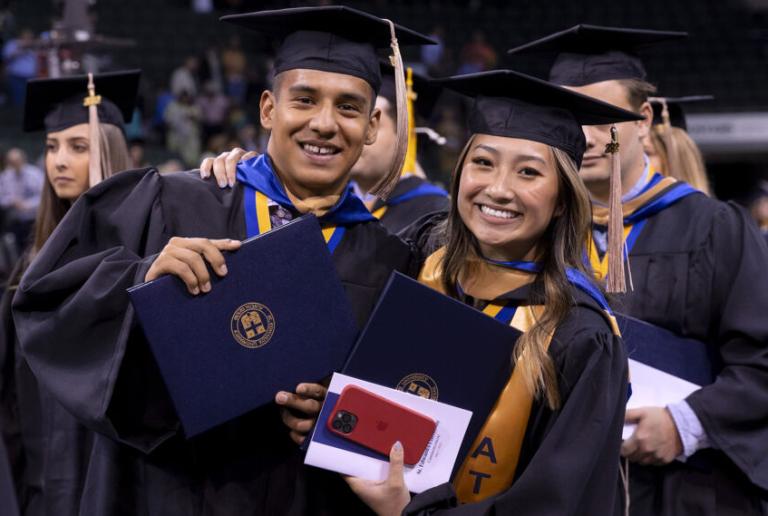
St. Edward's graduates in cap and gown show off their diplomas

Earn Two Degrees in Five Years

With our Accelerated Graduate Pathways, you can complete your BA in Spanish and master’s degree in Business Administration (MBA) in as little as five years, saving time and money. See details and requirements.

Success coaches and academic advisors guide you through undergraduate and graduate courses to maximize benefits.

UNDERGRADUATE

Global Languages and Cultural Studies

Ornate door

Embrace Multilingualism and Unlock Global Opportunities

Prepare for careers in fields like international business, diplomacy, translation, education and more.

Why earn your Global Languages and Cultural Studies degree at St. Edward’s?

The Kozmetsky Center of Excellence at St. Edward’s brings international experts to campus, either in person or virtually, to share their knowledge with the university community. You’ll have the chance to listen and ask questions of these global experts in sustainable development, peace and security, global health, climate change and global finance.

Advanced Spanish for Health and Helping Professions Certificate

Leverage your skills as a bilingual speaker or advanced second-language learner of Spanish and prepare for health-related professions that require specific, technical vocabulary and cultural knowledge as you earn your undergraduate degree. Develop interpersonal communication skills in Spanish focused on in-person encounters and interviews in a clinical or medical setting and demonstrate knowledge of the Latinx sociocultural context through research and experiential learning.

Study Abroad

Studying abroad is the perfect way to immerse yourself in a new environment and rely exclusively on your language skills. These programs will help you understand another culture and how people in another country view the United States. They also offer tremendous opportunities for personal growth. St. Edward’s offers study-abroad opportunities in Spain, France, Costa Rica, Japan, Italy and more.

Student Organizations

Language clubs (Spanish, French, German and Japanese), as well as Alpha Mu Gamma (the Honors Languages club) give you the opportunity to connect with students with similar interests and global worldviews. The International Student Association and Latinx Student Leaders Organization also offer you the chance to learn more about other cultures through social activities and programs.

Fulfilling the Language Requirement

The targeted level of language proficiency is "Intermediate High to Advanced Low" in both speaking and writing for the primary language and “Intermediate” in the second language. There are several ways to achieve the minimum proficiency required for the degree.

What will you learn?

Engage with diverse cultures and languages from around the world. By studying two modern languages, you’ll enhance communication skills, cross-cultural understanding and critical thinking. Embrace the challenge and fulfillment of becoming multilingual and open doors across the hemispheres. 

A few examples of courses students take in the major:

  • In Topics in Comparative Languages, Literatures and Cultures, better understand the world around you by sharing your own experiences as well as learning about those of your classmates. 
  • In Multilingualism in the U.S. and Intercultural Communication, improve your communication skills, cross-cultural understanding and critical thinking.

What skills will you gain?

Upon completing the Global Languages and Cultural Studies program, you’ll be ready to…

  • Develop language proficiency in one or more languages, including Spanish, French, German and Japanese. 
  • Gain intercultural communication skills and global awareness. 
  • Critically think and communicate with those in fields such as international business, diplomacy, translation, education and more.

Explore Details About the BA in Global Languages and Cultural Studies

Major Requirements: The BA in Global Languages and Cultural Studies is a 36-hour major requiring students to choose a primary language (18 hours beginning at 2311 or higher), a secondary language (12 hours beginning at 1311 or higher), and to complete 2 required core courses (CLLC 1310, CLLC 4330) taught in English. Languages include German, French, Spanish and Japanese. Students who test out of or place beyond beginning and intermediate levels will complete the degree with approved electives.

Electives: Students who are waived from intermediate courses through the departmental placement test or who demonstrate advanced proficiency may choose to take up to 6 hours of approved electives (in English) to reach the 36-hour major requirement.

View and download the full degree plan for our Global Languages and Cultural Studies major.

At St. Edward’s, our faculty are outstanding scholars, thought leaders, teachers and mentors who bring energy and enthusiasm to our vibrant learning community. They take pride in getting to know you, helping you achieve your goals and celebrating your successes.

View a list of our faculty members and their contact information on the Department of Languages, Literature and Cultures webpage.

Subscribe to Languages, Literatures and Cultures