


Chemistry and Your Future
Study how material substances interact, combine and change. Use that knowledge to find cures for diseases, create new products, develop nutritious food for the world’s growing population, monitor sources of pollution to protect the environment, or analyze evidence to solve crimes.
The Benefits of a Chemistry degree from St. Edward’s
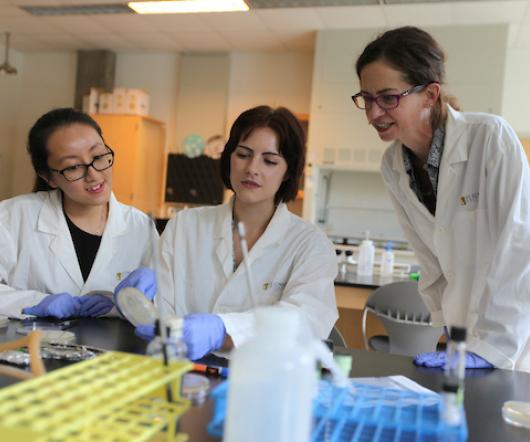
Whatever field you choose to pursue as a chemist — from pharmacology to toxicology to forensics to teaching — one thing is certain: The advantages of your St. Edward’s education will prepare you to succeed. You’ll find opportunities in and outside the classroom to learn, give back and achieve your goals. And your mentors will support you every step of the way.
Faculty Mentorship
You’ll learn in small classes taught by dedicated professors who make a point of getting to know you and becoming your trusted advisors. They’ll help you identify and focus on your goals, and provide guidance and insight during your and after college years.
Conduct Research
You are encouraged to join faculty led research groups and present their findings at professional conferences. Paid six- and eight-week summer research experiences are offered. Additionally, the Institute for Interdisciplinary Science (i4) offers paid in-workplace internships that help students gain valuable practical experience as they move forward academically and professionally.
Career Development and Networking
Love chemistry but unsure what you would like to do with your degree? The Chemistry department’s annual guest speaker series connects you with professionals in the field. Learn firsthand from chemists in academia, industry and government agencies about their professional journey as a chemist.
Academic Work and Student Orgs
The American Chemical Society student chapter at St. Edward’s University helps students explore careers in chemistry, connect with professionals and build community with fellow science-minded peers. Members also work with the Department of Chemistry to host guest speakers and participate in chemistry-focused outreach and community events.
Life as a Chemistry Student at St. Edward's University
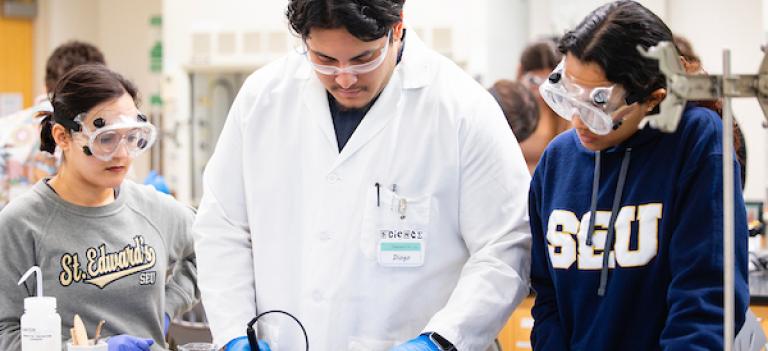
Students at St. Edward’s University discover a personalized, hands-on approach to learning that prepares you to succeed from day one. Through real-world learning, faculty mentorship, research experience and strong industry connections, you’ll build the skills, experience and confidence to thrive in a competitive, ever-changing internship and job market.
A Chemistry Program Designed for Success
Study how material substances interact, combine and change. Use that knowledge to find cures for diseases, create new products, develop nutritious food for the world’s growing population, monitor sources of pollution to protect the environment, or analyze evidence to solve crimes. Through faculty led research groups, internships with local companies, hands-on experience with advanced instrumentation and the career development guest speaker series. Students in the Chemistry major at St. Edward's are well-prepared, and supported, for a future in almost any area they choose to explore.
Preparing for Your Future in Chemistry
A degree in Chemistry from St. Edward’s University prepares students to pursue careers and graduate study across research, healthcare, industry and higher education. Through hands-on laboratory experience, close faculty mentorship and opportunities for undergraduate research, students build the analytical and problem-solving skills needed to thrive in a rapidly evolving scientific landscape. Graduates have gone on to roles in chemical research and development, pathology and laboratory science, as well as doctoral programs at leading institutions including Duke University, University of Michigan and The University of Texas at Austin — applying their knowledge to discoveries and innovations that impact industries, communities and everyday life.
Making an Impact
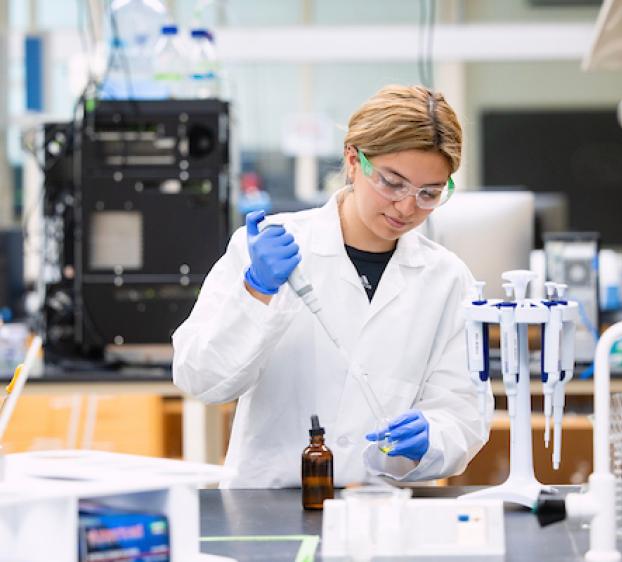
Meet the students, alumni and faculty advancing discovery and innovation through chemistry at St. Edward’s University. From undergraduate research and laboratory experience to graduate study and careers in science, healthcare and industry, their stories highlight how a chemistry education on the Hilltop prepares students to make an impact far beyond the classroom.
Frequently Asked Questions About the Chemistry Program
A Chemistry Degree Will Take You Wherever You Want to Go
As a Chemistry major at St. Edward’s, you’ll learn to think both scientifically and creatively. You’ll delve into the study of matter — its characteristics, behavior and structure. You’ll examine the way materials act and react in certain situations, and you’ll produce and observe these reactions, both in nature and artificially in a lab setting.
Through classroom studies, lab work and research, you’ll develop an understanding of how to collect, organize and interpret chemical data. In the process, you’ll learn to appreciate the world on the macro-scale while learning the underlying principles occurring on the molecular level.
Skills You Will Gain
As a Chemistry major, you’ll cultivate a range of skills that prepare you to excel in the workplace. You’ll be able to …
- Search, access, contextualize and effectively summarize readings of discipline-specific literature.
- Apply appropriate experimental techniques and instruments in the context of designing and executing an experiment.
- Use quantitative tools for data collection and analysis.
- Explain the purpose of general laboratory safety guidelines and their implementation in various lab settings.
- Communicate the findings of independent research in a manner appropriate to the audience, including oral presentations and the writing of experiments, research manuscripts, poster presentations, and research proposals.
- Demonstrate an ability to collaborate and arrive at a common goal within a team.
Research
You’ll perform research with cutting-edge instrumentation — St. Edward’s is proud to be considered one of the best-equipped and best-funded small college chemistry departments in the country. We’ve been highly successful in securing external funding in support of an advanced curriculum, modern laboratory instrumentation and undergraduate research.
Departmental and Research Funding
The Chemistry department faculty led research is funded by a departmental research grant from the Robert A. Welch Foundation. This fund provides support for paid summer research opportunities. Recently the department was awarded a Welch Foundation Equipment grant to fund a new Nanalysis 60mHz Pro Benchtop Nuclear Magnetic Resonance (NMR) system, with 1H, 13C and 19F capabilities. This advanced instrumentation provides students with hands-on experience in analyzing molecular structure and dynamics.
The Chemistry department is grateful for the ongoing gift of the Lewis fund, which supports student research. Given in memory of Dr. JD Lewis, longtime faculty member in the Chemistry department, this fund provides support for summer six-week and eight-week student research experiences.
Scholarships
- In addition to performing research over the academic year in one of the faculty-led research groups, students may apply for participation in the Chemistry Department’s full-time summer research program. The summer program is fully funded and successful applicants receive competitive student stipends.
- Students in chemistry-related majors at St. Edward’s may apply for Welch Foundation undergraduate research scholarships or Lewis scholarships — including a summer scholarship that provides a six-week or eight-week stipend to conduct research.
- Apply for a summer research experience for undergraduates [REU] at local and national universities, where you can gain experience studying different subfields of chemistry, gain a clearer understanding of what graduate school is like and focus on your career direction.
Research Experiences for Undergraduates (REU) include:
- University of Texas at Austin
- Texas State University
- Baylor University
- University of Texas at San Antonio
- University of North Carolina
- Michigan State University
- University of Nebraska
- University of Michigan
- University of Mississippi
- North Carolina State University
- Boston University
Conferences and Presentations
- Students are encouraged to present their results at professional meetings, such as regional and national meetings of the American Chemical Society and the Texas Academy of Science, where they’ll rub shoulders with professional chemists.
- Students also have the opportunity to present their undergraduate research at the annual Lucian Symposium [fall semester] and SOURCE Symposium [spring semester] on the St. Edward’s campus.
Application Dates and Deadlines
We welcome your application! Please see the information below regarding admission applications, dates and deadlines. If you need additional information, you can visit the Apply page for details, contact information and more.
First-Year Students:
Find what you need to apply and important deadlines. When you are ready, there are three ways for you to apply to St. Edward’s:
Add St. Edward’s to your list of schools if you’re using the Common Application to save time applying to your top colleges.
If you are applying to multiple schools in Texas, you can use ApplyTexas whether you’re a Texas resident or not.
Freshman ApplyTexas Application
It’s easy to apply using our convenient online application.
Freshman St. Edward's Application
Transfer Students:
Add St. Edward’s to your list of schools if you’re using the Common Application to save time applying to your top colleges.
If you are applying to multiple schools in Texas, you can use ApplyTexas whether you’re a Texas resident or not.
Transfer ApplyTexas Application
It’s easy to apply using our convenient online application.
Choose Your Degree Plan
Students pursuing a degree in Chemistry have two degree plans to choose from. This helpful course map (PDF) shows the sequence of prerequisites in the department.
1. Bachelor of Science in Chemistry
The BS in Chemistry is a rigorous course of study that incorporates more math and laboratory experience. This degree track is intended primarily to meet the needs of a student who wishes to seek employment in the chemical industry or to prepare for graduate study in chemistry.
Major Requirements: 69 hours of major courses, of which 23 hours are supporting courses from math, physics and biology.
General Education Requirements: In addition to the major program requirements, all students must satisfy the general education requirements. Talk with your faculty advisor and success coach about which courses are right for you.
View and download the full degree plan for the BS in Chemistry major (PDF).
2. Bachelor of Arts in Chemistry
This BA in Chemistry provides more opportunities to take non-science-related courses for a broader-based education and is intended primarily for students who wish to teach at the secondary school level or would like to use chemistry as a supporting discipline.
Major Requirements: 52 hours of major courses, of which 20 hours are supporting courses from math, physics and biology.
General Education Requirements: In addition to the major program requirements, all students must satisfy the general education requirements. Talk with your faculty advisor and success coach about which courses are right for you.
View and download the full degree plan for the BA in Chemistry major (PDF).
The Department of Chemistry also offers a degree in Biochemistry.
Add to Your Major
A Chemistry minor is available for students interested in the field of chemistry, or for students who would benefit from adding courses in chemistry to their education for their future endeavors.
Required courses:
- General Chemistry
- General Chemistry Lab
General Chemistry II - General Chemistry II Lab
Or
- Inorganic Chemistry I
- Inorganic Chemistry I Lab
- Organic Chemistry
- Organic Chemistry I Lab
- Chemistry Electives
Internships
Our internship program acquaints students with practical experience. Our students have recently interned with …
- MilliporeSigma
- Electroninks
STEM students at St. Edward’s can access paid internships offered by our Institute for Interdisciplinary Science (i4). For more information on these internship programs, please visit the Institute for Interdisciplinary Science (i4).
What do our graduates do?
Chemistry majors advance to a variety of careers and graduate schools from St. Edward’s. Here’s a sample:
- Associate Professor of Pathology, Duke University
- Scientific researcher at Braskem
- Chemist at Quality Chemical Laboratories
- R&D researcher at Procter & Gamble
- Postdoctoral associate at the Air Force Research Lab
- Chemical Biology PhD candidate at the University of Michigan
- Inorganic Chemistry PhD candidate at the University of California Irvine
- Graduate students at The University of Texas at Austin, the South Dakota School of Mines and Technology and the University of California Santa Cruz
- Yale University, Southern Methodist University, Texas State University, Baylor University
Get to Know Us
At St. Edward’s, our faculty are outstanding scholars, thought leaders, teachers and mentors who bring energy and enthusiasm to our vibrant learning community. They take pride in getting to know you, helping you achieve your goals and celebrating your successes.
View a list of our faculty members and their contact information on the Department of Chemistry webpage.