


Examine the Impact Chemical Substances Have On the Earth’s Ecosystems
Get ready to confront climate change, find ways to clean up air and water pollution, and respond to environmental disasters. Or figure out solutions to problems related to energy, waste and recycling. You’ll build your knowledge of both chemistry and environmental science — and a solid understanding of the connections between the environment, economics and policy.
Why earn your Environmental Chemistry degree at St. Edward’s?
If you want to use chemistry to safeguard the environment through public policy, natural resource management, corporate sustainability practices, teaching or other fields, one thing is certain: The advantages of your St. Edward’s education will prepare you to succeed. You’ll find opportunities in and outside the classroom to learn, give back and achieve your goals. And your mentors will support you every step of the way.

Build relationships with your professors
You’ll learn in small classes taught by dedicated professors who make a point of getting to know you and becoming your trusted advisors. They’ll help you identify and focus on your goals, and provide guidance and insight during and after your college years.
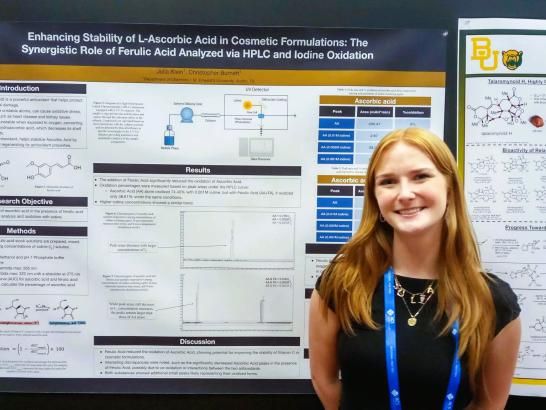
Conduct research
You’ll have the opportunity to engage in faculty-mentored research , present your work at professional conferences, and submit your findings for publication.

Develop your career path as a chemist
Love chemistry but unsure what you would like to do with your degree? The Chemistry department’s annual guest speaker series connects you with professionals in the field. Learn firsthand from chemists in academia, industry and government agencies about their professional journey as a chemist. It’s an excellent opportunity to network and gain firsthand knowledge about the field. In addition, gain valuable experience as a teaching assistant for a laboratory course where you’ll enhance your benchwork, leadership and teamwork skills — all while helping fellow students.
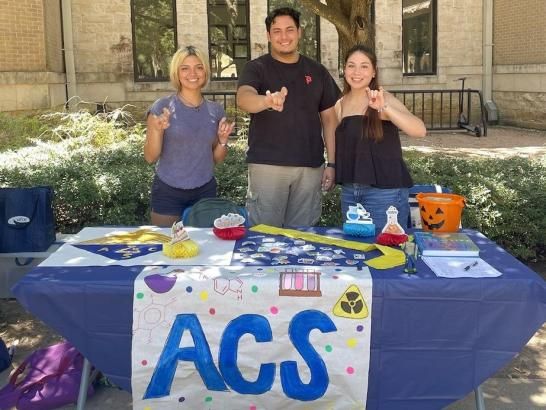
Get involved in the American Chemical Society student chapter
The American Chemical Society (ACS) student chapter on campus is a professional organization focused on enhancing student networking with professionals in the field, exploring careers in chemistry, and building a sense of community with people who love chemistry as much as you do. The ACS student group works closely with the Department of Chemistry in coordinating its annual guest speaker series and volunteering for chemistry-focused community events.

Reap the Rewards of Austin
Austin is a fast-growing technology hub and emerging center of science research and innovation. As an Environmental Chemistry major, you can explore career paths and practical application of your studies through internships and interactions within the greater Austin community.
What do our graduates do?
Environmental Chemistry majors go on to a variety of careers and graduate schools from St. Edward’s. Here’s a sample:
- Geochemist and risk assessment officer at Tetra Tech, a consulting and engineering company
- Master’s student at Texas A&M University
- PhD candidate at DePaul University
- PhD candidate at the University of North Texas
Explore Details About a Degree in Environmental Chemistry
Major Requirements: The Bachelor of Science in Environmental Chemistry requires 78 to 79 hours of major courses, which include a combination of environmental science, chemistry, philosophy, biology, math, and physics.
General Education Requirements: In addition to the major program requirements, all students must satisfy the general education requirements. Talk with your success coach and faculty advisor about which courses are right for you.
View and download the full degree plan for our Environmental Chemistry major (PDF).
A few examples of courses students in this major take:
- Environmental Politics and Policy – Explore new demands worldwide for dealing with the risks of climate change, population growth, loss of biological diversity and terrorism, which will force governments everywhere to rethink policy strategies and find new ways to reconcile environmental and economic goals.
- Environmental Chemistry – Examine the behavior and interactions of chemicals in natural and anthropogenic systems; their distribution, transport and fate.
- Environmental Ethics – Delve into moral concerns and ethical decision-making concerning the environment. Topics include individual, corporate, and state freedoms and responsibilities, permissible uses of animals, and comparison of strategies for protecting natural resources, as well as case studies regarding equity, justice, and individual and community rights to environmental resources.
- Biochemistry – Survey of the fundamentals of biochemistry. Topics include the structure of proteins, lipids and carbohydrates, catalysis, kinetics, bioenergetics and metabolism, and information pathways.
The Department of Chemistry also offers degrees in Chemistry, Biochemistry and Forensic Chemistry.
What You Will Learn
Some of the most critical and challenging issues that must be addressed in this century are environmental in nature. Finding good policy solutions to address these issues will require an understanding of the underlying processes that drive environmental changes. Many of these processes are chemical in nature and must be studied using the techniques of chemistry.
The professional tools needed to address these problems are extensive expertise in the field of chemistry and a general knowledge of the field of environmental science. The BS degree program in Environmental Chemistry is designed to prepare college graduates with this type of expertise. A degree in Environmental Chemistry provides professional preparation for students interested in applying a rigorous scientific degree to careers in the environmental field.
Graduates with this degree have a background appropriate for attending graduate school in chemistry or environmental science, or for professional employment in environmental analysis and environmental remediation positions with corporations, research labs and governmental agencies. Graduates of this program would also be well qualified to pursue a professional career in other areas of chemistry.
Skills You Will Gain
As an Environmental Chemistry major, you’ll cultivate a range of skills that prepare you to excel in the workplace. You’ll be able to:
- Search, access, contextualize and effectively summarize readings of discipline-specific literature.
- Apply appropriate experimental techniques and instruments in the context of designing and executing an experiment.
- Use quantitative tools for data collection and analysis.
- Explain the purpose of general laboratory safety guidelines and their implementation in various lab settings.
- Communicate about the findings of independent research in a manner appropriate to the audience, including oral presentations and the writing of experiments, research manuscripts, poster presentations and research proposals.
- Demonstrate an ability to collaborate and arrive at a common goal within a team.
Experiential Learning and Research
We emphasize experiential learning, so students majoring in Environmental Chemistry enroll in at least two semesters of research courses and join a student-faculty research group with the goal of producing and presenting professional-level work.
You’ll perform research with cutting-edge instrumentation — St. Edward’s is proud to be considered one of the best-equipped and best-funded small college chemistry departments in the country. We’ve been highly successful in securing external funding in support of an advanced curriculum, modern laboratory instrumentation and undergraduate research.
Departmental and Research Funding
In addition to an ongoing research grant from the Robert A. Welch Foundation, the Chemistry Department has secured curricular and equipment grants from the National Science Foundation, the Keck Foundation and the Educational Advancement Foundation.
The Chemistry department is grateful for the ongoing gift of the Lewis fund, which supports student research. Given in memory of Dr. JD Lewis, longtime faculty member in the Chemistry department, this fund provides support for summer six-week and eight-week student research experiences
Scholarships
- In addition to performing research over the academic year in one of the faculty-led research groups, students may apply for participation in the Chemistry Department’s full-time summer research program. The summer program is fully funded, and successful applicants receive competitive student stipends.
- Students in chemistry-related majors at St. Edward’s may apply for Welch Foundation undergraduate research scholarships or Lewis scholarships — including a summer scholarship that provides a six-week or eight-week stipend to conduct research.
- Apply for a summer research experience for undergraduates [REU] at local and national universities, where you can gain experience studying different subfields of chemistry and focus on your career direction.
NSF summer Research Experiences for Undergraduates (REU) include:
- The University of Texas at Austin
- Texas State University
- Baylor University
- University of Texas at San Antonio
- University of North Carolina
- Michigan State University
- University of Nebraska
- University of Michigan
- University of Mississippi
- North Carolina State University
- Boston University
Conferences and Presentations
- Students are encouraged to present their results at professional meetings, such as regional and national meetings of the American Chemical Society and the Texas Academy of Science.
- Students also have the opportunity to present their research at the annual Lucian Symposium [fall semester] and the SOURCE Symposium [spring semester] on the St. Edward's campus.
Our internship program acquaints students with practical experience. Our students have recently interned with:
- Tetra Tech
- Texas Commission on Environmental Quality
STEM students at St. Edward’s can access paid internships offered by our Institute for Interdisciplinary Science (i4). For more information on these internship programs, please visit the Institute for Interdisciplinary Science (i4).
At St. Edward’s, our faculty are outstanding scholars, thought leaders, teachers and mentors who bring energy and enthusiasm to our vibrant learning community. They take pride in getting to know you, helping you achieve your goals and celebrating your successes.
View a list of our faculty members and their contact information on the Department of Chemistry webpage.