Celebrating Our First-Generation Scholars
Being first-generation isn’t an unknown experience on the hilltop, but it doesn’t make the journey any less daunting. Nearly one-third of the St. Edward’s population is the first in their family to attend college and earn a degree — including President Montserrat Fuentes.
Nearly half of our incoming students are first-generation students, and this year, St. Edward’s closed the retention gap for first-year students year over year. First-gen and continuing-generation students were retained at the same rate, marking a milestone for St. Edward’s.
This week, St. Edward’s celebrates our students who were the first in their families to earn a college degree during First-Generation Scholars Week with a schedule packed with coffee conversations, the annual Blue, Gold, and First Breakfast, and more.
Meet just a handful of our first-gen students, faculty, and staff who continue to inspire our future Hilltoppers.
The Bill Munday School of Business
Carlos Benitez-Tovar ‘26
B.B.A., Finance
Hometown: Austin, TX

Junior Finance major Carlos Benitez-Tovar knew college was possible when he received his first financial aid offer from St. Edward’s University.
“In that moment, I realized that financial barriers wouldn’t stand in the way of my education. It was both a relief and a motivation to know that others believed in my potential enough to invest in my future,” Benitez-Tovar says.
The first moment he felt he belonged on campus was during the First-Gen Student Mixer at orientation, where he met students who shared similar backgrounds and goals.
“As a freshman and commuter, I often tried to figure everything out on my own, which created unnecessary stress and confusion. I thought asking questions would make me seem unprepared, when in reality, it’s one of the best ways to learn and grow,” he says. “Learning to communicate and seek guidance not only made my college experience easier but also helped me build genuine friendships and a supportive community.”
Once he started reaching out to professors, classmates, and staff, he realized that many of his peers either had the same questions or were eager to help.
Benitez-Tovar views success as deeply personal, rooted in growth, improvement, and becoming a little happier every day. In five years, he hopes to be a Financial Advisor, providing accessible financial guidance to his community, helping families build long-term economic stability.
Kathleen Wilburn
Professor of Management
B.A., University of New Mexico, ‘65; M.A. University of New Mexico, ‘67; M.A., University of Colorado, ‘76; Ed.D. University of Southern California, ‘83

Beloved business professor Kathleen Wilburn, Ed.D., was the first in her family to graduate from college. When her father was transferred from New Mexico to New York, Wilburn’s parents did not support her desire to attend college, so she found scholarships to help make it possible.
Today, she supports first-generation students by helping them find scholarships and jobs to support their financial needs. She also serves on the advisory Board for the McNair Program, supporting students as they earn their graduate degrees.
“I am using my education to help others learn and develop skills that will lead to successful lives,” she says. “It gives my life purpose and shows me that my difficult road was worth taking.”
Claudia Briseno-Chavez
Associate Director of Academic Counseling and Exploration & Success Coach for Bill Munday School of Business
B.A., St. Edward's University, ‘04; M.A., St. Edward's University, ‘11

Claudia Briseno-Chavez is a familiar face to many students in the Bill Munday School of Business. As a Success Coach and Associate Director of Academic Counseling and Exploration, Briseno-Chavez guides students through their academic journeys.
She knew college was a possibility when she participated in the U.S. Department of Education’s TRIO Talent Search Program in middle school.
“This program provided crucial early exposure to the university environment,” she says, “transforming the abstract idea of higher education into a tangible goal.” As a first-generation alumna herself, she leverages her own experience to help students navigate college, equipping them with the tools to advocate for themselves.
Briseno-Chavez wishes more people understood the mental and emotional stress of navigating a university system when your family doesn’t know the rules.
“The hardest part isn't the classes; it's learning the unwritten rules of college, often called the "hidden curriculum." This means constantly having to figure out the special vocabulary, the unspoken deadlines, and the expectations that seem to be common knowledge to other students,” she says. “This lack of guidance causes a lot of stress and makes first-gen students often feel like impostors… On top of that, we act as a bridge between our families' world and the new college world, which can be a heavy responsibility to balance.”
School of Behavioral and Social Sciences
Michael Hill, Jr. '26
B.A., Psychology
Hometown: Mesquite, TX

When Michael Hill, Jr., toured St. Edward’s University, he fell in love with the community. Hill realized college was possible when he noticed the amount of resources at his fingertips.
“You have to take that leap of faith and bet on yourself,” he says.
Hill has found support from the staff at the Career and Professional Development office and Student Disabilities Services, helping him combat his imposter syndrome and embrace each of his accomplishments. He’s also made his community by attending First-Gen Fridays and karaoke nights with the Black Student Alliance.
In five years, Hill hopes to continue learning about being a well-rounded therapist. Until then, you can find him taking in the nighttime skyline from the Main Building.
Natalie Beck Aguilera
Associate Professor of Social Work & Practicum Director
B.A., Southwestern University, ‘04; M.S.W., University of Texas at Austin, '09; D.S.W., University of Tennessee, Knoxville,'17

Natalie Beck Aguilera, DSW, LCSW, was always expected to pursue higher education. In college, she learned who she was as an individual and discovered her values. Outside of her own determination and hard work, Beck Aguilera credits her mentor, Sarah Walker, who helped her through this journey as a faculty sponsor for advocacy clubs and hired her in the counseling center for a summer.
Now, Beck Aguilera has practiced social work for over 16 years, working in the juvenile system, in school-based mental health, and in substance-use treatment. As a faculty member, she started the First-Generation Honors Society, which has since gone under, but she continues to support students by attending First-Gen Fridays and proudly displays her “First-Gen Faculty” placard outside of her office in Equity Hall.
While she helps her students navigate college, she’s still learning how to define success. “I know it's not what other people are telling me. It's not a paycheck. What it is for me is what I'm still finding out,” she says, “but what I know it is, is self-defined. It's not what someone else thinks of me. It's not what someone else has set out for me.”
School of Arts and Humanities
Sophia Cuevas '28
B.A., Animation
Hometown: San Angelo, TX

When Sophia Cuevas first toured St. Edward’s in junior high school, she knew the hilltop was the place for her.
“It was my first visit to any college campus, and yet it was the most impactful. The people I saw while taking the tour made me feel assured that I wouldn't stand out the way I did at San Angelo,” Cuevas says. “Since then, I've made plenty of amazing friends who love me for who I am.”
Things felt bleak for Cuevas until she found the St. Edward’s animation major. And while being the first in her family to attend college has been intimidating, isolating, and confusing at times, she’s found support from her animation professor, Jeanne Stern.
In five years, Cuevas hopes to be working on her next animation project, living a successful life. “To me, success means living a happy, comfortable life,” Cuevas says, “surrounded by people you love, and doing what you love the most every day.”
Sharon Nell
Dean of the School of Arts and Humanities
B.A., University of Houston, ‘77; M.A., University of Houston, ‘81; Ph.D., Rice University, ‘89

Sharon Nell’s parents decided that she would be the first to attend college in her school. Despite the imposter syndrome she faced, studying abroad and the support from her parents and professors motivated her to complete her degree.
Today, Nell has earned not only her bachelor's, master's, and PhD, but she is also serving her twelfth year as Dean of the School of Arts and Humanities at St. Edward’s University.
Nell encourages her students to meet with professors and ask questions. She aims to make a positive impact on students, faculty, and staff through her contributions as a dean.
“I ensure that programs lead to opportunities,” Nell says. “I enjoy applauding students at theatre productions, student exhibitions, SOURCE, and Honors thesis presentations.
Fernando Izaguirre
Success Coach for the School of Arts and Humanities
A.A., Lee College, ‘15; B.A., University of Houston, ‘18; M.F.A., Texas State University, ‘23

During Fernando Izaguirre’s sophomore year of high school, he was recommended to a college readiness program called AVID, or the Advancement Via Individual Determination. This is when he knew college was a possibility for him.
“Through AVID I got to visit college campuses I've never been to before,” Izaguirre says. “It was during those moments that I realized I had a real opportunity to lift my family out of poverty and to reach my dreams of being the first to graduate from college.”
Like many first-generation students, everything felt like high stakes to Izaguirre. He feared any mistake or low grade could reduce his chance of supporting his family and himself in the future. Izaguirre’s mother was his biggest supporter, along with Orlando Lara, his mentor, who believed in him as a poet.
Now, Izaguirre is a support for other students.
“As a Success Coach, I meet with first-generation students during advising and events,” he says. “I listen and have conversations with them about their career goals and aspirations. But I also help them find effective pathways to overcome any personal or academic challenges they are encountering. "
School of Natural Sciences
Giselle Chavez '25
B.A., Mathematics
Hometown: Edinburg, TX

Giselle Chavez was introduced to the College Assistance Migrant Program (CAMP) by her migrant counselor in high school, who helped her realize college was possible and guided her through the process. Wanting to get out of her comfort zone and move to a new city, Chavez chose St. Edward’s with its less intimidating, smaller campus.
“As a first-gen student, I was absolutely terrified and nervous about moving to another city to attend college. I had no idea what to expect, but I soon realized that most of my peers in my C.A.M.P. class shared the same emotions I had,” Chavez says. “C.A.M.P. and St. Ed's have never failed to make me feel at home. I quickly learned that St. Ed's was the perfect school for me.”
Chavez wishes more people understood that some first-gen students know very little about “simple, yet extremely important things,” like how and when to submit FAFSA or register for classes.
She’s found support from her math and education faculty professors, who go above and beyond in helping her excel in her career. In five years, Chavez hopes to be in the classroom as a secondary-level math teacher.
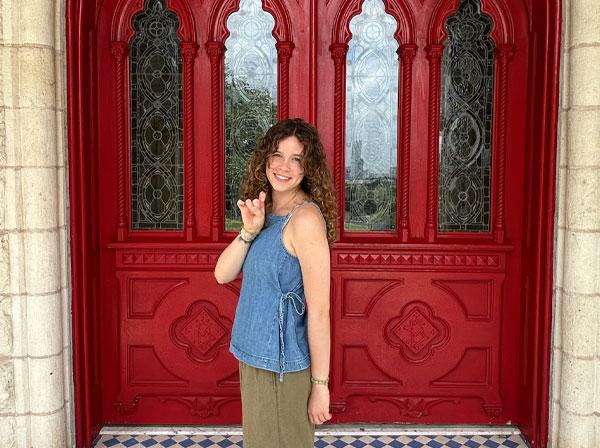
“I know that when I cross that stage and walk out of the red doors, all my hard work will have paid off,” she says. “I will have successfully graduated as a Latina, STEM, CAMP, and first-generation college student. “
Jackson Reyna
Assistant Professor of Practice in Chemistry
B.S. in Chemistry, University of Texas at Austin, '18; Ph.D. in Chemistry, University of Texas at San Antonio, ‘24

When Jackson Reyna accepted his job offer at St. Edward’s University, he was excited to stay close to home and launch his career. As a Hispanic-serving institution, it felt like a place where his background and experiences could help reach his students in a meaningful way.
Now, he’s giving students the tools he wishes he had as a first-generation student.
“It’s hard to explain how lonely it can feel. As a first-gen student, I had to figure out everything on my own: financial aid, picking classes, dealing with tough professors, on top of just trying to grow up and navigate adulthood,” Reyna says. “For the first time in my life, I couldn’t turn to my dad for advice; I had to figure it out. That kind of pressure can be overwhelming.”
After watching his cousin cross the stage at UT Austin, Reyna was motivated to make college his reality. With the love and support of his wife, Melissa, and dog, Mr. Dallas, he earned his Ph.D. in Chemistry. Today, Reyna helps his students navigate college and reach their own goals.
“To me, success means that by the end of the semester, my students enjoy chemistry at least 1% more than when they started. If they leave my class with even a little more curiosity or confidence in chemistry, I know I’ve done my job right,” he says. “Beyond that, success is about making a positive impact, continuing to grow, and supporting my students along the way.”
Ariana Gonzalez
Administrative Coordinator for the USDA NextGen E3 Program
B.A., Universidad Alejandro de Humboldt, Venezuela, ‘19

Ariana Gonzalez’s family always discussed college as something possible. Although they didn’t quite know how to make it possible, they knew they would make it happen.
“I want to tell other first-gen students that it is possible,” she says. “I know it feels unrealistic and hard, but it is possible. Look for resources, programs, and people who want to help. I believe the road it's a little bit easier if you ask for help, and thankfully, there are still people who understand how hard it is for first-gen students and are willing to help.
Although her position at St. Edward’s is not directly related to her major, Gonzalez has spent the past year becoming an illustrator and graphic designer with the small business, Mucho Amor. She’s still figuring things out, but knows she is successful because she gives her best in all she does, and has a community that uplifts her.
“Trust the process, believe in you, be gentle on yourself, and take the time that you need to take,” she says. “¡Sí se puede!”
School of Health Sciences
Nayelly Granillo-Rios '26
B.S., Nursing
Hometown: Espanola, NM

Nayellly Granillo-Rios’ high school counselors, Tobe-Bott-Lyons and Angelica Lopez, introduced her to the Upward Bound Program in New Mexico. Upward Bound is a federally funded educational program for first-generation high school students to help them pursue a college education. Her counselors opened her eyes to attending college out of state and gave her the confidence to take that leap.
“I still think about them often throughout my college experience and how their support helped make all of this possible,” she says.
On the hilltop, she’s found support from Sonia Briseno and Gilbert Contreas in the CAMP and from the nursing faculty. But it can still be difficult to navigate life independently.
“There’s often no roadmap or guidance from family when it comes to things like financial aid, college applications, or even balancing school and personal responsibilities,” she says. “It can feel overwhelming at times, but it also teaches resilience, independence, and the value of hard work.”
In five years, Granillo-Rios hopes to be a pediatric oncology nurse or in the ICU. She also wants to continue her education, working toward becoming a Certified Registered Nurse Anesthetist.
Jesica Naiman
Assistant Professor of Nursing, Simulation & Learning Resource Center Coordinator
B.S.N., Nova Southeastern University, ‘07; M.S.N., University of Wyoming, ‘16; Ph.D., Arizona State University, ‘25

When Jesica Naiman began nursing school, she realized she didn’t have the confidence or roadmap her peers appeared to have, but she kept going. Persistence became her strength, she says. Supported by colleagues and leaders in her field, Naiman was able to combat some of the challenges that come with being first-generation.
“Many first-generation students are navigating complex academic systems for the first time, learning not just course content but also how to learn effectively, manage time, and advocate for themselves,” she says. “This invisible work takes tremendous effort and resilience.”
Today, Naiman is the leader who supports first-generation students by demystifying academic expectations and providing individualized mentorship for each of her students.
“When I see (my students) grow in confidence, find their voice, and connect what they’re learning to real patient care, that’s when I feel most fulfilled,” Naiman says. “Success also means knowing I’m contributing to the forward movement of health science education—helping shape a new generation of compassionate, capable healthcare professionals who will make a difference in the lives of others.”