


A Math Foundation
At St. Edward’s, Mathematics students combine logic, creativity and computational thinking to solve complex problems and explore how math shapes the world around us. Through hands-on learning and close faculty mentorship, you’ll build skills in calculus, statistics, algebra and analysis while preparing for careers in technology, finance, engineering, research and beyond.
Why earn your Math degree at St. Edward’s?
Whatever field you choose to enter as a math major — from urban development to market research to computer technology to accounting to teaching — one thing is certain: The advantages of your St. Edward’s education will prepare you to succeed. You’ll find opportunities in and outside the classroom to learn, give back and achieve your goals. And your mentors will support you every step of the way.
Mentorship and Support
Get to Know Professors
You’ll learn in small classes taught by award-winning professors who make a point of getting to know you and becoming your trusted advisors. They’ll help you identify and focus on your goals, and provide guidance and insight during your college years and after you graduate.
Research
Real World Experience
You’ll engage in faculty-mentored research using the university’s state-of-the-art computer infrastructure, software and data storage, or in full-time, fully funded summer research programs at St. Edward’s or other major universities. And you’ll be encouraged to present your work at conferences and for publication.
Networking
Get involved
The Mathematics Association of America student chapter on campus opens doors to internships, research opportunities, social events, math conferences and career paths in mathematics. You’ll connect with people who love math as much as you do.
Educational Opportunities
Become a Teaching Assistant
Many of our students have the chance have the chance to serve as a teaching assistant for introductory classes and lead study sessions, or be a tutor in the Math Club. You’ll enhance your leadership, communication and people skills — all while helping fellow students learn the material.
Life as a Mathematics Student at St. Edward's University
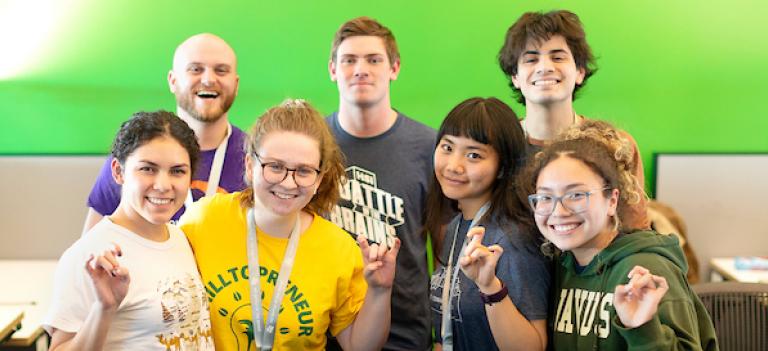
As a Mathematics student at St. Edward’s, you’ll be part of a close-knit community of curious, analytical and creative thinkers who enjoy solving problems and exploring new ideas together. Through small classes, collaborative projects and faculty mentorship, you’ll build strong connections while studying topics like calculus, statistics, analysis and applied mathematics. Beyond the classroom, you’ll find opportunities to engage in research, campus organizations, internships and life on the Hilltop — gaining practical experience, professional skills and a supportive community that helps you grow both academically and personally.
A Highly Successful Math Program
On the Hilltop, you’ll learn through applied problem-solving, faculty mentorship and hands-on experiences that connect mathematical thinking to real-world careers. In Austin’s growing technology, business, engineering and data sectors, Mathematics students develop the analytical skills, adaptability and confidence to solve complex challenges and make an impact across industries.
Preparing for Your Future in Math
At St. Edward’s University, the Mathematics program combines analytical thinking, problem-solving and computational skills with hands-on learning that prepares you for careers in technology, finance, engineering, research, data science and beyond. Through applied projects, collaborative learning, faculty mentorship and real-world experiences, you’ll strengthen your skills in calculus, statistics, analysis and mathematical modeling while building the adaptability and critical thinking needed for a wide range of careers and graduate study opportunities.

Making an Impact: Turning Data Into a Career in Sports
Matilda Sorić ’23, Math, turned her love of math, data and basketball into a career in professional sports. After gaining hands-on experience with the Oklahoma City Thunder and San Antonio Spurs, she now works as a Data Analyst supporting the New York Liberty and Brooklyn Nets — putting data to work in the fast-paced world of professional sports.
Frequently Asked Questions about a Math Degree from St. Edward's University
What You Will Learn and Skills You Will Gain
Our Mathematics degree ensures that you’ll graduate with a strong résumé that showcases your knowledge and skills. Here’s a sample what you’ll learn:
- Refine your critical thinking and problem-solving abilities.
- Deepen your understanding of calculus, modern algebra, physics and statistics.
- Build your programming and computational skills in applied computer science courses.
- Sharpen your skills in oral and written communication.
- Conduct rigorous research independently and in teams.
- Present your research findings in a manner appropriate to the audience, including oral presentations and the writing of experiments, research manuscripts, poster presentations and research proposals.
- Collaborate effectively with peers and professionals.
Experiential Learning
A core component of the St. Edward’s Mathematics program is a three-semester sequence of research courses. In these classes, you’ll conduct open-ended research on unsolved problems individually with faculty members. You’ll present your findings at regional and national professional conferences, where you’ll meet other mathematicians and learn about graduate-school options and careers in your field.
Mathematics majors are encouraged to participate in the William Lowell Putnam Mathematics Competition, the preeminent math competition for undergraduates worldwide. A typical competition involves two 3-hour sessions in which students solve 12 problems. Thousands of math majors nationwide score 0 points every year due to the hyper-strict grading scale, so any positive score is a noteworthy accomplishment. In the past decade, four students from St. Edward’s have earned a positive score on the exam.
Teaching Assistantships
Strong students with an interest in teaching and mentoring can serve as teaching assistants for introductory classes. At St. Edward’s, all classes are taught by professors, but student teaching assistants help tutor and lead study sessions. You’ll expand your communication and people skills by helping other students learn the material. If you’re interested in teaching, you could also become a tutor in the Math Lab.
Research
As part of your coursework at St. Edward’s, you’ll complete three semesters of research. You’ll have the option to further develop this research and present your findings at conferences and for publication. Recently, Mathematics majors have studied the following:
- Mathematical analysis of lottery voting
- Dark energy, the force that causes the universe to expand
- Detecting whether congressional districts are racially gerrymandered
- The effects of storm-related electrical changes on tropospheric ozone levels
Most math majors travel to at least one conference during their time at St. Edward’s. These include:
- Texas Undergraduate Mathematics Conference
- Joint Mathematics Meetings of the American Mathematical Society and the Mathematical Association of America
- MAA Texas Section Meeting
- Mathfest
- National Conference for McNair Scholars and Undergraduate Research
Outstanding students have been selected for Research Experiences for Undergraduates (REU), in which they join the lab of a professor at a major research university over a summer. These experiences help you decide if a research career is right for you. In recent years, Mathematics majors have completed these REUs:
- Deep learning – specifically, teaching computers to identify the content of an image — at the Center for Imaging Science at the Rochester Institute of Technology
- Research in the Mathematical Biosciences Institute Program at Indiana University-Purdue University Indianapolis
You’ll also have the opportunity to contribute to other research projects led by your professors. During Hurricane Harvey, which battered southern Texas in August 2017, several Mathematics majors, along with Natural Sciences professors and staff, collected meteorological data with weather balloons. They released 13 weather balloons that collected data used by the National Weather Services to create forecasts during the hurricane. Some of the students who participated also wrote code to automate the computation of data collected from the balloons and to visually display the data in graphs.
Find what you need to apply and important deadlines. When you are ready, there are three ways for you to apply to St. Edward’s:
Add St. Edward’s to your list of schools if you’re using the Common Application to save time applying to your top colleges.
If you are applying to multiple schools in Texas, you can use ApplyTexas whether you’re a Texas resident or not.
Freshman ApplyTexas Application
It’s easy to apply using our convenient online application.
Students pursuing a degree in Mathematics have two options to choose from. This helpful course map shows the sequence of prerequisites in the department.
1. Bachelor of Arts in Mathematics
This program provides a comprehensive exploration of mathematics that prepares students for advanced programs or professional careers. This option offers more latitude in the choice of general electives and is appropriate for students seeking a double major or minor.
Major Requirements: The BA in Mathematics requires 56–59 hours of Mathematics major courses, including supporting courses in subjects such as Computer Science or Physics.
General Education Requirements: In addition to the major program requirements, all students must satisfy the general education requirements. Talk with your success coach and faculty advisor about which courses are right for you.
View and download the full degree plan for the BA in Mathematics major (PDF).
2. Bachelor of Science in Mathematics
This program includes the same coursework as the Bachelor of Arts in Mathematics but with two additional semesters of laboratory science. This option explores calculus, modern algebra and other advanced topics in their purest form. Additionally, students learn to design and interpret prediction models for diverse industries, such as aeronautics, urban development and green energy.
Major Requirements: The BS in Mathematics requires 67–70 hours of Mathematics major courses, including supporting courses in subjects such as Computer Science, Physics and Biology.
General Education Requirements: In addition to the major program requirements, all students must satisfy the general education requirements. Talk with your success coach and faculty advisor about which courses are right for you.
View and download the full degree plan for the BS in Mathematics major (PDF).
Questions about placement into Mathematics courses? Refer to our placement guide for more information.
Additional Program Offerings
The Department of Mathematics also offers a Bachelor of Science in Applied Data Science, minors in Mathematics, Statistics and Physics, a certificate in Data Analysis, and a dual degree option in Mathematics and Engineering.
Students minoring in Mathematics must satisfactorily complete the following courses in addition to 9 hours of electives:
Required Courses:
- Calculus I
- Calculus II
- Calculus III or Discrete Mathematics
Elective Courses:
- Linear Algebra
- Differential Equations
- Inquiry and Proof
- Introduction to Mathematical Statistics
- Probability Theory
- MATH 3000+ upper-division courses (excluding 4150 and 4157)
Are you a current student? Contact your advisor for the next steps in declaring your major or minor.
Internships
You’ll also be encouraged to complete an internship to apply your mathematical skills in a professional context. Mathematics majors have recently interned at the following organizations:
- Exxon
- Molecular Rebar Design
- The Nature Conservancy
- National Ecological Observatory Network
- Department of Homeland Security STEM Summer Internship Program
- Society for Industrial and Applied Mathematics
- SpaceX
As a student in the Mathematics program, you are afforded access to the funding programs, including paid internships, offered exclusively to STEM students at St. Edward’s University by the Institute for Interdisciplinary Science (i4). For more information on these programs please visit the Institute for Interdisciplinary Science (i4) on the web.
Student Organizations
The St. Edward’s Math Club is a student chapter of the Mathematics Association of America. Members have traveled together to regional mathematics conferences, presented math concepts and helped with science fairs at local schools, and participated in the global MegaMenger collaborative fractal build. The club also hosts student and alumni research talks and serves as a forum for social events like Halloween pumpkin carving, bowling, laser tag and pizza parties.
The St. Edward’s Maker Club attracts tinkerers and programmers who have worked on projects involving 3-D printing, soldering, programming LED strips, sewing, laser cutting, vinyl cutting, button-making, and other creative endeavors.
At St. Edward’s, our faculty are outstanding scholars, thought leaders, teachers and mentors who bring energy and enthusiasm to our vibrant learning community. They take pride in getting to know you, helping you achieve your goals and celebrating your successes.
View a list of our faculty members and their contact information on the Department of Mathematics webpage.