


Make Real Change
A Political Science degree from St. Edward's University prepares you to understand how governments, institutions and communities work—and how you can help shape them. You'll study politics at the local, national and global levels while developing the critical thinking, research, writing and public speaking skills needed to lead with confidence.
Why earn your Political Science degree at St. Edward’s?
Whether you're interested in public service, law, diplomacy, public policy or political advocacy, you'll graduate ready to make a meaningful impact wherever your career takes you.
Study Politics Where It Happens
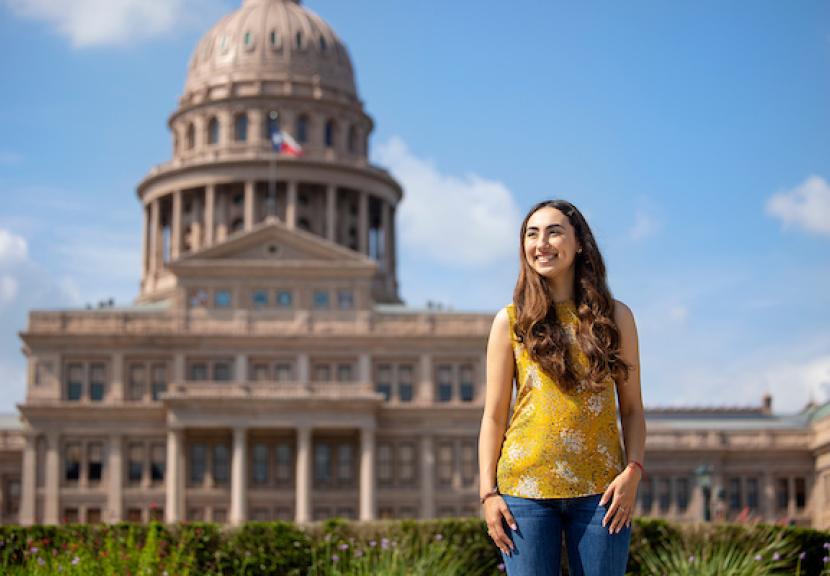
Austin is an ideal location for the study of politics. As the capital of Texas, the city gives you direct access to the state legislature, state agencies, nonprofit organizations, advocacy groups and elected officials. Internships and legislative experiences put you at the center of the policymaking process.
Develop a Global Perspective
At St. Edward's, you'll study political systems outside the United States and address challenges that cross borders. Study abroad programs put you on the ground in other countries, while faculty with international expertise connect classroom work to real-world global dynamics. You'll graduate with a perspective that reaches well beyond Austin.
Learn from Faculty Who Challenge and Inspire
Small class sizes mean you'll build meaningful relationships with professors who are accomplished scholars, mentors and advisors. They'll help you refine your interests, connect classroom learning to real-world experiences and prepare for graduate school, law school or your first career after graduation.
Build Your Network for What's Next
Every Political Science major completes at least one internship, giving you valuable professional experience before graduation. Students have interned with congressional offices, the Texas Legislature, nonprofit advocacy organizations, political campaigns and public policy groups, building connections that open doors to careers across the country.
Life as a Political Science Major at St. Edward's University
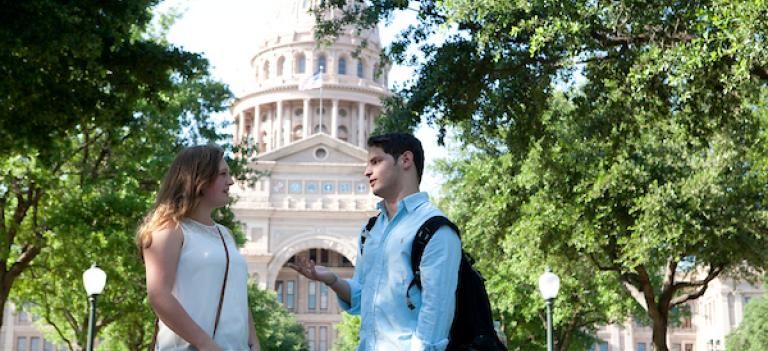
One day you might be attending committee hearings at the Texas Capitol. The next, you'll debate constitutional issues in class, interview public officials for The Civics Lab podcast or intern with a nonprofit working to influence public policy. Along the way, you'll collaborate with classmates who share your passion for leadership and social change while learning from faculty who encourage thoughtful discussion and diverse perspectives.
You'll graduate not only understanding how political systems work—but also how to help improve them.
A Highly Successful Political Science Program
Frequently Asked Questions about a Political Science degree from St. Edward's University
What You Will Learn
- How to critically analyze political institutions and processes at the local, national, and international levels using social science theories and evidence-based reasoning
- How to research, assess, and synthesize information to solve real-world political and policy problems
- How to communicate complex political and social issues clearly and persuasively in writing and speech, for professional and public audiences
- How to evaluate political questions through multiple ethical and cultural perspectives, with an understanding of the responsibilities that come with civic and professional life
Scholarships, Conferences and Summer Institutes
Political Science majors have been selected for many competitive learning opportunities domestically and abroad. They include:
- The Benjamin A. Gilman International Scholarship, sponsored by the State Department, which offers grants to undergraduates to study or intern abroad in locations including Chile, Brazil and Morocco.
- The State Department Critical Language Scholarship, an intensive overseas language and cultural immersion designed to expand the number of Americans mastering foreign languages that are critical to national security and economic prosperity.
- The Public Policy and International Affairs Junior Summer Institute at Carnegie Mellon University, a highly competitive seven-week program that trains students in the quantitative, analytical and communication skills they’ll need to study public policy in graduate school and enter a career that serves the public good.
- The highly selective Harvard Kennedy School Public Policy Leadership Conference, which introduces students to graduate programs in public policy at Harvard.
- The John Jay Fellows Program in Philadelphia, a semester-long leadership development program based on Christian principles that prepares participants for careers in public service.
Find what you need to apply and important deadlines. When you are ready, there are three ways for you to apply to St. Edward’s:
Add St. Edward’s to your list of schools if you’re using the Common Application to save time applying to your top colleges.
If you are applying to multiple schools in Texas, you can use ApplyTexas whether you’re a Texas resident or not.
Freshman ApplyTexas Application
It’s easy to apply using our convenient online application.
Major Requirements: The Bachelor of Arts in Political Science requires 42 hours of major courses. Students complete 21 hours of core courses and 21 hours of political science electives from the following areas of study: American Politics, Political and Civic Engagement, International Politics and Pre-Law.
General Education Requirements: The degree requires 45 hours of general education courses that students complete over four years in addition to their major courses and electives.
Certificates: Students will have the opportunity to complete two certificates in Political Science. The “Certificate on Law, Policy and Politics” allows students to explore the relationship between the legal and political realms. The “Certificate on International Security and Geopolitical Risk Analysis” allows students to explore transnational issues of interest to governments and employers.
View and download the full degree plan for our Political Science major (PDF).
A few examples of courses students in this major take:
- Politics and the Media – explore how public officials, political campaigns, and interest groups attempt to influence media coverage.
- Civil Rights and Liberties – examine the way the U.S. Constitution protects individual rights in the context of competing claims by various groups and interests.
- Strategic Intelligence and Covert Action – delves into the role the intelligence community plays in American foreign relations.
Yes. Students interested in pursuing a role in law or government can enhance their knowledge and skill sets with a Political Science minor. Students must complete the 18 hours of required coursework.
Required Courses:
- American National Government
- International Relations
- Comparative Politics
- Any three upper-division Political Science courses
What do our graduates do?
Political Science majors go on to a variety of careers and graduate schools from St. Edward’s. Here’s a sample.
- Foreign service officer for the U.S. Department of State
- Judicial law clerk at Court of Appeals for the First District of Texas
- Asylum and immigration attorney
- Health policy and advocacy director for Young Invincibles
- Director of marketing for FILA North America
- Trial attorney for the U.S. Department of Housing and Urban Development
- Data Analyst for the Center on Budget and Policy Priorities
- Law students at The University of Texas at Austin, the University of Pennsylvania and George Washington University
- Graduate students at the Elliott School of International Affairs at George Washington University, Georgetown University, New York University, and Stanford University.
Internships
Every Political Science major completes at least one internship, but you’ll be encouraged to go beyond that requirement to expand your education. Students recently have interned with these organizations:
- No Labels, a Washington, D.C.-based organization that supports nonpartisan problem solving
- Office of Austin Mayor Steve Adler
- Office of U.S. Representative Lloyd Doggett
- Office of State Rep. Oscar Longoria
- Office of former Colorado Governor John Hickenlooper
- Office of Texas Governor Greg Abbott
- Beto O’Rourke Senate Campaign
- Texas Public Policy Foundation
- Texas Senate Finance Committee
- Equal Justice Center, a nonprofit law firm
- Workers Defense Project
- Foley & Lardner LLP
- Generation Citizen, a nonprofit that teaches middle- and high-school students civic participation and engagement strategies
- Mighty Citizen, a local marketing agency focused on promoting community-impact organizations
- Annie’s List
- Caritas of Austin
- Texas Democratic Party
- Congressional Hispanic Caucus Institute in Washington, D.C.
- Public Citizen, a nonprofit consumer advocacy organization
- Make-A-Wish Central and South Texas
Yes. With our Accelerated Graduate Pathways, you can complete your BA in Political Science and one of four master’s degrees in as little as five years, saving time and money. See details and requirements.
- Political Science to Master of Business Administration (MBA)
- Political Science to MS in Business Analytics and Applied AI
- Political Science to MS in Digital Marketing and Analytics
Success coaches and academic advisors guide you through undergraduate and graduate courses to maximize benefits.
At St. Edward’s, our faculty are outstanding scholars, teachers and mentors who bring energy and enthusiasm to our vibrant learning community. They take pride in getting to know you, helping you achieve your goals and celebrating your successes.
View a list of our faculty members and their contact information on the Department of Political Science, International Affairs, and Environmental Science and Policy webpage.

Making an Impact
Political Science alumnus and Journalism minor Jacob Sanchez ’16 combined his interest in civic life with a passion for telling stories that matter. At St. Edward’s, he developed his skills inside and outside the classroom, leading the student newspaper Hilltop Views and completing internships with The Texas Observer and The Texas Tribune.
After graduation, Jacob began his career covering local news before joining the nonprofit newsroom Fort Worth Report as an education reporter. His in-depth reporting on issues affecting schools and communities has earned recognition from the Texas Managing Editors.
By pairing political science with journalism, Jacob built a foundation for understanding the institutions and policies that shape people’s lives — and for asking the questions that help communities better understand them. Today, he continues to pursue the work he discovered he loved at St. Edward’s: reporting stories that shine a light on K–12 education.