A Student Scientist on the Front Lines of Climate Resilience Research at St. Edward’s Living Lab
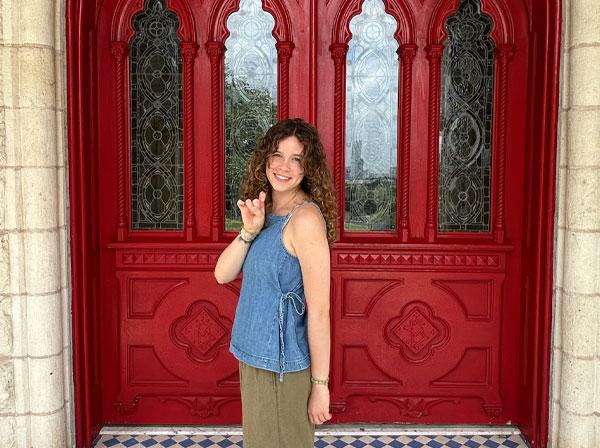
Walk across the hilltop, and you might find Janiece Jefferson ’25 checking on new plots of young trees scattered across campus. As the inaugural Climate Resiliency Living Lab intern, Jefferson tracks how well different species can withstand the extreme weather that Austin has grappled with in recent years.
Building Austin’s Climate Resiliency Through Tree Research
The Living Lab has two goals: to develop a list of climate-smart tree species and best practices for their care in Austin’s increasingly unpredictable climate, and to share that knowledge in hopes of expanding the tree canopy on the St. Edward’s campus and in Austin neighborhoods.
“I always wanted to make a meaningful impact in my community, and this project absolutely allows me to do so,” says Jefferson, an Environmental Science and Policy major.
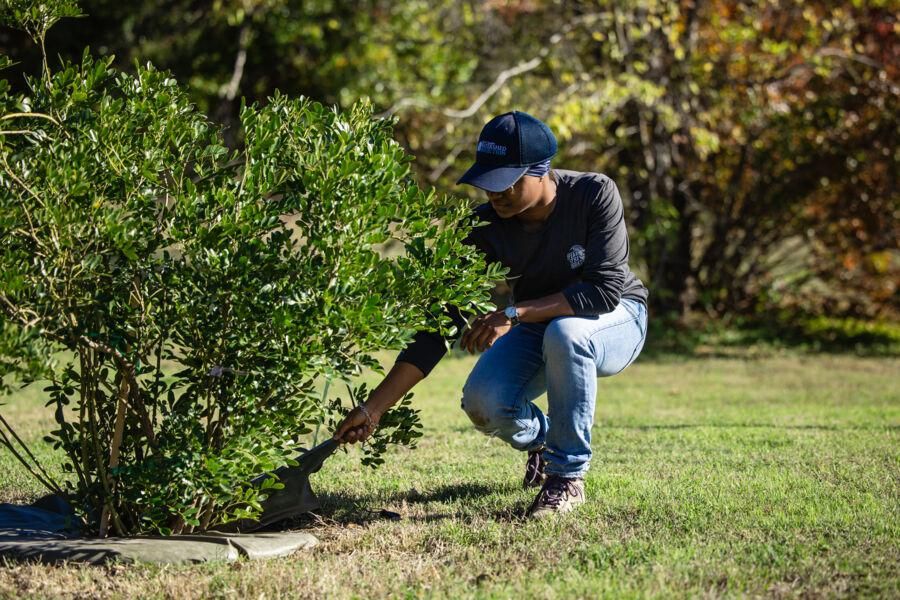
The lab, nicknamed CLI-RES, launched in 2023, amid the loss of mature trees on campus. In summer 2024 alone, crews took down 10 mature trees, all damaged by recent ice storms, cold snaps, record heat and droughts, says Jim Morris, associate vice president of University Operations. As the resident tree expert, Roy Johnson, campus arborist and sustainability coordinator, helps determine which species are selected for the project and develops care plans for the trees.
Amy Concilio, associate professor of Environmental Science and Policy, coordinates student research efforts and leads the collection and interpretation of data. Steven Fletcher, associate professor of Environmental Science and Policy, heads up community outreach and will be designing project-related K-12 rubrics for Austin teachers to use in their classrooms.
Grants Supporting Urban Forest and Climate Research
The cost of the new trees was covered partly by a $29,000 urban forest grant from the Austin Community Foundation. An innovative studies grant from St. Edward’s provided funding for electronic tree tags that log data every five minutes, allowing researchers to remotely monitor tree health.
The full scope of the project is still developing, and plans are in the works to add more trees and seek out support from additional grants. The results also will take time to percolate as researchers track how the trees fare through the various seasons and over time.
Hands-On Data Collection for Environmental Science Students
By Fall 2024, teams of faculty, staff, students and community volunteers had planted 90 new trees on the hilltop, including new plots in the East Woods, 22 relatively untouched acres on the east side of campus that St. Edward’s recently opened for classes and experiential learning.
The campus currently is “heavily loaded” with live oaks, Morris says. The project brings more biodiversity to the hilltop, and plots include different native or adapted trees that aren’t commonly found on campus.
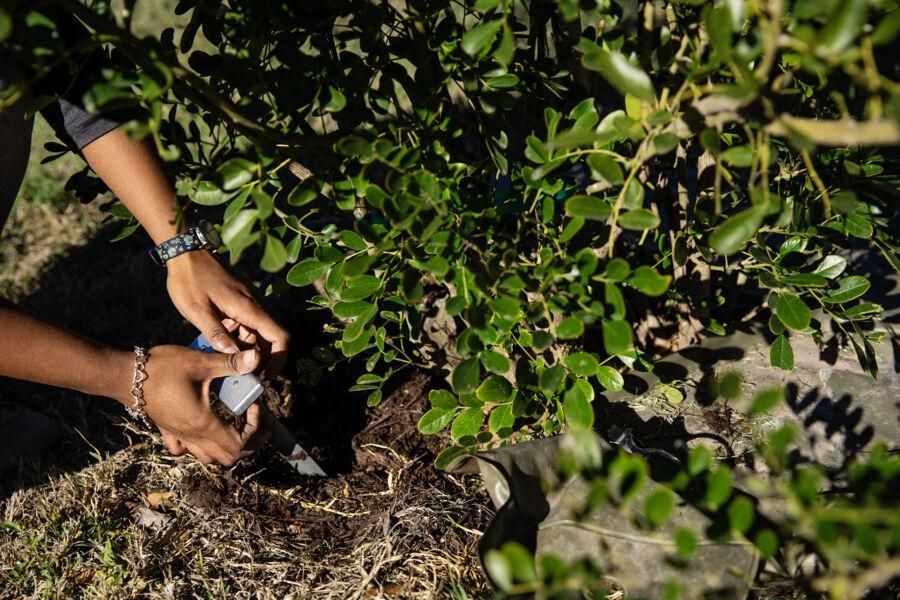
On her visits to each plot, Jefferson gathers data including the trees’ height and trunk thickness and the temperature, moisture level, conductivity, compaction and density of the soil. “It doesn’t feel like work to me,” she says. “I enjoy being outside. I enjoy collecting data for a project that’s much bigger than me and that will last long after I graduate.”
For his part, Morris is thrilled about the project’s climate resiliency and environmental justice benefits: building a list of resilient trees and proven strategies for their care, keeping campus leafy into the future, and bringing more urban tree cover and cleaner air to Austin, particularly in underserved neighborhoods on the east side.
“The St. Edward’s strategic plan states that we want to be leaders in environmental justice; we want to promote experiential learning; and we want to promote community outreach,” Morris says. “With this effort, we are able to do all of those things.”

St. Ed’s Magazine
This story was first published in the St. Edward’s University Magazine. Our magazine shares stories about the people, places and experiences that define the university's Holy Cross education.