

Menu
School of Arts and Humanities
School
Off
Academic Department
On
Administrative Department
Off

Bilingual Health Communication

Ornate door
Program Snapshot
Program Type
Bachelor of Arts
Department
Communication

Become a Skilled Healthcare Communicator and Leader 

The Bachelor of Arts in Bilingual Health Communication program equips you with the essential Spanish language, communication and cultural awareness skills to help meet today’s critical need for bilingual professionals in health-related fields.

In the healthcare professions, health communication and culturally competent leadership are at the heart of improving lives. As a student in the Bilingual Health Communication program at St. Edward’s, you’ll learn how to craft impactful messages that inform and empower individuals and communities to achieve better health. 

Our BA in Bilingual Health Communication is one of only a few undergraduate programs in the U.S. that combines a modern language with health communication. This program’s specialized Spanish language curriculum builds skills and confidence that enhance healthcare careers and outcomes. 

You’ll expand your oral and written proficiency, sharpen your dialect awareness and improve your ability to discuss complex topics, such as mental health, rehabilitation and wellness. You’ll master domain-specific vocabulary related to diseases, health practices, health literacy, medical terminology, healthcare settings and the rich Latinx sociocultural context.

 

test

Reap the Rewards of Austin

Austin is home to many healthcare organizations, nonprofits, government agencies and advocacy groups that work to address social issues for minorities, including healthcare education and access. With a substantial Spanish-speaking population in Texas, expertise in bilingual health communications is in high demand. Explore career paths and practical application of your studies through internships and interactions within the greater Austin community. 

Healthcare Adds More Jobs Than Any Other Industry

Overall employment in healthcare occupations is projected to grow much faster than the average for all occupations from 2023 to 2033. Approximately 1.9 million openings are projected each year due to employment growth and the need to replace workers who leave their occupations permanently.
U.S. Bureau of Labor Statistics 

Nursing instructor with student in classroom

What do our graduates do?

The BA in Bilingual Health Communication program allows you to master effective communication in both Spanish and English and harness the rich bilingual and bicultural strengths of our St. Edward’s community. 

Our graduates enter meaningful careers in fields where they craft impactful health campaigns, empower patients through education, navigate the complexities of health administration, or shape healthcare policy and advocacy. Aligned with our mission to create a more just and humane world, our graduates’ work fosters healthcare equity and access for everyone.

A Pathway to Advance Your Career

The BA in Bilingual Health Communication opens doors to exciting opportunities and pathways to graduate studies. With this degree, you can seamlessly transition into an Accelerated Graduate Pathway program at St. Edward’s, such as:

New graduate programs will be available in our School of Health Sciences in the near future. These programs will include: 

  • Master of Science in Physician Assistant Studies
  • Master of Science in Administrative Health Systems
  • Doctorate in Occupational Therapy
  • Master of Health Services

Explore details about the BA in Bilingual Health Communication

The Bilingual Health Communication degree is a 30-hour hybrid program that blends in-person and online classes. Students beginning the degree will have advanced proficiency in Spanish as evidenced by either placement test scores, credit-by-exam (AP/IB/CLEP) or prior coursework.

All students interested in this degree, but who have not yet reached the advanced level, are encouraged to consult with their academic advisor or the Chair of the Department of Languages, Literatures and Cultures to create a plan for reaching advanced proficiency. This could require anywhere from 3 to 18 hours of additional coursework, depending on the student’s level of proficiency.

Flexibility for Nontraditional and Transfer Students
Some communication courses are offered in online classes and have equivalencies with ACC and other community colleges, and many courses in the major do not have prerequisites. Check with your academic advisor for details. 

View details on each course in the Undergraduate Bulletin (PDF).

Required Core Courses (21 hours)

  • Spanish for the Health and Helping Professions – SPAN 3355 (3 hours)
    • Prerequisites: A score of 550+ on the placement test or equivalent credit-by-exam (AP/CLEP/IB) or completion of SPAN 3330 or SPAN 3341. Students who meet the prerequisites may begin the program.
  • Spanish for Healthcare Professionals and Latino Health in the U.S. – SPAN 3357 (3 hours)
    • Prerequisite: A score of 550+ on the placement test or equivalent credit-by-exam (AP/CLEP/IB) or completion of SPAN 3330 or SPAN 3341.
  • Introduction to Translation and Interpretation – SPAN 4305 (3 hours)
    • Prerequisite: A score of 700+ on the placement test or equivalent credit-by-exam (AP/CLEP/IB) or completion of SPAN 3330 or 3341 or 3355 or 3357.
    • General Education Span 4305 is currently designated as a writing-rich course.
  • Introduction to Communication – COMM 1306 (3 hours)
    • Prerequisite: Freshman or sophomore standing only, or permission of instructor
  • Health Communication – COMM 3308 (3 hours) (Fall and Spring)
  • Applied Health Communication – COMM 4383 (3 hours)
  • Internship in Communication – COMM 4350 (3 hours)
    • Prerequisites: Communication Core, sophomore, junior or senior standing, and permission of instructor. (Fall and Spring)
    • General Education: Culminating Experience

Required Electives (9 hours)

Choose at least one from Communication and one from Spanish/Comparative Language, Literature and Culture, and Chicanx-Latinx Studies.

  • Interpersonal Communication – COMM 2312 (3 hours)
    • General Education: Social Identities
  • Organizational Communication – COMM 2327 (3 hours)
    • General Education: Social Identities
  • Active Listening – COMM 2357 (3 hours)
    • General Education: Social Identities
  • Intercultural Communication – COMM 3344 (3 hours)
    • Prerequisite: Sophomore standing or permission of instructor
    • General Education: Global Perspectives and Social Identities
  • Leadership – COMM 4316 (3 hours)
  • Spanish Grammar in Context – SPAN 3330 (3 hours)
    • Prerequisite: Placement score of 700 and above or completion of a course at 3000 level with grade of C or better. (Fall)
    • General Education: Social Identities
  • Effective Written Communication – SPAN 3341 (3 hours)
    • Prerequisite: Placement score of 700 and above or completion of a course at 3000 level with a grade of C or better.
    • General Education: Writing Rich
  • Internship in Advanced Spanish for the Health and Helping Professions – Span 4363 (3 hours)
    • Prerequisite: SPAN 3355 or SPAN 3357
  • Introduction to Language and Culture – CLLC 1310 (3 hours)
    • General Education: Global Perspectives
  • Introduction to Chicanx and Latinx Studies – CHLX 1302 (3 hours)
    • General Education: Diverse American Perspectives and Social Identities

The Bilingual Health Communication program prepares you to become a leader in providing and advancing healthcare literacy and culturally competent care. You’ll engage in dynamic coursework and practical assignments such as these that strengthen your bilingual proficiency and communication skills:

  • Reflect critically on the role of communication in molding healthcare messages and the public’s reception of these messages.
  • Analyze the health messaging requirements and interests of culturally diverse stakeholders.
  • Design, critique and assess health communication messages and campaigns utilizing a variety of communication tools.
  • Produce a translation in Spanish that demonstrates knowledge of structural, lexical and cultural differences between English and Spanish and demonstrates mostly consistent control of Spanish grammar and syntax.
  • Produce a health communication message or campaign in the target language via an oral presentation that conveys sensitivity to the sociocultural context of diverse populations in Texas and the U.S.
  • Write an informative essay in Spanish, sustained by research, that reflects the health messaging requirements and interests of culturally diverse stakeholders.

The ability to communicate in more than one language enhances career prospects for graduates of our Bilingual Health Communication program and, more importantly, improves the quality of patient care. Career paths include a range of professional settings such as these: 

  • Public Relations
  • Advertising
  • Patient Education
  • Health Administration
  • Social Media
  • Healthcare Policy and Advocacy
  • Community Health
  • Medical Interpretation and Translation

Questions?

For additional information about the BA in Bilingual Health Communication, please contact us. We welcome hearing from you and telling you more about our program!

Stephen King, PhD
Professor of Communication
512-428-1090
sking1@stedwards.edu

Georgia Seminet, PhD
Associate Professor of Spanish
512-448-8565
georgias@stedwards.edu
Leadership and Ethics

Ornate door

Prepare to Be a Moral and Ethical Leader in Todays Complex World

Learn to lead with integrity, communicate effectively, and build and maintain thriving organizations and communities with a Certificate in Leadership and Ethics from St. Edward’s.   

We live in a world in which organizational leaders constantly face ethical decision-making challenges. Designed with an interdisciplinary approach, the Certificate in Leadership and Ethics instills an understanding of why and how an ethical mindset is critical to being an effective leader.

In this certificate program, you’ll examine and evaluate theories, strategies and principles of ethical leadership that include leader-mentor relationships, motivation, teamwork, power, trust and negotiation. Coursework combines the analytical study of ethics with the communication skills required to be leaders in the modern workplace.

The Certificate in Leadership and Ethics can be earned while pursuing your undergraduate degree. This credential is a valuable, mission-driven addition to any major that enhances your appeal to employers.

To complete the 12-hour Certificate in Leadership and Ethics, students must complete two required courses and two elective courses.

Required Courses:

  •  Leadership – COMM 4316 
  • One (1) upper division course in Ethics taught by the Philosophy Department, not including the ethics course the student uses to satisfy the General Education Curriculum requirement. (Any 3000 or 4000 level course taught by the Philosophy Department with “Ethics” in the title or otherwise approved by the Philosophy Department Chair will fulfill this requirement.)

Elective Courses:

Select two courses from the following list:

  • Organizational Communication – COMM 2327  
  • Teams, Collaboration and Community – COMM 3339 
  • Directed Readings – PHIL 4341 
  • Senior Seminar – PHIL 4342 
  •  Organizational Behavior – MGMT 3334
  • The Art and Science of Negotiation – BUSI 3324 

For more details and course descriptions, view and download the Undergraduate Course Bulletin (PDF).

For information about the Certificate in Leadership and Ethics, contact Mark Cherry, PhD, chair of Philosophy, or Stephen King, PhD, chair of Communication.

Health Communication (Minor)

Ornate door

Inspire Individuals to Heed and Use Health Information

As a Health Communication minor, youll study audiences and their behaviors related to health practices to determine the format and frequency of messaging.

Students with an education in health communication can enter jobs in public relations, advertising, patient education, health administration, social media, healthcare policy and advocacy, community health, and other related fields.

Minor Requirements

Required Courses (6 hours required)

  • Introduction to Health Communication – COMM 3308 
  • COMM 4383 Applied Health Communication – COMM 3308 

Electives (12 hours required; at least 3 hours must be +3000)

  • Interpersonal Communication – COMM 2312 
  • Nonverbal Communication – COMM 2322  
  •  Persuasion – COMM 2326
  • Organizational Communication – COMM 2327 
  • Active Listening – COMM 2357 
  • Social Media for Public Relations – COMM 3309 
  • Teams, Collaboration and Community – COMM 3339 
  • Intercultural Communication – COMM 3344 
  • Native American and Chican@x Communication – COMM 3345 
  • Family Communication – COMM 3346 
  • Sports Communication – COMM 3372 
  • The Dark Side of Interpersonal Communication – COMM 3374 
  • Public Relations for Nonprofit Organizations – COMM 4326 
  • Internship (in Health Communication) – COMM 4350 
  • Lying and Deception – COMM 4356 
  • Special Topics in Health Communication – COMM 4390 
  • General Psychology – PSYC 2301 
  • Adolescent Psychology – PSYC 2307 
  • Self and Society – SOCI 1301 
  • Social Welfare: Historic Response to Need – SOCI 2318 
  • Concepts of Physical Fitness and Wellness – KINE 2344 

Total Hours: 18

For more information about this minor and course descriptions, view and download the Undergraduate Bulletin (PDF).

UNDERGRADUATE

Communication

Ornate door
Program Snapshot
Program Type
Bachelor of Arts
Department
Communication

Bring Meaning and Clarity to Complex Situations with a BA in Communication

Prepare for a creative career in one of the most popular majors in the country.

Employers consistently rank communication skills at the top when making hiring decisions.

Why earn your Communication degree at St. Edward’s?

Located in the heart of Austin, there are ample opportunities to gain hands-on experience and apply your communication skills. Our faculty creatively integrate their scholarly research, public engagement, and expertise in communication with a wide range of interests and disciplines in their work with students.

Public Relations Student Society of America (PRSSA)

The Public Relations Student Society of America is all about making connections. Our PRSSA chapter provides out-of-the-classroom experiences that give students enhanced knowledge of the public relations field.  Members have access to exclusive internships and job postings, networking events with local professionals, personalized agency and corporation tours and fun social events.

Lambda Pi Eta (LPH)

Lambda Pi Eta is the National Communication Association’s official honor society at four-year colleges and universities. With more than 450 active chapters nationwide, LPH recognizes, fosters and rewards scholastic achievement, stimulates interest in the field of communication, and promotes professional development and interest in graduate studies among communication majors.

test

Reap the Rewards of Austin

And Austin is the perfect place to be a Communication major. Our students intern at places like Livestrong, Margin Walker Presents, ACL, SXSW, and the Austin Film Society.

What will you learn?

As a Communication major, you’ll begin by studying the principles of communication, but you’ll also become adept at applying them — so you can take your skills to a Fortune 500 company, fledgling nonprofit or buzzing startup.

A few examples of courses students take in the major:

  • In Public Relations for Nonprofit Organizations, you’ll learn the public relations process by creating your own project for an Austin client.
  • In Communication and Popular Culture, you’ll analyze a pop-culture event occurring in the Austin community.
  • In Rhetoric and Public Memory, you’ll study monuments and memorials around campus and around Austin. You’ll analyze what they communicate about the population’s values and power structure.

What skills will you gain?

Upon completing the Communication program, you’ll be ready to…

  • Gain the ability to craft compelling narratives that resonate with diverse audiences.
  • Participate actively in the communication revolution, wielding the power of narrative to navigate the complexities of the modern world and drive positive change.
  • Listen and speak effectively, embrace multiple viewpoints, and discover shared values.
  • Understand human connections and relationships.
  • Analyze persuasive communication’s role in driving positive change by examining impactful speeches, influences and media trends in public relations and advertising.
  • Use persuasive techniques, message crafting and audience analysis to navigate our interconnected world.
  • Critically examine language, imagery, symbols and media’s influence in shaping perception and societal change through critical media studies.
  • Actively shape contemporary discourse and communication practices.

What do our graduates do?

Communication majors go on to a variety of careers (PDF) and graduate schools from St. Edward’s. Here’s a sample:

  • Launched a growing nonprofit for hearing and vision screenings
  • Landed the prestigious Alfred Fleishman Diversity Fellowship at FleishmanHillard
  • Emmy Award winner for coverage of a Pittsburgh water main break that grew into a water crisis
  • Technical writer at leading employment search engine and Austin company Indeed
  • Director of Marketing and Communications for a Bay Area nonprofit
  • Broker for a real estate investment firm
  • Created a cancer foundation to provide financial support to families impacted by cancer
  • Co-wrote and co-directed a film which earned a Grand Jury award at SXSW
  • Movie prop master in New York City
  • Law school graduate
  • Marketing executive in the music industry

Explore Details About the BA in Communication

Degree Plan

Major Requirements: Bachelor of Arts with a major in Communication requires 45 hours of major courses. Students complete five “core” communication courses, totaling 15 hours. Students will also choose from one of four concentrations totaling 30 hours.

  • Public Relations and Advertising
  • Relational Communication
  • Critical Media Studies
  • Communication Influence and Diversity

General Education Requirements: The Communication degree requires 43 hours of general education courses that students complete over four years in addition to their major courses and electives.

View and download the full degree plan for our Communication major (PDF).


Get involved with student productions in whatever medium interests you most.

  • Hilltop Views, the weekly student newspaper, is published both in print and online. Student journalists report news from the campus and greater Austin community. You can get involved as early as your freshman year as a writer, editor, photographer or designer.
  • Sorin Oak Review is a literary magazine that showcases the poetry, prose and artwork of St. Edward’s students. Working on the editorial staff is a great way to gain experience in project management and the practical details of putting together a publication.
  • Arete is a student-produced academic journal that publishes student-written research, nonfiction essays and commentary. Editors choose from among the dozens of submissions to create a cohesive journal that represents a variety of perspectives.
  • New Literati publishes both creative and academic work.
  • B. Hooved is the student humor journal, inspired by our Hilltopper goat mascot.
  • Topper Radio is the student-run radio station.
  • Topper Studios is the digital media club. Members are involved in creating podcasts, YouTube channels, short films, music videos and comedy sketches, and helping their fellow students produce digital content. Students in Topper Studios also frequently make promotional videos for other clubs at St. Edward’s.

The Digital Media Center in the Munday Library is a resource for creating your own content and learning new skills. Here, you can produce and edit videos, podcasts and visual design projects with the help of your fellow students. The lab is equipped with top-of-the-line computers running the latest software including the Adobe Creative Suite. It also has a group editing/podcasting room, a green screen room and a “whisper room” used for voiceovers. If you are skilled at software, hardware repair, graphic design or video editing, you can apply to work in the lab as a digital media specialist. 

The Communication minor is designed as a broad-based introduction to the discipline of Communication as well as an opportunity for students to explore—in more depth—a specific concentration. Students who wish to earn a Communication minor must take the following coursework, totaling 18 hours.

Required Courses

  • Introduction to Communication – COMM 1306 
  • Interpersonal Communication – COMM 2312 

Elective Courses

Choose 12 elective hours in communication; at least nine of these hours must be level 3000 or higher.

Are you a current student? Contact your advisor for next steps in declaring your major or minor. 

The Communication department offers a minor in Health Communication. For more information, please view the Health Communication minor webpage.

At St. Edward’s, our faculty are outstanding scholars, thought leaders, teachers and mentors who bring energy and enthusiasm to our vibrant learning community. They take pride in getting to know you, helping you achieve your goals and celebrating your successes.

View a list of our faculty members and their contact information on the Department of Communication webpage.

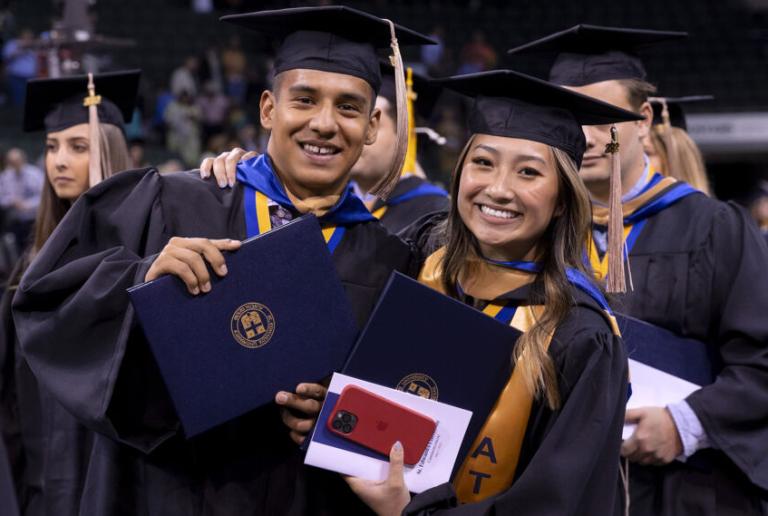
St. Edward's graduates in cap and gown show off their diplomas

Earn Two Degrees in Five Years

With our Accelerated Graduate Pathways, you can complete your BA in Communication and master’s degree in as little as five years, saving time and money. See details and requirements.

Adjunct Faculty
Phone:
Office: Premont Hall 307
Email Lance Bennett
Assc Prof of Practice Public Relations/Adv
Phone:
Office: Holy Cross Hall 310
Email Nancy Reiter-Salisbury
Subscribe to Communication