

Menu
School of Arts and Humanities
School
On
Academic Department
Off
Administrative Department
Off

UNDERGRADUATE

Writing and Rhetoric

Ornate door
Program Snapshot
Program Type
Bachelor of Arts
Department
English

Harness the Power of Words with a BA in Writing and Rhetoric

Express yourself and make a positive impact on your community through language. 


Why earn your Writing and Rhetoric degree at St. Edward’s?

Austin is packed with opportunities for strong writers. Intern with an award-winning advertising agency, a policy research organization that’s analyzing bills during the Texas legislative session, or one of the many publications that cover news and profile the capital city’s incredible characters. You’ll also learn from experienced, passionate, and invested faculty whose work has appeared in professional journals, short-story collections, books, newspapers and more. 

Learn from published authors

Hosted by the School of Arts and Humanities, the Marcia Kinsey Visiting Writers Series brings poets, novelists, playwrights and essayists to campus to read from their work and talk with students about the process of writing. Previous visiting writers include Pulitzer Prize winner Jericho Brown, Jonathan Safran Foer, Naomi Shihab Nye, and many more.

Collaborate with avid readers

A fully student-run organization, The Book Jackets Literary Club gathers students to share conversation about books and writing ideas. Students also gather to read and perform each other’s work and invite speakers to discuss internship and job opportunities for literature and writing majors. The club also shares information about upcoming literary events on campus and at local bookstores.

Get published on the hilltop

If you have a love for poetry and prose, a desire to report news, or an itch for comedy writing, there’s likely a publication on the hilltop waiting for you! Submit a piece to or join the editorial staff of Sorin Oak Review, St. Edward’s literary magazine that showcases the poetry, prose and artwork of the students. Arete is the student-produced academic journal that publishes student-written research and nonfiction essays. Inspired by our Hilltopper goat mascot, B. Hooved is the student humor magazine and is often featured in the student newspaper, Hilltop Views. The award-winning print and online newspaper welcomes creatives from all over campus.

test

Reap the Rewards of Austin

You’ll have ample opportunities to intern in the book publishing world, in media, and on communications teams for businesses and nonprofits. St. Edward’s students have recently interned at the Texas Book Festival, KUT Radio, Community Impact Newspaper, Texas Monthly, Austin Chronicle, KXAN-TV, The Writing Center, Austin Film Festival and many more. 

What do our graduates do?

Writing and Rhetoric majors go on to a variety of careers and graduate schools from St. Edward’s. Here’s a sample:

  • Technical writer at Amazon Publisher Services
  • Communication chief in the Dallas Mayor’s Office
  • Content strategist for IBM
  • Information specialist for the American Cancer Society
  • Graduate student at the Newhouse School of Journalism at Syracuse University
  • Assistant Editor at Better Homes & Gardens
  • Editor for the Texas Legislative Council
  • Reporter at the Houston Chronicle
  • Grant Writer for the City of Brownsville

Explore Details About the BA in Writing and Rhetoric

Under the Writing and Rhetoric Program, students can choose one of four specializations.

1. Creative Writing

Creative Writing offers courses from traditional genres such as poetry, fiction, nonfiction, playwriting and writing for stage screen, as well as writing in emerging and hybrid genres. Our Creative Writing faculty is led by award-winning working artists. In addition to traditional workshop-based writing courses, this concentration includes courses in literature and professional writing to create customized writing experiences and broad skills.

  • Major Requirements: 36 hours of major courses plus electives.
  • General Education Requirements: 34 hours of general education courses.

View and download the full degree plan the Creative Writing concentration (PDF).


2. Professional Writing

The Professional Writing track provides students with timely experience that they can apply in the job market. The professional writing faculty, whose experience ranges from the courtroom to the conference room, help students develop an array of skills and problem-solving strategies. Students can choose coursework in editing, magazine writing, advertising and public relations, and technical and business writing, as well as courses in journalism and creative writing. 

  • Major Requirements: 33 hours of major courses plus electives.
  • General Education Requirements: 34 of general education courses.

View and download the full degree plan for the Professional Writing concentration (PDF).


3. Journalism and Digital Media

The Journalism and Digital Media track offers courses in reporting and writing news, digital media production and design, copyediting and media standards. Students select additional courses in various areas of journalism and digital media, including magazine writing, opinion writing, broadcast journalism, documentary production, entertainment writing, and sportswriting. Those pursuing careers in journalism and digital media need strong writing and research skills. Public relations and business professionals benefit from learning clear communication for branding, marketing, and pitching new ideas.

  • Major Requirements: 36 hours major courses plus electives.
  • General Education Requirements: 34 hours of general education courses

View and download the full degree plan for the Journalism and Digital Media concentration (PDF).


4. General

The General track is for students who seek to develop their versatility as writers and scholars. With a solid foundation in grammar, style, and rhetorical theory, students can choose to customize a course of study that may include classes in Legal Writing, Entertainment Journalism, Grant Writing, or Humor Writing. 


  • Major Requirements: 24 hours of major courses plus electives.
  • General Education Requirements: 34 hours of general education courses.

View and download the full degree plan for the General concentration (PDF).

A few examples of courses students take in the major:

  • Grant Proposal Writing: You’ll choose an Austin-area nonprofit to help with an application for grant funding. Your class will visit the foundation's library to search for funders, choose a foundation that matches the mission of your nonprofit, and write a grant proposal. Many students have successfully won funding for their cause in amounts of up to $75,000.
  • Technical Writing: This course will help you communicate complex ideas clearly in any professional context. You'll conduct usability testing and learn about the principles of universal design that improve accessibility for English language learners and for users with physical and neurological differences.  You’ll leave the course with professional writing samples you can use to apply for scholarships, internships and employment opportunities.
  • Career Preparation: You’ll network with alumni from across the country, curate a personal branding and e-portfolio, and learn about graduate programs and freelancing. You’ll also participate in “deep dives” with employers from different professional writing sectors. These guest speakers are in a position to hire, and they explain the history and mission of their organization, what the workplace culture is like, and what a strong application looks like. Previous speakers have included staff from National Instruments and the Greater Austin Hispanic Chamber of Commerce. 

What you will learn.

Develop your ability to persuade your audience as a campaign speechwriter, an advocate for policy changes, or a marketing copywriter. Learn digital techniques and skills that will prepare you for work in newsrooms and other media outlets. Train your editor’s eye to notice mistakes and improve a piece of writing. Use your skills to make the world a better place, by writing copy for nonprofits or winning grants that let them expand their mission. Your classes are built to help you refine your craft and practice writing in real-world settings.

Skills you will gain.

Upon completing the Writing & Rhetoric program, you’ll be ready to:

  • Clearly communicate complex information to a variety of audiences;
  • Confidently apply your extensive knowledge of grammar and style;
  • Market and pitch original ideas;
  • Support statements using trustworthy sources;
  • Conduct in-depth research;
  • Professionally provide and accept feedback;
  • Share your writing using a variety of formats;

Whether your primary field of study is in business, psychology, the arts or the sciences, a Writing and Rhetoric minor makes an excellent pairing with nearly any major. Strong writing skills are always in demand. A Writing and Rhetoric minor is especially useful in careers involving content creation, research or policy.

 Students who wish to earn a Writing and Rhetoric minor must take the following coursework, totaling 24 hours.

Required Courses

In addition to the following 24 hours of minor requirements, including at least 9 upper-level courses, students must satisfy all General Education Requirements

  • Writing in the Digital Age: WRIT 2311 — 3 hours  
  • Grammar and Style: WRIT 2320 — 3 hours
  • Analyzing Rhetoric: WRIT 2325 — 3 hours
  • Introduction to Professional Writing: WRIT 2313 — 3 hours  
    OR
    Introduction to Creative Writing: WRIT 2300 — 3 hours  
  • Digital Media Production and Design: JOUR 3314  — 3 hours  
    OR
    The Craft of Editing 3 hrs: WRIT 3330 — 3 hours  

Select nine hours from the list below. At least six hours must be upper-division.

  • Journalism I: Introduction to Writing and Reporting News: JOUR 2321 — 3 hours
  • The Persuasive Writer: JOUR 3303 — 3 hoursArts and Entertainment Writing: JOUR 3304 — 3 hours
  • Digital Media Production and Design: JOUR 3314 — 3 hours
  • Journalism II: Producing News Online: JOUR 3322 — 3 hours
  • Sports Journalism: JOUR 3324 — 3 hours
  • Introduction to Creative Writing: WRIT 2300 — 3 hours
  • Playwriting Workshop: WRIT 2303 — 3 hours
  • Special Creative Writing Workshop: WRIT 2304 — 3 hours
  • Creative Nonfiction Workshop: WRIT 2305 — 3 hours
  • Poetry Workshop I: WRIT 2312 — 3 hours
  • Introduction to Professional Writing: WRIT 2313 — 3 hours
  • Fiction Workshop I: WRIT 2314 — 3 hours
  • Topics in Writing WRIT 2399 — 3 hours
  • Fiction Writing II: WRIT 3308 — 3 hours
  • Stage and Screen Writing: WRIT 3309 — 3 hours
  • Topics in Intermediate Creative Writing: WRIT 3310 — 3 hours
  • Poetry Writing II: WRIT 3322 — 3 hours
  • Legal Writing: WRIT 3326 — 3 hours
  • Technical Writing: WRIT 3329 — 3 hours
  • The Craft of Editing: WRIT 3330 — 3 hours
  • Advertising and Publicity: WRIT 3331 — 3 hours
  • Workplace Writing: WRIT 3332 — 3 hours
  • Print Production: WRIT 3333 — 3 hours
  • Content and Social Media Strategy: WRIT 3334 — 3 hours
  • History and Theories of Rhetoric: WRIT 3336 — 3 hours
  • Advanced Editing: WRIT 3337 — 3 hours
  • Special Nonfiction Writing Topics: WRIT 3339 4340 — 3 hours
  • Magazine Writing: WRIT 4342 — 3 hours
  • Advanced Creative Writing Seminar: WRIT 4343 — 3 hours
  • Career Preparation in Writing and Rhetoric: WRIT  — 2 hours
  • Grant Proposal Writing: WRIT 4345 — 3 hours
  • Internship in Writing and Rhetoric: WRIT 4150; 4250; 4350 — 1–3 hours
    OR
    Internship in Journalism and Digital Media JOUR 4150; 4250; 4350 — 1–3 hours


At St. Edward’s, our faculty are outstanding scholars, thought leaders, teachers and mentors who bring energy and enthusiasm to our vibrant learning community. They take pride in getting to know you, helping you achieve your goals and celebrating your successes.

View a list of our faculty members and their contact information on the Department of English webpage.

UNDERGRADUATE

Video Game Development

Ornate door
Program Snapshot
Program Type
Bachelor of Arts
Department
Visual Studies

Create New Worlds with a BA in Video Game Development

Learn to adapt and become well-versed in interactive storytelling techniques, game design and audio.

Learn every phase of the process of creating games: building a concept, prototyping, narrative design, asset creation, testing and release. You’ll become well-versed in interactive storytelling techniques, game design and game audio, and you’ll learn strategic software platforms. But—equally important—you’ll learn how to think and adapt.

Why earn your Video Game Development degree at St. Edwards?

Welcome to the third largest hub for video game development in the country. Video Game Development majors at St. Edward's are in a prime location to network and volunteer at events like the Austin Game Conference and Classic Game Fest

Take your learning outside of the classroom

The "Meet the Makers" series brings accomplished industry veterans to campus. Learn from—and network with speakers like programmers, game designers, board game creators, comic book writers and working professionals from DC Comics, SXSW Gaming, Worldwalker Games and Team Dogpit. Video Game Development majors have recently interned with Nokia, McAfee, HealthStart Foundation, The Museum of Human Achievement and We Care Insurance. 

Showcase your work at Game Fairs

Show off your work at the end of every semester and have the humbling experience of watching others play your game at the Game Fair. This student showcase gathers all Video Game Development students for a party in the game lab. Invite your friends and family to play your game, offer feedback, and take time to test out your classmates' creations. 

Explore the world

Spend a semester at our partner school Abertay University in Dundee, Scotland. Abertay is the one of the first universities in the world to offer a game development curriculum, offering one of the best game programs in northern Europe. 

Become a game changer

Help a community organization design and develop an educational game to advance its mission. Video Game Development majors have worked on the tablet game Monstralia, produced by Austin's HealthStart Foundation, which helps children develop healthy habits.

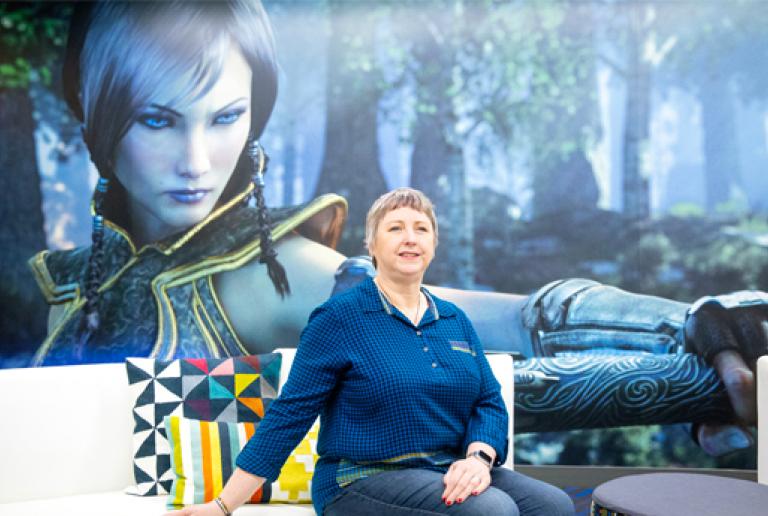
Sheri Graner Ray, a former Senior Game Designer at EA and now a game industry consultant, poses in her office.

Reap the Rewards of Austin

Austin is home to small indie developers and global competitors like Blizzard Entertainment, Electronic Arts, BioWare, Cloud Imperium Games, Daybreak Game Company, NCSoft, ZeniMax/Bethesda, Kabam, Wargaming,net, Retro Studios, Devolver Digital and Aspyr Media. 

What do our graduates do?

Video Game Development majors go on to a variety of careers from St. Edward's. Here is a sample:

  • Production coordinator at Bungie, Inc.
  • Embedded software engineer at Activision
  • Game engineer at Schell Games
  • Senior Business Operation coordinator at Zynga
  • Software developer at Epic Systems Corporation PLC
  • Associate producer at Electronic Arts
  • QA tester at Aspyr Media

Explore Details About a BA in Video Game Development

Degree Requirements

Major Requirements: The B.A. in Video Game Development requires 56 hours of major courses, which include courses in computational foundations, digital media, visual studies, and game development. 

General Education Requirements: The degree requires approximately 40 hours of general education courses which students complete over four years in addition to their major courses and electives.

A few examples of courses students take in this major:

  • Interactive Storytelling – This seminar contrasts traditional storytelling with the particular challenges of interactive narrative. Students develop an ability to craft interactive narrative and explore the range of storytelling techniques available in video games.
  • Game Design Studio I – Designed as a portfolio course, this course explores gameplay in 2D space and gives the student the opportunity to expand their game design portfolio by creating interactive projects using sound game design tools and methods.
  • Introduction to Game Audio – This course will give students a solid understanding of physics of audio and sound design techniques used to record and produce sound effects, ambient tracks, and dialog for video games.  

Skills You Will Gain

Upon completing the Acting program, you’ll be ready to…

  • Confidently craft interactive narratives;
  • Expand your game design portfolio by creating interactive projects using sound game design tools and methods;
  • Understand the physics of audio;
  • Adapt to new technologies and consumer needs;
  • Implement sound design techniques used to record and produce sound effects, ambient tracks and dialog for video games.

At St. Edward’s, our faculty are outstanding scholars, thought leaders, teachers and mentors who bring energy and enthusiasm to our vibrant learning community. They take pride in getting to know you, helping you achieve your goals and celebrating your successes.

View a list of our faculty members and their contact information on the Department of Visual Studies webpage.


Undergraduate

Theater Arts

Ornate door
Program Snapshot
Program Type
Bachelor of Arts
Department
Performing Arts

Expand Your Creative Abilities with a BA in Theater Arts

Learn every aspect of the craft—singing, directing, design, administration—and graduate prepared to work in any part of a theater organization. 

Learn to write and direct your own play, or design a costume from drawing to finished product. Gain a core foundation of theatre history, music and dance. Then let your skills shine in the four productions you’ll work on each year.
 

Why earn your Theater Arts degree at St. Edward's?

Theater Arts majors are uniquely positioned to take advantage of the arts supported by Austin’s vibrant culture. You’ll be connected to the pulse of a cosmopolitan city, an epicenter to creativity and a handful of world-class events. You’ll get to study at our award-winning theater program, hosted in the intimate professional Mary Moody Northen Theatre, which consistently receives awards from Austin critics. 

Become a member of Actors' Equity

Through our degree specializations, you’ll have the option to focus on design and technology, specialize in theater management, or be a part of the next generation of storytellers. No matter what you choose, you’ll learn from working alongside professional artists and you’ll have the chance to earn your membership in Actors' Equity Association, the American labor union of professional actors and stage managers. 

Test your fit

As you are making your college decision, get a better feel of out theater program through Scholarship Audition Weekend. Prospective theater students who have applied for university admission and have been accepted to St. Edward’s are invited to join us in February for a weekend of theater program activities! You'll have opportunities to sit in on classes, tour the campus, dine with current students, audition for a theater scholarship, see a show, meet the cast and crew and take workshops with university faculty. 

Learn from guest artists

Guest artists from the world of professional theater, film and television work with faculty and students in production. Students will also have the opportunity to engage in hands-on work in acting, writing, design and directing.

Study in the epicenter of creative expression

While studying at St. Edward's, you will be connected to the pulse of a cosmopolitan city. Our students regularly participate in both internships and other professional positions in Austin’s many professional theater companies. Your immersion in such a colorful art scene will enrich your educational experience and connect you to people who share your passion. 

Students performing in Godspell at the Mary Moody Northen Theatre at St. Edward's.

Reap the Rewards of Austin

Austin is home to 80 theatre companies and to a community of people who appreciate the beauty of human expression. By studying Theater Arts on the hilltop, you'll learn from local artists and gain access to attend (and even contribute to) performances in and around the city!

What do our graduates do?

Theater Arts majors go on to a variety of careers and graduate school from St. Edward's. Here's a sample:

  • Production manager for the Broadway production house of Juniper Street in New York City
  • Assistant production manager for Hudson Scenic Shop, a commercial scenery construction shop
  • Head of wardrobe for Cirque du Soleil’s LUZIA tour
  • Development associate for Theatre for a New Audience, in New York City
  • MFA in Design from Yale University
  • Rigger for Disney World
  • Apple

Explore Details About a BA in Theater Arts

Degree Plan

Major Requirements: 
The Bachelor of Arts in Theater Arts requires  28 hours of Theater Core major courses and 25 hours of Emerging Forms Specialization courses.

General Education Requirements: 
The Theater Arts degree requires 39 hours of general education courses plus major courses and electives.

Skills You Will Gain

Upon completing the Theater Arts program, you’ll be ready to:

  • Enhance your skills in writing, video-game design and digital content creation so you’re telling the story;
  • Produce costumes and set pieces;
  • Confidently set up professional lighting and sound;
  • Build wigs, apply theatrical makeup techniques and construct scenes;
  • Analyze interpersonal relationships within productions;
  • Take ethical precautions for running shows.

Under the Theater Arts Program, students can choose one of three specializations.

1. Emerging Forms

Emerging Forms establishes an interdisciplinary approach to theater studies by including courses from the writing, video-game design and digital content creation, offering students a unique opportunity to become the storytellers. 

  • Major Requirements: 28 hours of Theater Core major courses and 25 hours of Emerging Forms Specialization courses.
  • General Education Requirements: 39 hours of general education courses plus major courses and electives.
  • Electives: 28 hours of elective options

Upon completion of the freshman year, students will choose whether to continue with the Emerging Forms emphasis or, shift their focus to Theater Design/Technology or Theater Management, or audition for the BFA in Acting. View and download the full degree plan for Theater Arts with Emerging Forms Specialization (PDF).


2. Theater Design & Technology

Theater Design & Technology students will master skills to produce costumes and set pieces, as well as lighting at a professional caliber. 

  • Major Requirements: 28 hours of Theater Core major courses and 37 hours of Theater Design/Technology Specialization courses.
  • General Education Requirements: 39 hours of general education courses plus major courses and electives.
  • Electives: 16 hours of elective options

View and download the full degree plan for Theater Arts with Design/Technology Specialization (PDF).


3. Theater & Stage Management 

The Theater & Stage Management specialization will bestow students with the leadership and communication skills necessary to be successful in this field. Students will also earn the necessary professional production credits to join the Actor’s Equity Association upon graduation.

  • Major Requirements: 28 hours of Theater Core major courses and 24 hours of Theater Management Specialization courses.
  • General Education Requirements: 22 hours of general education courses plus major courses and electives.
  • Electives: 29 hours of electives

View and download the full degree plan for Theater Arts with Management Specialization (PDF).

At St. Edward’s, our faculty are outstanding scholars, thought leaders, teachers and mentors who bring energy and enthusiasm to our vibrant learning community. They take pride in getting to know you, helping you achieve your goals and celebrating your successes.

View a list of our faculty members and their contact information on the Department of Performing Arts webpage.

Undergraduate

Spanish

Ornate door

Develop a Global Mindset with a BA in Spanish

Build upon your cultural understanding of Spanish-speaking nations and communities. 

Refine and professionalize your language skills and cultivate an understanding of Hispanic cultures. With a Spanish major, you'll gain practical experience through study abroad, internships and courses in Spanish for the professions.

Why earn your Spanish degree at St. Edward's?

Spanish majors participate in service experiences and often volunteer their Spanish-speaking skills to social services across Austin. The Spanish program also offers opportunities to study abroad in Argentina, Chile, Mexico and Spain. Choose a program led by St. Edward’s professors for several weeks, or study at an international university for a semester.

Grow as a second-language learner

If you have studied Spanish formally and did not grow up hearing the language, you are probably a second-language learner. You can take a placement test or receive credit through CLEP or AP exams. For information on receiving credit for your prior knowledge in Spanish, contact Georgia Seminet.

Improve as a heritage learner

If you grew up hearing Spanish spoken by your parents or grandparents, you are probably a heritage learner. We have special classes designed to help heritage learners improve their grammar, vocabulary, and cultural knowledge. You can also take a placement test or receive credit through CLEP or AP exams. For more information, contact Emily Bernate.

Gain hands-on experience

Apply your Spanish skills by interning or volunteering at organizations that serve Austin’s Spanish-speaking residents where you’ll assist immigrants, refugees, asylum-seekers and other vulnerable members of the community. Spanish majors have interned as tutors and advocates for young English learners. They have interned at El Buen Samaritano, which provides healthcare, education and basic needs for Latino families, and at the Equal Justice Center, a nonprofit law firm. 

Use your Spanish for good

The Spanish program at St. Edward’s University offers a certificate in Advanced Spanish for the Health and Helping Professions for students with advanced oral proficiency.  Develop interpersonal communication skills in Spanish focused on in-person encounters and interviews in a clinical or medical setting. Through this certificate, students will demonstrate cultural knowledge of the Latinx sociocultural context through research and experiential learning. 

What do our graduates do?

Spanish majors go on to a variety of careers and graduate schools from St. Edward's. Here's a sample:

  • Reporter for Searchlight New Mexico, a nonprofit investigative journalism outlet
  • Graphic designer at the Metropolitan Museum of Art in New York
  • Account executive at NWN Corporation, a technology solutions company
  • Vice president of sales for Brazilian Blowout
  • Officer at European Climate Foundation
  • House manager at The Long Center for Performing Arts

Explore Details About the BA in Spanish

Degree Plan

Major Requirements: 
The BA in Spanish requires 36 hours of major coursework, which includes a combination of language, linguistic, and cultural studies in Spanish. Our Majors are required to take SPAN 3330 (offered every fall), 3341 (offered every spring), 3322 and 4398. They must complete a total of 2 4000-level courses.

General Education Requirements: 
The degree requires 34 hours of general education courses that students complete over four years in addition to their major courses and electives. 

Electives:
Students complete three (3) additional hours of elective coursework from the following areas of study: cultures, communication, history, political science, religious studies, or history. 

For a complete list of required and elective courses and course descriptions for the Spanish major, view the current Undergraduate Bulletin (PDF).

Skills You Will Gain

Upon completing the Spanish program, you’ll be ready to:

  • Effectively communicate with Spanish speakers from all over the world;
  • Translate and apply your Spanish to careers like immigration law, bilingual psychiatry and counseling, bilingual speech therapy, education and non-profit work;
  • Provide a comforting and accepting space for Spanish-speakers.
Degree Requirements (PDF)

Minor Requirements

Students will complete 18 hours of Spanish courses. SPAN 3330 and SPAN 3341 are required of all minors. Nonnative speakers will usually start the minor with SPAN 2312 and complete the 18 hours with subsequent courses. Native speakers and bilinguals seeking a minor in Spanish will normally begin with higher-level courses and complete the hours required with the two core courses plus electives. 

In addition to the following 18 hours of minor requirements, students must satisfy all General Requirements for a Minor (page 50) to be eligible to complete this minor.

Required Spanish Language Courses: 6 hours

  • Spanish Grammar in Context – SPAN 3330  (3 hours)
  • Effective Written Communication – SPAN 3341  (3 hours)

Intermediate Spanish Language Courses: 0–9 hours
Students who place out of 15 hours of Spanish may not take intermediate courses, except for SPAN 2351. However, they are usually necessary as foundational courses for nonnative speakers and English-dominant bilinguals who need to refine their skills before entering the 3000-level. Up to nine hours of the intermediate courses listed below can be used as electives to fulfill the requirements for the major or minor.

  • Spanish IV (Intermediate) – SPAN 2312  (3 hours)
  • Topics in Modern Latin America and Spain – SPAN 2325  (3 hours)
  • Practical Spanish Conversation – SPAN 2326  (3 hours)
  • Topics in Hispanic Studies – SPAN 2351  (3 hours)

For a complete list of required elective courses and course descriptions for the Spanish minor, view the current Undergraduate Bulletin (PDF).

At St. Edward’s, our faculty are outstanding scholars, thought leaders, teachers and mentors who bring energy and enthusiasm to our vibrant learning community. They take pride in getting to know you, helping you achieve your goals and celebrating your successes.

View a list of our faculty members and their contact information on the Department of Languages, Literature and Cultures webpage.

St. Edward's graduates in cap and gown show off their diplomas

Earn Two Degrees in Five Years

With our Accelerated Graduate Pathways, you can complete your BA in Spanish and master’s degree in Business Administration (MBA) in as little as five years, saving time and money. See details and requirements.

Success coaches and academic advisors guide you through undergraduate and graduate courses to maximize benefits.

Religious and Theological Studies

Ornate door

Reflect on Questions That Captivate Humankind Through the Lens of Faith

Understand what religion teaches us about justice and how it influences culture, conflicts and current events around the world with a BA in Religious and Theological Studies. 

Study the development of global religions and the role they play in the world today. Learn what religion teaches people about the meaning of life and one's purpose. 

Why earn your Religious and Theological Studies degree at St. Edward's?

The Department of Religious and Theological Studies reflects the university's mission and Holy Cross heritage. Here, you'll gain context to explore questions of faith in a setting informed by the Catholic Intellectual Tradition. At the same time — recalling the hospitable and welcoming ethos of the Brothers of Holy Cross — the department also provides a context for the academic study of religion that extends to all traditions. 

Join the conversation at annual lecture series

Tune in to the university's two annual lecture series: The Nostra Aetate Lecture and The Most Reverend John McCarthy Lecture Series. The Nostra Aetate Lecture explores interreligious dialogue and the values reflected in the groundbreaking Vatican II (1965) document of the same name. The Most Reverend John McCarthy Lecture Series on the Catholic Church in the 21st Century is named in honor of a former Diocese of Austin bishop and features religious and lay experts from around the country discussing issues facing modern and contemporary Catholicism.

Study faith through service

Volunteer and learn about local life through Service Break Experiences, which are built on ongoing relationships between St. Edward’s and the service locations. Give back to the community through S.E.R.V.E Austin, a weekly, semester-long volunteer commitment at a specific site where you’ll develop relationships with immigrants and refugees, children at an after-school program, young adults working on their GED, the elderly or the formerly homeless. S.E.R.V.E. 1 Day events are also offered through the semester and include Saturday-morning service.

Learn and lead with Campus Ministry

Campus Ministry at St. Edward’s offers programs that enhance your spiritual life. Small-group Bible studies and retreats help you meet other students and set aside time to focus on prayer and scripture. The peer ministry program equips student leaders to help plan retreats, interfaith events, and programs that support social justice advocacy.

Apply social justice on and off the hilltop

You’ll be encouraged to put your faith into practice through advocating for a more just world. St. Edward’s students can volunteer or intern with Catholic social justice organizations including Pax Christi, NETWORK and the Campaign to End the Death Penalty.

test

Reap the Rewards of Austin

Austin’s religious community is diverse and offers many opportunities to participate in interfaith dialogue, volunteer or intern at faith-based service organizations, or work at the intersection of religion and politics.

What do our graduates do?

St. Edward’s Religious and Theological Studies majors go on to a variety of careers. Here’s a sample:

  • Judicial Law Clerk for Supreme Court of Texas
  • Literacy Tutor for AmeriCorps
  • Director of Campus Ministry at St. Mary’s College
  • Ambassador for Poverty Relief with Noonday Collection 
  • Director of Social Justice Ministries at St. Austin Catholic Parish
  • Filmmaker for The Congregation of Holy Cross
  • Director of the Beecken Center for the School of Theology at Sewanee, The University of the South
  • Peace Corps Volunteers, Dominican Volunteers, Jesuit Volunteer Corps
     

Explore Details about the BA in Religious and Theological Studies

Degree Plan

Major Requirements: 
The Bachelor of Arts in Religious and Theological Studies requires 30 hours of major courses. The curriculum introduces students to key facets of the study of religion and theology and our signature courses emphasize clarifying one’s values, experiential learning, and career readiness.

A few examples of courses students in this major take:             

  • Global Religions Understand how religion impacts beliefs and cultural practices by studying the religions of those right here in Austin and around the globe.
  • History of Christian Theology – From the end of the first century to the fifth century, study the development of Christian Theology and dive into the controversies over the nature of God, the divinity of Christ and the structure of the Church and its teachings.  

Skills You Will Gain

Upon completing the Religious and Theological Studies program, you’ll be ready to:

  • Conduct thorough research
  • Critically think and interpret complex texts
  • Construct a reasoned argument
  • Understand different perspectives
     
Degree requirements

At St. Edward’s, our faculty are outstanding scholars, thought leaders, teachers and mentors who bring energy and enthusiasm to our vibrant learning community. They take pride in getting to know you, helping you achieve your goals and celebrating your successes.

View a list of our faculty members and their contact information on the Department of Religious and Theological Studies webpage.

St. Edward's graduates in cap and gown show off their diplomas

Earn Two Degrees in Five Years

With our Accelerated Graduate Pathways, you can complete your BA in Religious and Theological Studies and master’s degree in Business Administration (MBA), Digital Marketing and Analytics, or Organizational Leadership in as little as five years, saving time and money. See details and requirements.

Success coaches and academic advisors guide you through undergraduate and graduate courses to maximize benefits.

Undergraduate

Photography and Media Arts

Ornate door
Program Snapshot
Program Type
Bachelor of Arts
Department
Visual Studies

Create Compelling Images that Communicate Ideas

As a Photography and Media Arts major at St. Edward’s, you’ll go beyond creating photographs to understanding the messages they encode in our highly visual culture. 

This concept-driven degree program produces image makers who are passionate about generating sophisticated visual communication. Learn traditional analog, film-based photography and darkroom printing as you build on the basics with digital imaging. You’ll become well-versed in both black-and-white and color still photography as well as video/film narratives. 

You’ll learn to work in a professional studio setting and take elective courses focused on documentary photography, creative exploration and alternative processes.  And you’ll gain a full understanding of the big picture: how the technology and uses of photography have changed over time, and how you can help shape photography’s future.

Why earn your Photography and Media Arts degree at St. Edward’s?

Whether you choose to pursue your talent for visual storytelling through commercial, fine art or documentary photography or video — one thing is certain: The advantages of your St. Edward’s education will prepare you to succeed. You’ll find opportunities in and outside the classroom to learn, give back and achieve your goals. And your mentors will support you every step of the way.  

Build relationships with your professors

Learn in small classes taught by award-winning professors who make a point of getting to know you. They’ll help you identify and focus on your goals, define and cultivate your visual style, and provide guidance and insight during your college years and after you graduate.

Become a sophisticated visual thinker

Collaborate with talented and committed faculty members and peers who share your enthusiasm for building ideas with visual tools. Grow in your ability to develop and communicate ideas through imagery and to respond to changes in techniques, technology and society. 

Boost your résumé with real-world experience

Master your craft and sharpen your portfolio with hands-on experience. Take on a required semester-long internship with a commercial photographer, media organization, marketing firm, film production company, museum, video gaming studio or other professional setting. 

Graduate ready to hit the ground running

Get support planning for your next steps after graduation. In a Professional Practices course, you’ll explore career options available in the field and develop and fine-tune a portfolio of your work that’s reviewed in class. You’ll also learn career management skills and strategies for success as a creative professional.

test

Reap the Rewards of Austin

Austin is one of the fastest-growing cities in the U.S. and a hub of media arts, film production, video game development and entertainment. Our Austin location, partnerships and connections allow you to immerse yourself in dynamic opportunities for pursuing internships and careers in the visual arts. 

What do our graduates do?

Photography and Media Arts majors go on to a variety of careers from St. Edward’s. Here’s a sample:

  • Fashion designer and Project Runway judge
  • Owner and founder of New York City­­–based retouching studio
  • Associate producer at VICE Media
  • Publicity director of Brooklyn-based powerHouse Books, which specializes in fine art, documentary, pop culture, fashion and celebrity books
  • Art gallery manager at Texas Christian University
  • Fulbright Scholars
  • Masters of Fine Arts graduates 
  • Freelance wildlife photography

Explore Details about the BA in Photography and Media Arts

Degree Plan

Major Requirements: 
The BA in Photography and Media Arts requires 51 hours of major courses, which include a combination of visual studies and photography coursework.

Electives: 
Students complete 6 hours of elective courses in photography, focusing on a range of different topics. Past topics include: Installation Strategies, Documentary Photography, Digital Darkroom, Alternative Processes and Photographic Book Design.

General Education Requirements: 
The degree requires 4257 hours of general education courses that students complete over four years in addition to their major courses and electives. There is ample opportunity to minor in other areas in addition to the major and general education courses.

View and download the full degree plan for the Photography and Media Arts (PDF) major.

A few examples of courses students in this major take:          

  • Intermediate Digital Imaging: Students build visual solutions while learning and working with techniques such as panoramic imagery, large-scale composite image prints, image post-production and handmade books.
  • Large Camera – This course in black-and-white photography focuses on the use of the view camera, view camera optics, metering techniques and basic Zone System techniques.
  • Studio and Location Projects – This course introduces students to the professional use of the studio, studio lighting and studio production techniques.
  • Video – This course is an introduction to the theory and technical aspects of video production with an emphasis on the aesthetic and communicative potential of the medium.

For more details and course descriptions, view and download the Undergraduate Course Bulletin (PDF).

Skills You Will Gain

Upon completing the Photography and Media Arts program, you’ll be ready to …

  • Cultivate your ability to think and create while mastering contemporary digital imaging technologies.
  • Shoot and process black and white film.
  • Gain experience in the creation of video/film narratives.
  • Create silver gelatine prints.
  • Break new ground with contemporary digital technologies.
  • Think outside of the box through electives like Documentary Photography, Photographic Book Design and other approaches to the media arts. 
  • Photograph and perform professional quality, post-production techniques and DAM (digital asset management) of your work. 

Experiential Learning

Every Photography and Media Arts student completes a semester-long internship class. Students have worked with professional commercial photographers, media production houses, a national network affiliate TV station, the Austin History Center, and a documentary film producer. They have also interned with well-known exhibition venues including those specializing in work by women artists and Latino/indigenous artists of color. Internships are conducted both locally and outside of Austin.


Advanced Facilities

Students majoring in Photography and Media Arts study leading digital imaging practices and learn traditional darkroom and (analog) film-based camera skills. Many photography programs across the U.S. have scaled back or eliminated their wet process facilities. St. Edward’s maintains a fully-equipped photo lab that allows students to print 35mm to 4x5 inch film. Students also gain experience in the creation of video/film narratives. 

Photo Lab

In addition to the digital capture/scanning and large format printing facilities you should expect at any top-line university program, we provide darkroom facilities for film processing, printing and alternative processes. Large-format cameras and lenses; studio and location strobe equipment; portable flashes, tripods, and light meters; and other equipment are available for students to check out at no charge. 

Studio and location skills are also taught in our professional studio facility. Digital work is completed in the Visu Printing Lab equipped with scanners and large format printers dedicated to the Visual Studies Department.

Art Gallery

The Department of Visual Studies Fine Arts Gallery is a teaching space featuring rotating exhibitions from outside the university and exhibits by current students. Painting, printmaking, installation, video, sculpture, ceramics, design and photography are on view, depending on the season’s schedule. 

Courses can support any other academic program, and students majoring in other fields are welcome to minor in Photography and Media Arts. In addition, several courses may be taken as electives by non-majors.

Required Courses:

  • Visual Studies I
  • Analog Photography I
  • Styles & Themes (topic varies by semester)
  • Intermediate Digital Imaging
  • History of Photography​


Elective Courses:

In addition, students select three elective courses in the major. Courses students can choose from include:

  • Styles and Themes (repeatable when topics vary)
  • Studio and Location Projects
  • Topics in Photography and Media Arts

At St. Edward’s, our faculty are outstanding scholars, thought leaders, teachers and mentors who bring energy and enthusiasm to our vibrant learning community. They take pride in getting to know you, helping you achieve your goals and celebrating your successes.

View a list of our faculty members and their contact information on the Department of Visual Studies webpage.
Undergraduate

Philosophy

Ornate door
Program Snapshot
Program Type
Bachelor of Arts
Department
Philosophy

Learn to Think Creatively and Solve Complex Problems

Dive into classic and contemporary philosophical texts to understand the history of ideas. Studying philosophy teaches you to analyze issues thoughtfully, form rational arguments and challenge assumptions — including your own.

The knowledge and skills you gain as a Philosophy major at St. Edward’s apply to many fields, such as law, politics, academia, publishing, teaching, healthcare, business and management. You’ll graduate prepared to lead purposefully, make meaningful choices and contribute to a better world.

Why earn your Philosophy degree at St. Edward’s?

Whether you choose to enter the workplace right away or go on to pursue a master’s or doctorate — one thing is certain: The advantages of your St. Edward’s education will prepare you to succeed. You’ll find opportunities in and outside the classroom to learn, give back and achieve your goals. And your mentors will support you every step of the way. 

Build relationships with your professors

Learn in small classes taught by award-winning professors who make a point of getting to know you. They’ll help you identify and focus on your goals, and provide guidance and insight during your college years and after you graduate.

Join a vibrant, like-minded community

You’ll have the chance to conduct and present research, write for student publications, participate in spiritual and service activities, and attend thought-provoking lectures by visiting experts — all while leveraging your critical thinking. 

Get involved in the Philosophy Club

The St. Edward’s Philosophy Club brings together students with a shared passion for philosophy and history. During meetings, workshops and speaker events, you’ll discuss ideas and engage in lively debates that deepen your perspective. 

test

Reap the Rewards of Austin

Austin is one of the fastest-growing cities in the U.S. and home to nearly 100 Fortune 500 firms. Our Austin location, partnerships and connections allow you to immerse yourself in the city’s dynamic business, government, nonprofit and academic environments. 

What do our graduates do?

Philosophy majors enter a variety of careers and graduate schools after St. Edward’s. Here’s a sample:

  • English Teaching Assistant in the Fulbright U.S. Student Program
  • Content strategist at AirBnB
  • Team manager at Apple
  • University professors at Furman University and the University of California
  • District attorneys and attorneys in private practice
  • Reporter for the Fayette County Record
  • Graduate students at institutions including American University, Boston College, University of Edinburgh, Harvard University, the University of Pennsylvania, Purdue University and Stanford University

Explore Details About the BA in Philosophy

Degree Plan

Major Requirements: 
The Bachelor of Arts in Philosophy requires 42 hours of Philosophy major courses comprised of a combination of history of philosophy, ethics, and logic courses, as well as History of Christian Theology I or II. In addition, students are encouraged to take other support courses such as Art History, Political Theory, Literary Criticism, etc. to narrow their focus to their chosen career.

General Education Requirements: 
The Philosophy degree requires 57 hours of general education courses that students complete over four years in addition to their major courses and electives.

A few examples of courses students in this major take:             

  • History of Philosophy I – Revisits a period of almost a thousand years, beginning with the Greeks circa 600 B.C. and continuing through the transition from the classical to the medieval period.
  • Philosophy of Religion – Explores the complex relations between religion and culture.
  • Advanced Logic – Examines a more advanced consideration of sequential logic, first-order predicate logic, and modal logic (logic of possibility and necessity). (Pre-req: PHIL 2303)

For more details and course descriptions, view and download the Undergraduate Course Bulletin (PDF).

Skills You Will Gain

Philosophy majors hone their ability to analyze, critique, organize and communicate with others. The life skills they develop are assets in any career:

  • Critical thinking
  • Problem-solving
  • Writing
  • Speaking
  • Communication
  • Independent thinking
  • Collaboration
  • Flexibility
  • Research

Hands-On Experiences

Philosophy majors can put their critical thinking into action through internships. Students have previously interned at Austin’s Equal Justice Center and at Mongazon école supérieure in Angers, France, helping French children improve their English. 

Degree Requirements (PDF)

Philosophy majors are an eclectic bunch who are active in a wide range of projects.

  • The Philosophy Club meets weekly to discuss a brief reading, movie or podcast that is relevant to a theme the members have chosen for the semester, such as feminist philosophy. As a member, you’ll discuss ideas and debate with fellow students who are interested in philosophy and history.
     
  • The Food and Philosophy lecture series features well-known speakers from around the country who address current topics over lunch. Topics have included the following:
    • Genetically Engineering Our Children
    • Conscientious Refusal to Participate in Evil
    • Real Judging, Fake Judging and the Myth of Judicial Activism
       
  • Hilltop Views, the weekly student newspaper, is published in print and online. Student journalists report news from the campus and the greater Austin community. You can get involved as early as your freshman year as a writer, editor, photographer or designer. 
     
  • Sorin Oak Review is a literary magazine that showcases the poetry, prose and artwork of St. Edward’s University students. Working on the editorial staff is a great way to gain experience in project management and the practical details of putting together a publication. 
     
  • Arete is a student-produced academic journal that publishes student-written research, nonfiction essays and commentary. Editors choose from among the dozens of submissions to create a cohesive journal that represents a variety of perspectives. 
     
  • New Literati is a student-produced journal of both academic and creative work. 
     
  • B. Hooved is the student humor journal, inspired by our Hilltopper goat mascot. 
     
  • Phi Alpha Delta, the pre-law organization, meets weekly to listen to guest speakers, learn about the law school admission process, participate in mentorship programs, do service work and learn about internships. The club also has a mock trial team that competes in events hosted by the American Mock Trial Association and Phi Alpha Delta. The team has traveled to Washington, D.C., to compete.
     
  • Campus Ministry at St. Edward’s offers programs that enhance your spiritual life, including small-group Bible studies, retreats, interfaith events and programs that support social justice advocacy. The department also coordinates both one-day and semester-long service projects in Austin, as well as Service Break Experiences in other states or countries. Through SBEs, you’ll travel to another community, volunteer and learn about local life while living simply (without your phone, for example). 

Philosophy is an intriguing discipline that uses logic and reason to analyze the world and ourselves. Students of philosophy bring critical and creative thinking, ethical reasoning, and uncommon wisdom to any career they choose. Here's a list of helpful resources that gives you an overview of the many benefits of majoring in philosophy.

Skeptical about all these claims? 
Excellent! You’re ready to be a philosophy major! And don't just take our word for it. Ask members of our faculty and staff — Professor of English (and lawyer) Drew Loewe, Professor of French (and Department Chair) Philippe Seminet, Professor of University Studies Cory Lock, and Vice President of Admission Tracy Manier — if their BA in Philosophy degrees have enhanced their life and work. They’re sure to tell you it helped them prepare for careers and more. 

Don’t hesitate to contact our faculty in the Philosophy Department for more information!

Students who wish to earn a Philosophy Minor must take the following coursework, totaling 18 hours.

Required Courses:

  • Ethical Analysis
  • Logic
  • History of Philosophy I, II or III
  • Philosophy of Religion or Theory of Knowing
  • Directed Readings or Senior Seminar
  • Electives

Students may choose any upper division Philosophy elective to complete their minor.

For more information about coursework, please review the Undergraduate Bulletin (PDF).

At St. Edward’s, our faculty are outstanding scholars, thought leaders, teachers and mentors who bring energy and enthusiasm to our vibrant learning community. They take pride in getting to know you, helping you achieve your goals and celebrating your successes. The Department of Philosophy faculty has also adopted the Chicago Statement on free speech, affirming our commitment to free expression. 

View a list of our faculty members and their contact information on the Department of Philosophy webpage.


St. Edward's graduates in cap and gown show off their diplomas

Earn Two Degrees in Five Years

With our Accelerated Graduate Pathways, you can complete your BA in Philosophy and a master’s degree in Business Administration (MBA) or a master’s degree in Science in Digital Marketing and Analytics in as little as five years, saving time and money. See details and requirements:

Success coaches and academic advisors guide you through undergraduate and graduate courses to maximize benefits.

UNDERGRADUATE

Graphic Design

Ornate door
Program Snapshot
Program Type
Bachelor of Arts
Department
Visual Studies

Craft Your Impact as a Thinker and a Maker

Cultivate your creative voice and spark cultural change as you chart your own path in design.

Why earn your Graphic Design degree at St. Edward’s?

Study Graphic Design in a city where technology and art intersect. Use your creativity and artistic side to communicate information visually — in websites, publications and everyday objects.

Dedicated Faculty

Learn from thoughtful faculty who are mindful about your growth as an individual, and benefit from forming relationships with small cohorts of students.

An Innovative Curriculum

Dive into a diverse curriculum that spans image making, typography, publishing, design history, motion graphics, social impact and open experimentation. Coursework in the program leads to a senior thesis year where students define their own practice as designers and focus on an area of personal interest—everything from branding to digital product design and entrepreneurship.

Hands-On Experiences

Benefit from our shared interdisciplinary facilities, including a risograph publishing lab, Mac computer labs, a photo studio and traditional dark room, ceramics lab, animation studio, dedicated printing and production labs with high-end digital imaging equipment, as well as bookmaking and craft tools like heat presses and vinyl cutters.

On-Campus Projects

Learn how graphic design contributes to the formation and expression of complex societal ideas and values. Join the staff of Arete or the Sorin Oak Review, campus publications for academic and creative works, or lend your talents to Hilltop Views, the campus newspaper.

test

Reap the Rewards of Austin

Forge relationships with Austin's creative community through our student organization, Command G, and our extensive alumni network. Gain insights, opportunities, and industry experience through a dedicated portfolio development course and internship requirement. Command G arranges workshops and roundtables and provides opportunities to explore careers in the field through studio visits.

What will you learn?

Focus on developing your own voice as a graphic designer, define your own trajectory in design.

A few examples of courses students take in the major:

  • In Interactive Design, explore design issues unique to user-centered interaction in digital media. Examine a range of formal and conceptual issues, including user interface, organization, narrative, motion, time and sound.
  • In Social Design, explores issues of responsibility and how designers participate, shape and criticize the world around us.

What skills will you gain?

  • Discover your style by studying image making, typography and experimentation.
  • Understand the evolution of art by focusing on design history and social impact.
  • Define your own practice as designers and focus on an area of personal interest—everything from branding to digital product design and entrepreneurship.

What do our graduates do?

Graphic Design majors go on to a variety of careers and graduate schools from St. Edward’s. Here’s a sample.

  • Designer at FODA Studio, an award-winning boutique design agency based in Austin.
  • UX/UI designer at USAA design office, an in-house agency creating digital products serving the military community.
  • Senior Product Designer at the New York Times.
  • Founder of GNDR SHREDR, a Portland-based screenprinting shop and design studio focusing on queer skating culture.
  • Digital creative designer at James Avery Artisan Jewelry, a Texas-based, family-owned company that specializes in designing hand-crafted jewelry.
  • Graphic Designer for Texas Senate.
  • Senior Interaction Designer at frog, a global design consultancy.
  • Founder of SeaLab, a digital product design agency.
  • Graphic Designer at Houston First Corporation, the official Destination Management Organization for Houston.
  • Art director at The Barbarian Group, a New York-based advertising agency working on global brands.

Explore Details About the BA in Graphic Design

Major Requirements: The BA in Graphic Design requires 49 hours of graphic design major courses, which include a combination of introductory coursework, visual studies, art, and graphic design.

General Education Requirements: The Graphic Design degree requires 57 hours of general education courses that students complete over four years in addition to their major courses and electives.

View and download the full degree plan for our Graphic Design major.

At St. Edward’s, our faculty are outstanding scholars, thought leaders, teachers and mentors who bring energy and enthusiasm to our vibrant learning community. They take pride in getting to know you, helping you achieve your goals and celebrating your successes.

View a list of our faculty members and their contact information on the Department of Visual Studies webpage.

UNDERGRADUATE

Global Languages and Cultural Studies

Ornate door

Embrace Multilingualism and Unlock Global Opportunities

Prepare for careers in fields like international business, diplomacy, translation, education and more.

Why earn your Global Languages and Cultural Studies degree at St. Edward’s?

The Kozmetsky Center of Excellence at St. Edward’s brings international experts to campus, either in person or virtually, to share their knowledge with the university community. You’ll have the chance to listen and ask questions of these global experts in sustainable development, peace and security, global health, climate change and global finance.

Advanced Spanish for Health and Helping Professions Certificate

Leverage your skills as a bilingual speaker or advanced second-language learner of Spanish and prepare for health-related professions that require specific, technical vocabulary and cultural knowledge as you earn your undergraduate degree. Develop interpersonal communication skills in Spanish focused on in-person encounters and interviews in a clinical or medical setting and demonstrate knowledge of the Latinx sociocultural context through research and experiential learning.

Study Abroad

Studying abroad is the perfect way to immerse yourself in a new environment and rely exclusively on your language skills. These programs will help you understand another culture and how people in another country view the United States. They also offer tremendous opportunities for personal growth. St. Edward’s offers study-abroad opportunities in Spain, France, Costa Rica, Japan, Italy and more.

Student Organizations

Language clubs (Spanish, French, German and Japanese), as well as Alpha Mu Gamma (the Honors Languages club) give you the opportunity to connect with students with similar interests and global worldviews. The International Student Association and Latinx Student Leaders Organization also offer you the chance to learn more about other cultures through social activities and programs.

Fulfilling the Language Requirement

The targeted level of language proficiency is "Intermediate High to Advanced Low" in both speaking and writing for the primary language and “Intermediate” in the second language. There are several ways to achieve the minimum proficiency required for the degree.

What will you learn?

Engage with diverse cultures and languages from around the world. By studying two modern languages, you’ll enhance communication skills, cross-cultural understanding and critical thinking. Embrace the challenge and fulfillment of becoming multilingual and open doors across the hemispheres. 

A few examples of courses students take in the major:

  • In Topics in Comparative Languages, Literatures and Cultures, better understand the world around you by sharing your own experiences as well as learning about those of your classmates. 
  • In Multilingualism in the U.S. and Intercultural Communication, improve your communication skills, cross-cultural understanding and critical thinking.

What skills will you gain?

Upon completing the Global Languages and Cultural Studies program, you’ll be ready to…

  • Develop language proficiency in one or more languages, including Spanish, French, German and Japanese. 
  • Gain intercultural communication skills and global awareness. 
  • Critically think and communicate with those in fields such as international business, diplomacy, translation, education and more.

Explore Details About the BA in Global Languages and Cultural Studies

Major Requirements: The BA in Global Languages and Cultural Studies is a 36-hour major requiring students to choose a primary language (18 hours beginning at 2311 or higher), a secondary language (12 hours beginning at 1311 or higher), and to complete 2 required core courses (CLLC 1310, CLLC 4330) taught in English. Languages include German, French, Spanish and Japanese. Students who test out of or place beyond beginning and intermediate levels will complete the degree with approved electives.

Electives: Students who are waived from intermediate courses through the departmental placement test or who demonstrate advanced proficiency may choose to take up to 6 hours of approved electives (in English) to reach the 36-hour major requirement.

View and download the full degree plan for our Global Languages and Cultural Studies major.

At St. Edward’s, our faculty are outstanding scholars, thought leaders, teachers and mentors who bring energy and enthusiasm to our vibrant learning community. They take pride in getting to know you, helping you achieve your goals and celebrating your successes.

View a list of our faculty members and their contact information on the Department of Languages, Literature and Cultures webpage.

French

Ornate door

Become a truly global citizen with a major in French, the official language of 30 countries worldwide and one of two working languages used by the United Nations.

French is spoken all over the world, and being bilingual will enhance your job prospects, your appreciation of arts and culture, and your ability to help people who need a translator. At St. Edward’s you can practice your language skills and learn about the cultures of the French-speaking world through clubs, volunteer and internship experiences, and studying abroad.

French Minor 

Students will complete 18 hours of French courses. At least six hours towards the minor must be taken in residence at St. Edward’s University. An additional six hours must be taken at St. Edward’s or in approved study-abroad programs. At least nine of the hours taken abroad or in residence must be upper-division or represent courses in the language beyond the intermediate level. 

Study Abroad 

Studying abroad is the perfect way to immerse yourself in a French-speaking environment, learn about another culture and understand how people in another country view the United States. You can spend a semester or year abroad at one of St. Edward’s partner universities in France: L’Institut Supérieur de Gestion (ISG) in Paris or Université Catholique de l'Ouest (UCO) in Angers, a small city 90 minutes southwest of Paris. Or study in another French-speaking setting such as Cameroon, Senegal, Madagascar, Rwanda or Geneva, Switzerland.

French Club 

As a member of the French Club, you’ll be part of weekly conversation meetups to practice language skills and intercultural communication.

Required Courses:

  • FREN 2311 French III 
  • FREN 2312 French IV 
  • FREN 2325 Reading and Listening Comprehension  OR  FREN 2326 Practical Conversation
  • FREN 3335 Advanced Composition and Conversation I

Advanced students may be exempt; see the area coordinator.

Choose six hours from the following courses:

  • CULF 3331 Contemporary World Issues (approved topic)
  • HIST 3320 European History: Reformation Through 1900
  • FREN 3331 Topics in French Literature and Film
  • FREN 3332 Survey of French History
  • FREN 3334 Business French
  • FREN 3337 Topics in French Cultural Studies
  • FREN 3339 Topics in French Language and Linguistics
  • FREN 4350 Internship

At St. Edward’s, our faculty are outstanding scholars, thought leaders, teachers and mentors who bring energy and enthusiasm to our vibrant learning community. They take pride in getting to know you, helping you achieve your goals and celebrating your successes.

View a list of our faculty members and their contact information on the Department of Languages, Literature and Cultures webpage.

Subscribe to School of Arts and Humanities