


Our goal is simple: to make the grant process more approachable, less stressful, and more successful.
The Office of Sponsored Programs (OSP) is here to help faculty and staff move great ideas from concept to funded project. We partner with investigators from the earliest stages of thinking through an idea all the way through proposal submission.
At St. Edward’s, we believe the strongest proposals begin with conversation. Whether you are pursuing your first external grant or building a complex, multi-partner project, OSP is available to help you identify the right opportunity, shape your ideas, develop a strong proposal, and navigate the submission process.
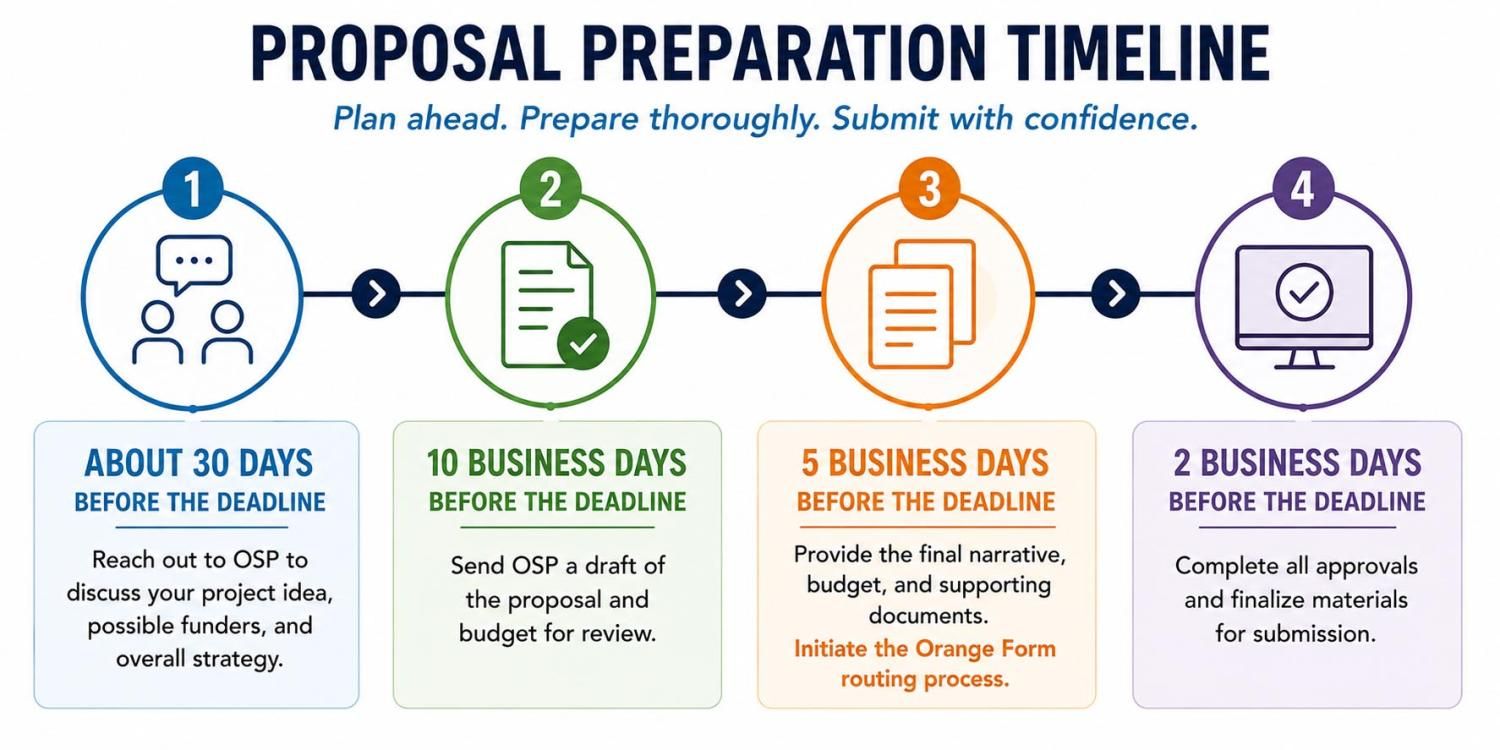
We encourage faculty and staff to contact OSP as early as possible, ideally about 30 days before a sponsor deadline. Starting early gives us time to think strategically together, refine the project, build a strong budget, gather needed approvals, and avoid the last-minute rush that can make proposal development more difficult.
Suggested Timeline
To help make the process manageable and successful, we recommend the following timeline. Projects that involve multiple institutions, subawards, international partners, cost sharing, or research involving human or animal subjects may need additional time.
How OSP Can Help
OSP supports faculty and staff throughout the entire pre-award process. We can help you:
- Identify funding opportunities from federal agencies, foundations, corporations, and nonprofit organizations
- Explore how your interests and ideas align with sponsor priorities
- Talk through project concepts and develop a strategy for a strong, competitive proposal
- Review and strengthen proposal narratives
- Create sponsor-compliant budgets and budget justifications
- Coordinate letters of support, institutional information, and other required materials
- Navigate sponsor systems such as Grants.gov, Research.gov, and foundation portals
- Work through questions related to IRB, IACUC, export controls, cost sharing, or other compliance issues
- Obtain institutional approvals and submit proposals on behalf of the university
Our role is not simply to review forms at the end of the process. We see ourselves as partners in helping faculty and staff tell the story of their work in a way that is clear, compelling, and aligned with what funders are looking for.
Sponsored Programs Award Life Cycle
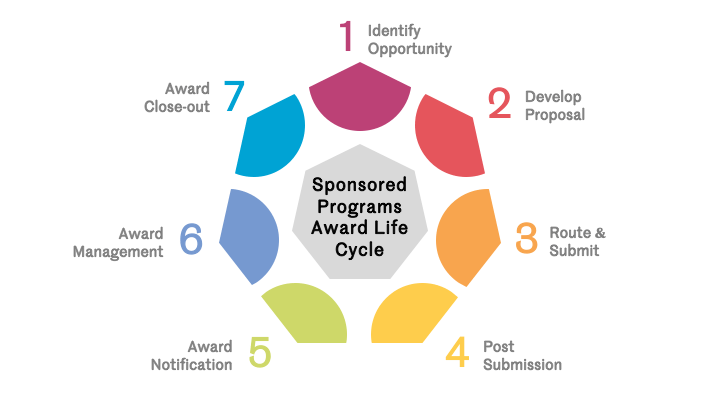
The Sponsored Programs Award Life Cycle consists of seven sequential stages, beginning with identifying a funding opportunity and ending with award close-out.
Grant Award Life Cycle Steps and Resources
Below are the step all federal, state and city grants that are supported by the Office of Sponsored Programs. If you are just getting started with a idea for a proposal or you are familiar with the steps necessary to submit a proposal to a sponsor and want a refresher on that process, click on Steps 1, Identifying an Opportunity, 2, Develop Proposal or 3, Route and Submit.
After you have submitted a proposal but have questions on what might be requested from a sponsor before they issue an award letter, click on Step 4, Post Submission.
If you have received an award letter, Congratulations! Step 5 Award Notification will help you figure out the how to accept the award. In addition Step 6, Award Management can help you navigate SEU internal processes with your expenses and most importantly Step 7 Award Close-out will remind you the step with reporting and other important tasks required by each sponsor.
Contact OSP for assistance in locating funding according to your expertise and collaboration with others on campus.
Common funding sites
- Grants.gov
- USDA National Institute of Food and Agriculture (NIFA) Grants
- Humanities Texas Grants
- American Psychological Association Scholarships, Grants, and Awards Database
- NASA
Institutional subscription
- InfoEd SPIN (click here on how to set up an account and use SPIN)
Developing a competitive research proposal requires early planning and collaboration, with support available from university resources such as OSP.
Proposal Budget
A budget should represent the most accurate estimate of the costs required to carry out the scope of work described in the proposal. Because proposal budgets are projections of future expenses, rates and costs may change over time and its the principal investigator (PI) who should recognize those adjustments over the award period. Most changes will require prior approval from the sponsor. While OSP reviews proposal budgets to ensure compliance with funding agency guidelines on allowable costs and the appropriate application of F&A costs, responsibility for identifying and planning project expenses ultimately rests with the PI. Below are common budget categories including a general budget spreadsheet and justification template.
General Budget Template (click here) and Budget Justification Template (click here)
Direct Costs
- Salaries: Salaries and wages for individuals who are working on the project scope, to be paid in proportion to the expected effort on the project. Per Uniform Guidance (2 CFR 200.413(c)), the salaries of administrative and clerical staff are normally treated as indirect costs and therefore not typically allowable as direct costs.
- Fringe: Fringe (or benefit) rates are composite rates based on the budgeted personnel’s position classification, and are subject to change.
- Travel: Costs for transportation, lodging, and subsistence/per diem for travel directly related to the proposed project. Be sure to use the correct date of travel to calculate costs on the US General Services Administration site (click here to find rates).
- Participant Support: costs for items such as stipends or subsistence allowances, travel allowances, and registration fees paid to or on behalf of participants or trainees (but not employees) in connection with conferences, or training projects.
- Subawards: An award provided by a pass-through entity (another institution) to carry out an intellectually significant part of the project. This does not include costs associated with contractor or vendor services.
- Other Direct Costs: Other project costs that are necessary to advance the work of the project. For example, other direct costs may include publication costs, laboratory supplies, service agreements, laptops, and/or software. Some sponsors may restrict what can be budgeted in this category. General office supplies, like pens and paper, are considered an indirect cost and should not be included.
Indirect Cost
Facilities and Administration (F&A)/indirect costs (IDC) (or overhead) represent project expenses that cannot be easily identified with any specific sponsored project but are incurred for common or joint objectives related to all sponsored projects at St Edward's Univeristy. Click here for the Institutional Indirect Cost Rate
Additional Institutional Information for Proposal Applications
| EIN | 741109641 |
| NSF Institutional Number | 100945 |
| Cage Code | 1QH33 |
UEI DUNS | NJ3CNK23MP29 06-642-2098-0000 |
| SAM Registration | Valid until 10/13/2026 |
| Certificate of Compliance with FCOI | Effective date 8/24/2012 |
| IRB Registration No. | IRB00009859; Valid through 1/22/2028 |
| IRB Parent Institution No. | IORG0008223 |
| FWA No. | FWA00027924; Valid through 9/16/2030 |
| IBC Registration | Valid through 8/10/2024 |
| IPEDS ID | 227845 |
| OPE ID | 000362100 |
| FICE Code | 003621 |
EU PIC EU Transparency Register | 902784918 ID: 485952735351-10 |
Congressional District Texas House District | TX-021 24 |
| Faculty/Staff Fringe Rate | 24% |
| Student Fringe Rate | 1.4% |
| DHHS Rate Agreement | 60% of salaries and wages |
| Cognizant Federal Agency | DHHS |
| POC Name | Arif Karim, DHHS Central States Office 1301 Young Street, Room 732, Dallas 75202 |
| POC Phone | 214-767-3261 |
NSF Proposal Guidance
The Office of Sponsored Projects (OSP) is responsible for reviewing and authorizing proposals for submission on behalf of St. Edward's University, as well as interpreting, negotiating, and accepting contracts and grants funded by federal and state agencies, foundations, and other public and private sources.
OSP reviews proposals to:
- Ensure compliance with university, federal, and sponsor policies to uphold institutional integrity
- Review, negotiate, and accept sponsored agreements
Facilitate and review award modifications (e.g., funding, timelines, scope, PI changes, transfers, terminations)
Before a proposal can be submitted, the project must be approved by multiple stakeholders within the university via the Orange Form.
St. Edward’s University OSP Grant Proposal Approval Form, AKA Orange Form (download here) must be filled out correctly and accurately at least 5 business days before the submission is due to the sponsor.
In some cases, sponsors may request clarification after a proposal is submitted, with the two most common examples outlined below.
Just In Time requests: After a proposal is submitted and during the sponsor’s proposal review process, a sponsor may request additional information from the PI, via a Just-in-Time (JIT). Such information may include updated budgets, protocol approvals, updated disclosures, or other items upon the sponsor’s request. A PI’s response to these requests must be reviewed and submitted to the sponsor by OSP.
Budget Modifications: A sponsor may request a revised detailed budget from a PI during the proposal review process or before a new increment is released due to a change in total budget amount available (usually for NSF or DOE proposals). A PI’s response to these requests must be reviewed and submitted to the sponsor by OSP. If a PI receives such a request, reach out to the Director of Sponsored Programs for further direction.
Responsibilities
PI/PD and OSP
- Receive, review, and negotiate award from funder
- Have all parties, PI/PD, AOR and the sponsor representative sign and date the Notice of Award (NOA), Memorandum of Understanding (MOU) or Contract
- Provide Grants and Contracts Specialist with award letter and approved budget to request a new FOAPAL (fund-org) knowing that dean of the PI's school will be the org manager
- Org manager is responible if for approving all expenses, including if the sponsor doesn't approve of an expense, it will come out of their budget
- Once the FOAPAL is setup, a Post Award meeting will be scheduled with the OSP Grants and Contracts Specialist
Responsibilities
PI/PD and OSP
- Budget revisions and prior approvals
- Such actions may include reduction in PI effort, changes in key personnel, budget category changes, or changes in the scope of work. PIs should review their award terms to determine if proposed changes require prior approval and request sponsor approval in advance if such a change is needed.
- Preparing and submitting progress reports by due sponsor due date
- Most funders require some form of technical/narrative progress reporting over the life of a project. PIs are responsible for timely and accurate reporting to funders on the project’s progress. Many funders allow PIs to submit technical/narrative progress reports directly, either via their sponsor portal or by email. PIs should work with the Grants and Contracts Specialist and the Restricted Funds Accountant to respond to progress report budget questions on spending and effort. When reports are delayed, funders may withhold future funding increments for the PI or withhold awards for the entire institution. Sponsors will contact PIs if they are aware that they are out of compliance with a sponsor’s reporting deadline.
- Carry forward request (if allowed/applicable)
- The carry forward of a project’s remaining unspent funds (also called unobligated funds) into the next budget year may either be automatic or may require the sponsor’s prior approval, depending on the sponsor and award type. If a sponsor requires prior approval for carry forward, these requests must be reviewed, approved, and submitted to the sponsor by the PI. A PI should contact the OSP Grants and Contracts Specialist to discuss this process.
- No cost extension request (if allowed/applicable)
- Many funders allow recipients to request an extension to the end date of their award to continue work on the project with any remaining funds. This is called a no cost time extension (NCE) and may require a written justification and an estimate of the remaining funds. A NCE cannot be requested merely for the purpose of using unspent funds. NCE requests must be reviewed, approved, and communicated to the funder by the PI.
- Establish contract and monitor subwardees
- All technical and financial progress is monitored by the Principle investigator(s). PIs ensure that financial progress is aligned with technical progress, all costs are allowable and allocable, and should not approve invoices if work does not align. PIs also ensure that all subrecipient reporting, cost-sharing, compliance, and closeout requirements are updated as needed and completed in a timely manner.
Restricted Funds Accountant
- Preparing and submitting financial progress reports by due sponsor due date
- Adjusting carry forwards amounts to annual adjusted budget, if applicable
Responsibilities
PI/PD
- Verify if the award will be closed or extended. If the award is being extended, PI/PD must consult with OSP
- Verify that Subaward(s) is/are ready for closeout
- PI must confirm that deliverable have been met
- Confirm all invoices have been received
- Verify if any cost share from a Department/Office have been met in Banner
- Submit all final reports to the funder. Notification of completed reports including a copy of the reports must be sent to OSP for file retention in accordance with regulation (if review need, send to OSP before submission to funder)
- Final Technical Report
- Patent and Property Report
- Final invention Statement
- Final Financial Report from Restricted Funds Account (internal)
- Other (review award document for any additional reporting)
Record Retention
As the recipient of sponsored funds, the PI/PD at St. Edward's is responsible for ensuring that OSP has all records from the project ensuring they are maintained in compliance with sponsor, University, State and Federal regulations. This includes but is not limited to Uniform Guidance (2 CFR 200.334). The Office of Sponsored Programs (OSP) requires all financial records, supporting documents, statistical records, and other records related to sponsored projects to follow the sponsor’s retention schedule, whichever is longer.
OSP
- Work with PI/PD to verify that all expenditures are processed and posted. If changes are to be made OSP will contact the Restricted Funds Account to correct in Banner.
- Additional responsibilities can include:
- Ensure budget matches the award amount
- Ensure expense is in correct account
- Ensure payroll has correct amount according to proposed budget
- Ensure that all stipends (faculty and students) are posted correctly
- Request, review sign and submit final invoices from consultants/contractors
- Submit PCard & travel expenses in Concur
- Identify and submit any outstanding request
- Identify and document any cost transfers
Restricted Funds Accountant
- Prepare and submit financial reports to the sponsor in accordance with award's terms and conditions
Contact Us
General OSP inquires: osp@stedwards.edu
Proposal inquires: aclayton@stedwards.edu
Award management: amcinern@stedwards.edu
IRB inquires: irb@stedwards.edu